
Epstein’s island: Inside the Caribbean fiefdom where he wooed the wealthy and abused girls
Epstein’s island: A Glamorous Escape and a Hidden Prison
The Crime Scene Unveiled
Jeffrey Epstein’s Caribbean retreat, Little St. James, served as a playground for elites and a prison for young women. While high-profile guests arrived by private jet and spent days scuba diving or riding jet skis, the girls Epstein brought to the island endured harsh conditions. One survivor described attempting to flee by swimming into the ocean after being stripped of their passports and subjected to severe abuse.
“The activities were so obvious and bold that anyone spending any significant time at one of Epstein’s residences would have clearly been aware of what was going on,” a victim stated in a court document.
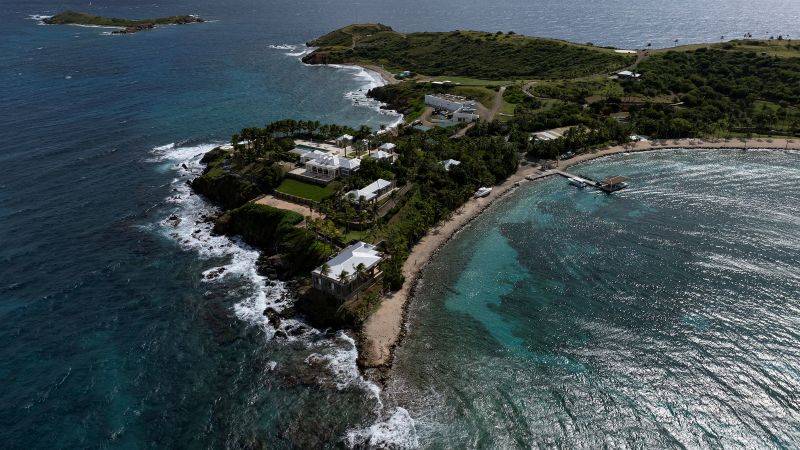
The island, roughly 70 acres in size, became a key asset in Epstein’s decades-long exploitation. Over nearly two decades, it functioned as both a social hub and a secluded site for predatory behavior. Recently, millions of pages of documents from the Department of Justice have shed light on the island’s role in a global sex trafficking scandal.
Staff and Victims’ Accounts
Testimonies within the DOJ files challenge claims by Epstein’s visitors that they were unaware of his crimes. Photos of nude girls on walls, reports from airport workers about underage girls being transported, and an interior decorator’s account of a bedroom designed with pink furnishings and bunk beds all point to a system of control. Some staff and victims specifically named individuals, including Google co-founder Sergey Brin and 23andMe co-founder Anne Wojcicki, who visited the island in 2007.
“They observed that we did not speak and that we remained mute,” the victim wrote. “They witnessed the trauma on our faces and in our eyes. Sergey and Anne witnessed our souls and bodies riddled with fear. They said nothing. They did nothing.”
Epstein’s Financial Empire
Epstein acquired Little St. James for $8 million in 1998, leveraging its isolation to entrap victims. The island, situated over a mile from St. Thomas in the US Virgin Islands, was accessible only by helicopter or boat. Its remote location allowed Epstein to maintain secrecy while offering a luxurious facade to attract influential guests.
The Island’s Transformation
Initially a modest retreat, the island evolved into a sprawling estate. Satellite images from 2002 showed minimal structures, but by the late 2000s, Epstein had expanded it with a theater, library, gym, and staff housing. Despite its beauty, the island masked its darker purpose, as described by Thomas Volscho, a City University of New York professor.
“Little St. James became ‘the hub’ of Epstein’s sex trafficking because it was the ideal place to ‘isolate his victims,’” Volscho said. “You’re in paradise, but you’re in hell at the same time.”
Following Epstein’s death in 2019, his estate sold both Little St. James and Great St. James for about $60 million, some of which covered settlements from abuse claims. Yet, questions about the island’s role in his network persist, with new details revealing a pattern of exploitation that spanned years.
