Daftar Isi
Ecorescuezone.com – NEW DELHI — India's education minister tendered his resignation on Saturday, meeting a key demand of students whose anti-government protests swelled this week beyond the capital New Delhi and onto the streets of more than a dozen cities.
Following news of the resignation of the education minister Dharmendra Pradhan, a spokesman for protest leaders Saurav Das, called on demonstrators — mostly students — to go home. He said the protests, which began in early June, would end "in good faith."
The students held Pradhan responsible for a series of leaks in nationwide exams for university seats or government jobs, which millions of students take every year.
The protests posed the most serious challenge to the 12-year rule of India's Hindu nationalist prime minister Narendra Modi. For weeks, the government had ignored the protesters, then vilified them, with the education minister calling protest leaders " the B team of terrorists, " according to the Indian daily The Hindu. Presenters of Modi-loyal media outlets suggested the protest leaders were paid by India's enemy and neighbor, Pakistan.
"The government realized that the familiar playbook that it's often deployed to deal with these kinds of agitations was not working," said Milan Vaishnav, senior fellow and director of the South Asia Program at the Carnegie Endowment for International Peace, and host of a popular podcast, Grand Tamasha.
He added: "They were not easily able to undermine the credibility of the protesters. The pressure was mounting … I think this was their way of trying to cut their losses."
In a two-page letter posted on X, Pradhan said he was resigning because he didn't want the students' anger to be exploited by "anti-national forces." He did not clarify what he meant by "anti-national forces," but it appeared to be a dig at insinuations that the protesters were led, or infiltrated by enemies of India. Pradhan did not apologize for the paper leaks.
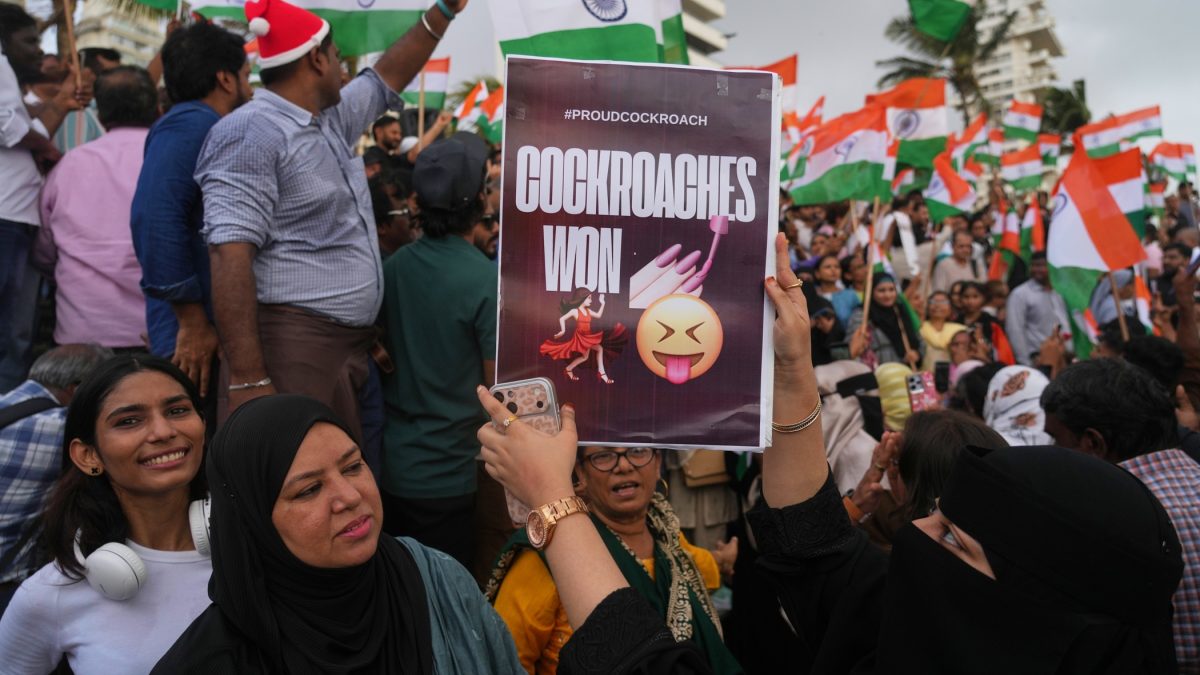
Near the main protest site in New Delhi, streets echoed with cheering students, whose celebrations went on well into the evening. Abhijeet Dipke, a 30-year-old whose satirical group 'Cockroach Janta Party' has been leading the protests, fell to his knees on hearing the news. Then he raised his fist and announced: "We have done it."
Even as leaders told protesters to go home, Dipke said in a statement that the students had other demands: compensation for the families of students who died by suicide after questions of a medical entrance exam paper leaked in May, forcing some 2 million students to retake the test – one of the incidents that initially sparked these protests.
The local newspaper The Indian Express reported at least a dozen students died by suicide following the announcement, with some leaving notes behind saying they could not bear the idea of resitting the exam.
The student leaders also demanded action against the security personnel who attacked protestors as they marched to Parliament in New Delhi earlier this week.
The resignation of Pradhan, seen as a confidant of the prime minister Modi, suggests that the government had to shift tactics after protests, which began in New Delhi on June 7, dramatically swelled in size. Unlike previous protests in India's recent history, these demonstrations cut across the country's traditional demographic lines.
India has the world's largest number of young people, with around 367 million people between the ages of 15 and 29. Education is "a kind of leveler, bringing everybody together," said sociologist Raheel Dhattiwala .
Sushant Singh , a political analyst at Yale University said because the crowd "cuts across caste, class, religion, language," the government struggled to deploy its usual playbook. "It has become very difficult for the state to demonize them," said Singh. "That is the uniqueness of this protest at this point."
Many protesters came from the heartland of the ruling Hindu nationalist party, a belt of territory from central to north India. Brothers Rishabh, 23, and Mohit, 22, traveled 50 miles by rickshaw, train, and metro to reach the central protest site in New Delhi. Like many Indians, they do not have a family name.
"The [exam] papers are being leaked, the rich are paying for their children to pass, and [we] poor people are being left behind," Rishabh told NPR on Friday. "Where are we supposed to go?"
But young Indians' complaints weren't triggered by the exam leaks alone. The protests coincided with a controversial comment by India's Chief Justice Surya Kant describing unemployed youth as "cockroaches" in May, a comment he later said was misquoted. The comments are what prompted Dipke to form the 'Cockroach Janta Party.'
The party has since received support from prominent Indians, including author Arundhati Roy, who recently wrote: "Just when hope seemed lost, they came. Young roaches riding in on the rain. The progeny of the unholy union between a judge and a joke."
These protests dramatically swelled in size last week after police forcibly removed a respected educator — who was on hunger strike in solidarity with the students — from the New Delhi protest site, effectively detaining him in a government hospital .
On Friday, the educator, Sonam Wangchuk, announced that he had broken his 26-day fast after receiving assurances that the government would hold authorities to account over the country's failing exam systems.
Even more students held their own protests across the country after police violently cracked down on thousands of protesters who tried to march into parliament on Monday.
Following that outcry, the prime minister Narendra Modi addressed students directly: "Friends, I understand that paper leak is no ordinary subject," he began in Hindi in a post released to Instagram overnight Thursday. He said his government had caught those accused of leaking exam questions and they "are lying in jails."
After Modi issued that statement, student leaders said they would meet with a government representative. They later told protesters they had repeated their demand for the education minister's resignation by the weekend and warned that if he did not, they would call for nationwide marches on Monday.
On Saturday, the students got what they asked for — taking many Indians by surprise.
"This is not a government that backs down very easily," said Vaishnav. "The fact that they were letting [the education minister] go is indeed quite a big deal," he said.
Dhattiwala , the sociologist, said she presumed that the protest leaders may try to continue their momentum in more formal avenues. "There could be a possibility that they might start a youth party," she said, speaking of Dipke and the Cockroach party he led to political success. "Who knows?"
Vaishnav, with the Carnegie Endowment, said even before projecting to the future, "we should stop and remark at how improbable a victory this was," praising the success of the movement and Dipke, a recent graduate of Boston University who returned to India in June to spearhead the movement.
"He sets up an internet meme called a cockroach people's party that goes viral. And he decides to take advantage of that, to come back to his home country and launch a protest to force the sitting education minister to resign. It actually succeeds."
"If you were to rewind the clock a couple of months, I mean, this would have seemed like pure fantasy."
Bilal Kuchay contributed reporting from New Delhi.
Related Reading
Frequently Asked Questions
What is India s cockroach movement ousts minister?
India s cockroach movement ousts minister is the main topic of this guide. The article explains the context, practical details, and next steps readers should understand.
Why does India s cockroach movement ousts minister matter?
India s cockroach movement ousts minister matters because readers are looking for a useful answer, not just a short summary. Good content should match search intent and help them decide what to do next.