Federal government thins the herds of wild horses in Colorado

Daftar Isi
Colorado’s High Desert Becomes a Stage for One of America’s Most Divisive Wildlife Policies
Ecorescuezone.com – On a clear morning roughly an hour’s drive west of Meeker, Colorado, a helicopter cut across the vivid blue expanse above the sagebrush flats. Below, small bands of mustangs — some chestnut, some palomino, some dark bay — bolted through the dusty terrain as the rotor wash pressed down on them. From the shelter of gnarled trees about a mile distant, a handful of onlookers tracked the unfolding scene toward a corralling pen designed to funnel the animals into captivity.
The operation is part of a broader federal mandate. The Bureau of Land Management, an agency within the U.S. Department of the Interior, administers public rangeland in ten Western states and, by extension, the wild horse populations that roam those acres. When the agency’s range assessments conclude that equine numbers exceed what the land can sustainably carry, it authorizes a set number of captures. For this particular gathering in rural Rio Blanco County, approximately 1,000 horses were targeted for removal.
The Emotional Cost of a Corral
Among the spectators was Robyn Smith, a retired architect who has spent years crisscrossing the American West documenting free-roaming mustangs through a high-powered lens. She was the first to spot the morning’s initial group — roughly half a dozen animals of mixed coloring moving as a unit.
“It makes me happy they’re living their best life,” Smith said. “And it’s just such a beautiful thing to see when you’re just wild and free like that.”
That sentiment, however, gave way quickly to grief. As the helicopter descended and its thrum drove the group — including a young foal — toward the pen, Smith fired her shutter in rapid succession and began to weep. She explained that once captured, the animals are separated. The BLM reunites very young foals with their dams, but beyond that, the odds of any two horses reuniting are slim.
“That’s a family. That’s a family out there,” Smith said through tears. “It’s a family broken.”
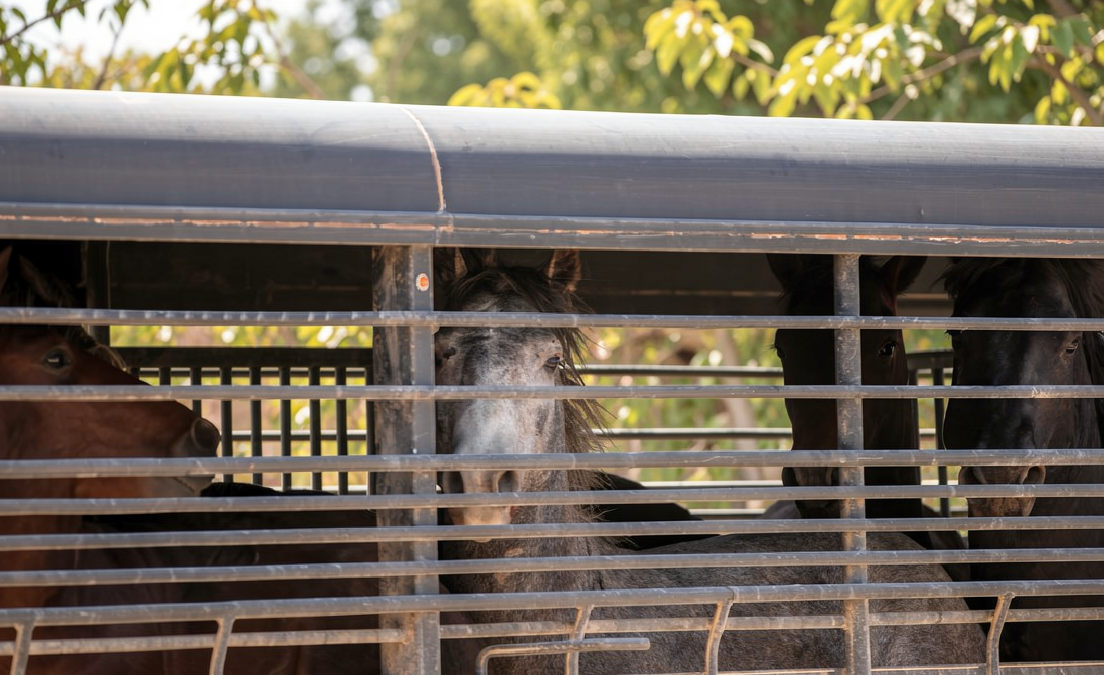
The destination for most of the captured animals is a network of long-term holding pens that advocates frequently compare to incarceration. The BLM currently maintains roughly 60,000 horses in those facilities, a program that costs federal taxpayers approximately $100 million annually.
A Rancher’s Counterargument
Not every voice in the room shared Smith’s sorrow. Rio Blanco County Commissioner Callie Scritchfield, a former rancher, argued that managed captivity is the more humane option compared with the hardships of unmanaged range life. She recalled encountering a mustalg trapped in a mud hole, struggling for the last available water.
“Was trying to get the last drop of water, but he’s bogged down. He don’t have the strength to get out,” Scritchfield said, grimacing at the memory. “It’s not pretty.”
Of the holding pens themselves, she offered a pragmatic defense:
“You never see a skinny one in there. He’s always got something to eat every day, and he’s got a drink of water every day.”
For Scritchfield, that daily guarantee of feed and water outweighs the risks of starvation and entrapment that she witnessed firsthand on the open range.
Range Ecology and the Cow Question
Troy Osborn, a range specialist and former U.S. Forest Service employee, framed the issue in ecological terms. He noted that federal lands in the Meeker area have been stripped of forage by both domestic cattle and wild horses, which share broadly similar dietary needs.
“We want to see the ground healthy. We want to see it productive,” Osborn said. “We want to see it used by all animals, by all species.”
The numerical disparity between the two groups is stark. The BLM estimates just over 85,000 wild horses roam federal lands across the West, while millions of cattle graze the same public and private acres. Ranchers contend that livestock movements are carefully managed through fencing, rotation, and market economics, whereas mustang herds shift unpredictably. Left unchecked, those herds can roughly double in size within a few years — a growth curve the agency says roundups are designed to interrupt.
From Corral to Companion: The Adoption Pipeline
Each year, a portion of the captured population exits the holding system through sale or private adoption. The BLM reports that about 8,000 wild horses were sold or adopted in the most recent year.
Cindy Day is one such adopter. Four years ago she brought home a large gray mustang she named Moses, describing his initial temperament as “horrifically wild.” At the small ranch she purchased near Grand Junction, Colorado, the two have since built a working relationship. Day now leads Moses around the property, training him to accept a saddle, though she has not yet mounted him. She envisions a future of trail rides through the surrounding mesas.
“Good boy! Good boy!” Day said, pressing a kiss to his cheek. “Mama kisses? Thank you, baby!”
Day also volunteers with Piceance Mustangs, a nonprofit based in the region that assists the BLM with tasks outside the agency’s budget — including administering supplemental doses of birth-control medication to horses still in federal care. Organizations like Piceance Mustangs operate across the West, filling gaps in a program that, for all its scale, remains constrained by limited appropriations.
What Comes Next
The Colorado roundup is not an isolated event but one node in a recurring cycle that stretches from Montana to New Mexico. Each gathering forces a public reckoning: how many animals can a landscape bear, who decides that number, and what happens to the surplus. For advocates like Smith, the answer should be fewer captures and more in-situ management. For commissioners like Scritchfield and range managers like Osborn, the answer is that the land itself demands intervention before starvation and habitat degradation become irreversible. And for adopters like Day, the question is whether a single bond between a human and a once-wild animal can offset the thousands of separations that precede it.
The helicopter has long since banked east. The sagebrush, flattened in a narrow corridor where the horses ran, will regrow within a season. The policy debate, however, shows no sign of settling.
Related Reading
Frequently Asked Questions
What is Federal government thins the herds of wild?
Federal government thins the herds of wild is the main topic of this guide. The article explains the context, practical details, and next steps readers should understand.
Why does Federal government thins the herds of wild matter?
Federal government thins the herds of wild matters because readers are looking for a useful answer, not just a short summary. Good content should match search intent and help them decide what to do next.