A battle over ‘Italian brainrot’ could shape who owns AI art

Daftar Isi
When a Stick Figure Holds a Bat: The Copyright War Brewing Over AI-Generated Memes
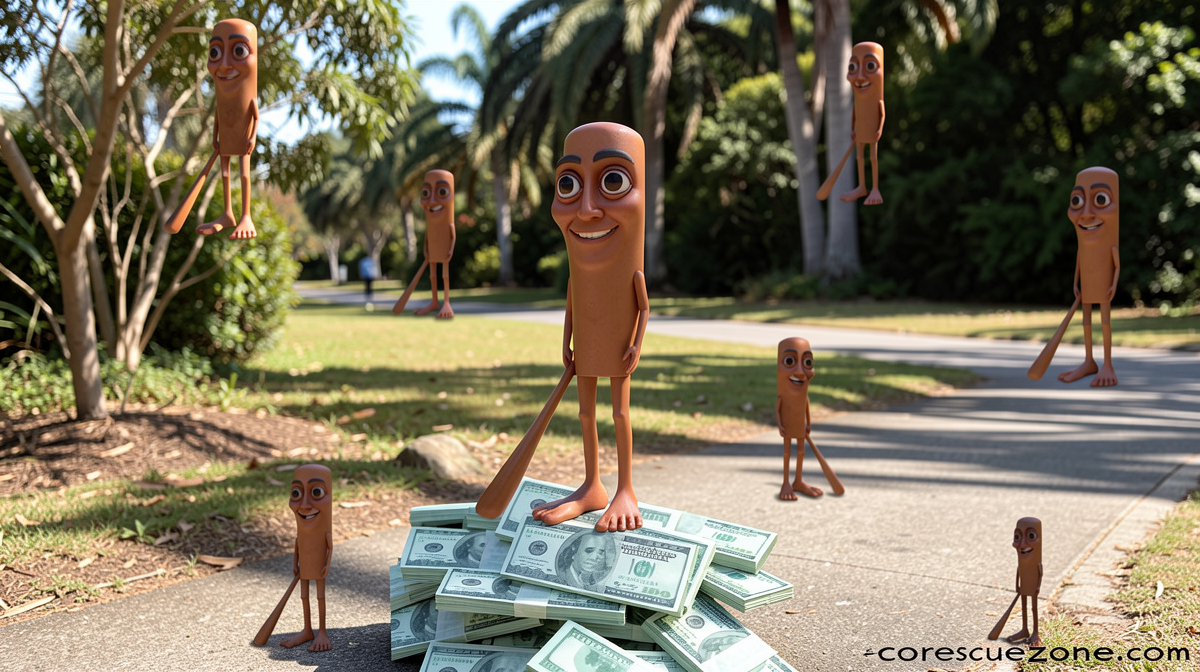
Ecorescuezone.com – A wooden stick with a cartoon face, two human legs, two human arms, and a baseball bat tucked under one limb. That is Tung Tung Sahur, one of the most recognizable figures in a bizarre new genre of internet imagery that has captured the imaginations of children across the globe. Now, a question that could reshape how the entertainment industry treats AI-made content has landed in a California courtroom: does anyone actually own that stick figure?
The answer, if resolved one way or the other, may determine whether millions of dollars in licensing revenue flow to the humans who typed prompts into a chatbot, or whether such characters remain in a legal no-man’s-land where any company can deploy them freely in games, merchandise, and streaming content.
The Cultural Phenomenon Behind the Lawsuit
In early 2025, a wave of strange, AI-generated characters flooded social media platforms, YouTube channels, and eventually video games. Collectively dubbed “Italian brainrot,” these figures carry deliberately absurd, faux-Italian names and visual designs that skewer logic in a way that adults find baffling but that younger audiences devour with enthusiasm. A cow whose torso is the ringed planet Saturn, complete with oversized human feet, goes by the name La Vaca Saturno Saturnita. A frothy espresso dressed in a ballet tutu answers to Ballerina Cappuccina. The aesthetic is Dadaist, deliberately nonsensical, and built to be screenshotted, shared, and remixed by kids who grew up inside the internet.
Because the characters spread so rapidly and so widely, commercial products aimed at younger demographics began incorporating them almost immediately. The most consequential example is Steal a Brainrot, a video game developed by Do Big Studios and released last year, just weeks after the brainrot wave hit peak virality among the youth internet. In the game, brainrot figures appear on a conveyor belt; players grab them, build collections, and can also raid other players’ stashes. The title has become one of the most-played experiences on Roblox, the online gaming platform, with hundreds of thousands of concurrent players at any given moment.
The Licensing Demand That Became a Lawsuit
When Steal a Brainrot surged up the Roblox charts, its creator Sam Brakta — known online as SpyderSammy and the owner of Do Big Studios — received correspondence from a French startup called Mementum Lab. The company, which represents the young creators behind several of the brainrot figures appearing in the game, asked Do Big to open licensing negotiations specifically for Tung Tung Sahur.
For most intellectual property, that request would be routine. Want to place Darth Vader in a new title? You pay a fee to Disney, which holds the Star Wars catalog. The transaction is well understood, well priced, and well enforced.
Do Big, however, chose a different path. Rather than negotiate a license, the company filed suit. In an amended complaint submitted in July, Do Big asserted that Mementum’s claimed rights simply do not exist. The filing argued that under established copyright doctrine, protection requires human authorship, and that material generated by artificial intelligence does not meet that threshold.
“It’s our client’s position that the various brainrots that are featured in this game, because they were created by AI, are not protectable — they’re not owned by anybody,” said Aaron Moss, a copyright attorney at Mitchell Silberberg & Knupp, the firm representing Do Big and SpyderSammy.
The Opposing Argument
Mementum Lab disagrees. Eben Jeda, a co-founder of the French company, contends that the brainrot characters are already known to millions of children worldwide and carry potential revenue in the hundreds of millions of dollars. From Mementum’s perspective, the humans who crafted the prompts, selected the outputs, and built the cultural momentum around each figure performed a creative act worthy of protection.
The dispute thus pits two competing theories of authorship against each other in a jurisdiction where the law has not yet drawn a clean line.
Where the Law Stands — and Where It Hasn’t
The broader legal landscape is still being mapped. In 2024, a federal court ruled that a chatbot cannot serve as the sole inventor of a product or artwork, effectively closing the door on pure machine authorship. Yet that same decision left open the possibility that humans directing AI tools could produce copyrightable works. Last year, the U.S. Copyright Office reinforced that position, affirming that AI-assisted output could qualify for copyright while cautioning that each case must be evaluated individually.
“Whether human contributions to AI-generated outputs are sufficient to constitute authorship must be analyzed on a case-by-case basis.”
Mark McKenna, a law professor at the University of California, Los Angeles who co-directs the university’s Institute for Technology, Law and Policy, frames the current moment as one of genuine uncertainty.
“We’re still in the middle of figuring out, as a copyright matter, how much human involvement there has to be” for AI art to be legally protected, McKenna said. He expects that eventually an AI-drawn image, story, or song will receive copyright registration, but he added, “I don’t have some specific prediction of how many prompts it’s going to take.”
Why This Case Matters Beyond One Stick Figure
The stakes extend well past a single Roblox title. If a court rules that the brainrot characters are unprotectable because their creation was sufficiently automated, the decision could open the floodgates for any company to incorporate AI-generated visuals into commercial products without compensation to the prompt-writers. Conversely, if the court finds that the human curation, selection, and iterative prompting behind each figure constitutes authorship, it would establish a precedent that empowers thousands of young creators who have built audiences around AI-assisted characters.
Either outcome will ripple through game development, merchandise licensing, streaming content, and the broader question of what counts as creative labor in an era where a single typed sentence can produce an image. The Italian brainrot dispute, for all its absurd imagery, may become the case that forces the legal system to answer that question with specificity rather than deference.
Related Reading
Frequently Asked Questions
What is A battle over Italian brainrot could?
A battle over Italian brainrot could is the main topic of this guide. The article explains the context, practical details, and next steps readers should understand.
Why does A battle over Italian brainrot could matter?
A battle over Italian brainrot could matters because readers are looking for a useful answer, not just a short summary. Good content should match search intent and help them decide what to do next.