Supreme Court gives Trump an interim win on his mail voting order, but hurdles loom

Daftar Isi
Midterm Ballots in Limbo as Supreme Court Pauses State Challenge to Trump’s Mail-Vote Directive
Ecorescuezone.com – With voters in dozens of states preparing to cast ballots by mail for this fall’s congressional elections, the nation’s highest court has thrown a temporary wrench into the machinery of absentee voting. On Monday, the Supreme Court issued an unsigned order temporarily suspending a lower-court judgment that had shielded 23 predominantly Democratic-led states — along with Washington, D.C. — from the full force of an executive order President Trump signed in March. The move grants the administration a narrow, interim reprieve but leaves the underlying constitutional questions entirely unresolved.
What the Court Decided — and What It Deliberately Did Not
The justices did not rule on whether Trump’s directive is lawful. The unsigned order explicitly stated that its “disposition of this application does not mean that any measure taken by the Government to implement the Order will necessarily be lawful.” In practical terms, the ruling addressed only the procedural question of whether the suing states had waited long enough before mounting their challenge. By pausing the June decision of U.S. District Judge Indira Talwani, the Court effectively told those states they must wait for a final agency action before returning to court with their claims.
Three liberal justices dissented. Justice Ketanji Brown Jackson, writing for the dissent, argued the majority’s timing choice would destabilize an already fragile election cycle.
“This decision needlessly injects chaos and uncertainty into the upcoming midterm elections,” Jackson wrote. “To be sure, the Court has not foreclosed States from challenging this blatantly unconstitutional Order. But it declines to explain when, exactly, is the right time to bring a meritorious election-rule claim challenging unconstitutional interference with electoral processes. The majority just signals that these claimants had to wait—even though the election cycle had started and despite facing pocketbook costs, threats of prosecution, and an affront to their sovereignty—before receiving the relief to which they are likely entitled.”
A Second Injunction Still Blocks Federal Action Nationwide
The interim pause does not clear the path for the Postal Service to execute the president’s instructions. A separate, broader injunction issued by Judge Talwani on August 11 in Boston continues to bar the USPS from following the administration’s directives across the entire country. In a court filing submitted late Monday, the White House indicated it will petition the First Circuit Court of Appeals to suspend that nationwide order if Talwani has not voluntarily paused or vacated it by 5:30 p.m. Eastern Time on Tuesday. Twelve Republican-led states have already lodged appeals against the August ruling, adding another layer of appellate complexity to an already tangled litigation landscape.
What the March Executive Order Actually Demands
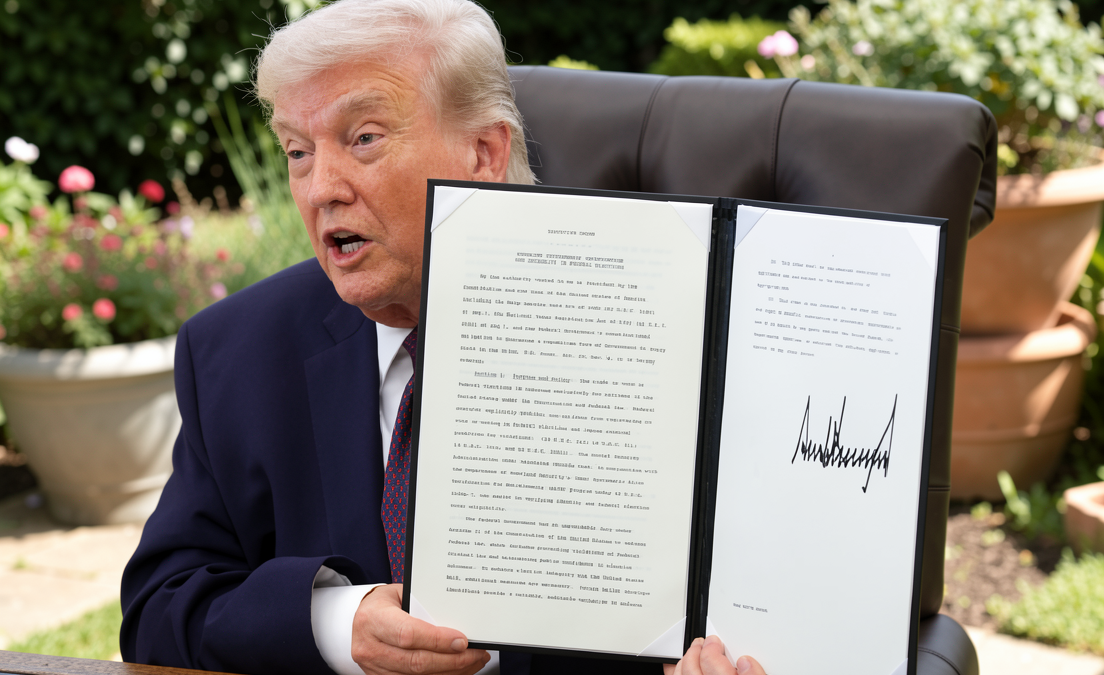
The directive at the center of this dispute instructs the Department of Homeland Security to compile state-level rosters of adult U.S. citizens and requires the Postal Service to obtain from each state a list of individuals eligible to vote by mail. Under the order, USPS would be permitted to deliver mail-in ballots exclusively to persons appearing on those lists. Election officials, in turn, would be obligated to affix specific barcodes to every mail-ballot envelope. The Postal Service has already promulgated a final rule governing federal ballot mail in response to the order, though that rule’s enforceability remains contested in court.
Trump, who himself cast a mail ballot in Florida earlier this year, has framed the directive as a safeguard against non-citizens voting in federal elections. Independent research, however, has consistently found that non-citizen participation in federal ballots is vanishingly rare, a fact that critics cite when questioning the order’s stated rationale.
The June Ruling Now Paused
In June, Talwani concluded that the president had exceeded constitutional authority. The Constitution vests the power to set rules for federal elections in state legislatures and Congress, not in the executive branch, she reasoned. She further held that the Postal Service, as an independent agency insulated from direct presidential command, possesses no statutory authority to regulate mail-in voting procedures. The Supreme Court’s Monday order grants emergency relief sought by the administration and twelve Republican-led states, pausing that June judgment in the 23 states and D.C. that brought the original suit — without passing judgment on the merits.
Political Reactions and the Road Ahead
New York State Attorney General Letitia James, representing the coalition of challenging states, characterized the ruling as a setback but not a final verdict.
“This decision is a painful setback, but it will not be the final word,” James said. “The right to vote is sacred, and no administration should be allowed to put that right in jeopardy by making it harder for eligible voters to cast their ballots.”
James added that the states are actively exploring additional legal avenues. The litigation is far from concluded: multiple parallel suits remain pending, appellate briefs are due in the coming weeks, and the practical question of whether federal agencies can complete implementation before ballots go out in November hangs in the balance. For millions of voters who rely on mail ballots, the next few weeks will determine whether the interim pause translates into a permanent restructuring of how absentee votes are processed — or whether the courts ultimately reinstate the protections the states sought.
Related Reading
Frequently Asked Questions
What is Supreme Court gives Trump an interim?
Supreme Court gives Trump an interim is the main topic of this guide. The article explains the context, practical details, and next steps readers should understand.
Why does Supreme Court gives Trump an interim matter?
Supreme Court gives Trump an interim matters because readers are looking for a useful answer, not just a short summary. Good content should match search intent and help them decide what to do next.