NASA is about to launch a space telescope that could change how we see the universe

Daftar Isi
A $4.3-Billion Telescope Built from a Spy Satellite Will Redefine Cosmic Cartography
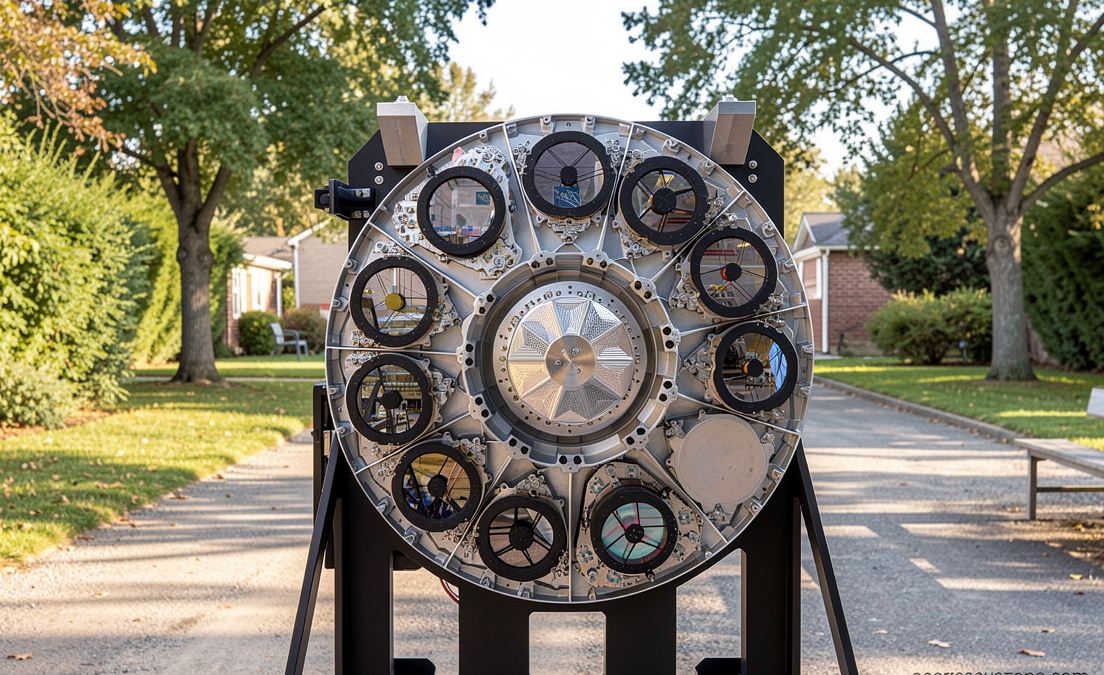
Ecorescuezone.com – On August 30, a spacecraft that spent years sitting idle in a government hangar will finally leave the ground — not to peer down at Earth, but to stare upward into the deepest reaches of space. The Nancy Grace Roman Space Telescope, a $4.3-billion observatory named after NASA’s first chief astronomer, is poised to become the most powerful wide-field survey instrument ever placed in orbit. Its five-year mission will catalog vast stretches of the Milky Way, hunt for planets invisible to every other technique, and test whether the foundational model of cosmic expansion still holds.
The stakes are enormous. For over a decade, astronomers have relied on a particular mathematical framework to describe how galaxies recede from one another. Recent measurements have cast doubt on that framework, and Roman is expected to deliver the precision needed to settle the question once and for all.
From Spy Hardware to Science Flagship
The telescope’s origin story reads like a government procurement fairy tale. Roughly fifteen years ago, NASA began engineering a space-based instrument whose primary job would be detecting Type 1A supernovae — the thermonuclear detonations of white dwarfs that serve as standard candles for measuring cosmic distances. Those supernovae were the very tools that, in the late 1990s and early 2000s, revealed the universe’s expansion is accelerating, a finding that earned the 2011 Nobel Prize in Physics.
While those plans were still on the drawing board, an unexpected phone call arrived from the National Reconnaissance Office, the agency responsible for surveillance satellites.
“The National Reconnaissance Office reached out to NASA,” says cosmologist Daniel Scolnic at Duke University, “saying, ‘We have this amazing satellite sitting in a hangar that we’re not using. And what do you guys think about instead of pointing downwards, we point upwards, and you guys use it?'”
NASA accepted. Engineers performed substantial modifications to the airframe and payload, and what had been a dormant reconnaissance platform was reborn as the next major space observatory in the American program. The repurposing saved years of development time and billions in fabrication costs, though the scientific payload was redesigned from scratch to meet astronomy’s demanding requirements.
Supernovae, Dark Energy, and the Fate of a Model
Dark energy — the name given to whatever is driving the accelerating expansion — remains the least understood component of the cosmos. Scolnic emphasizes that catching additional Type 1A events at greater distances would sharpen the distance-redshift relation and tighten constraints on the equation of state governing that mysterious force.
“In the last few years, there have been measurements saying that model might be wrong — and that’s something that Roman will absolutely nail, whether the model’s right or wrong,” Scolnic says.
If the current concordance model (a flat universe dominated by dark energy and cold dark matter) survives Roman’s scrutiny, confidence in decades of cosmological inference will be reinforced. If it does not, the implications ripple outward into particle physics, gravity theory, and the very definition of what the universe is made of.
A Month Where Hubble Would Need a Century
Beyond supernovae, Roman carries a second headline mission: a one-month all-sky survey of the Milky Way. Julie McEnery, the telescope’s project scientist, explains that while Roman’s sensitivity and angular resolution are broadly comparable to those of the Hubble Space Telescope, its wide field of view and rapid scanning architecture make it orders of magnitude faster at covering large areas.
“That one month of observations to survey our Milky Way galaxy would take about a century with Hubble,” McEnery says.
The resulting catalogs — millions of stellar positions, proper motions, and photometric measurements — will be released openly. McEnery stresses that access will not be gated behind institutional subscriptions.
“You can be a teacher in a high school in Kentucky and your students have the opportunity to see Roman data at the same time as a professor in Princeton,” she says.
That democratization of data is itself a scientific strategy: more eyes on the same pixel set increase the odds that anomalous objects — variable stars, transient events, previously unknown stellar populations — are flagged quickly.
Hunting Planets Einstein Called Impractical
One of Roman’s most anticipated capabilities is gravitational microlensing detection of exoplanets. The principle, described by Albert Einstein in 1936, is straightforward: when a foreground star (with its own planets) passes in front of a background star, the foreground mass bends and magnifies the background light. A planet orbiting the lens star produces a brief, characteristic distortion in the light curve.
Einstein himself judged the effect too faint to exploit observationally. Modern charge-coupled devices and space-based photometry have overturned that verdict. Scott Gauti at Ohio State University, who helped develop the microlensing detection technique, expects Roman’s cadence and sensitivity to yield a flood of new worlds.
“We’re looking for planets that are just completely undetectable by any other method,” Gauti says. That includes planets at the center of our galaxy, “that are very analogous to our own solar system planets like Jupiter, Saturn, Uranus, and Neptune.”
Those galactic-center planets would be the first direct evidence that giant-planet architecture is not a peculiarity of the Solar System but a common feature of stellar systems across the disk and bulge.
Galaxies, Structure, and the Unpredictable
Roman’s deep, wide fields will also expose thousands of previously unknown galaxies, extending the map of large-scale structure — the cosmic web of filaments, walls, and voids — to redshifts and angular scales no current survey reaches. Each new node in that web refines estimates of the matter power spectrum and tests structure-formation models.
Yet the single most important discovery may be the one nobody has yet imagined. Wendy Freedman, an astronomer at the University of Chicago, points to a pattern in the history of observational astronomy: every major new survey instrument has surfaced at least one phenomenon that was not on the original science requirements document.
“The history of astronomy really has shown that when you get a new capability, and especially a survey capability, you learn something new, something unexpected,” Freedman says. “Often that turns out to be the most exciting part of a new facility. So I am completely open to what this telescope will find.”
Whatever Roman uncovers — whether a confirmation of the standard model, a crack in its foundations, a census of unseen worlds, or something no one has yet named — the data will belong to everyone. The telescope’s design philosophy treats the sky not as a collection of targets to be studied one at a time, but as a single, continuously sampled dataset whose full meaning will emerge only after years of cross-disciplinary analysis. In that sense, the launch on August 30 is less a destination than a starting gun: the real science begins the moment the first frames hit the ground stations.
Related Reading
Frequently Asked Questions
What is NASA is about to launch a space?
NASA is about to launch a space is the main topic of this guide. The article explains the context, practical details, and next steps readers should understand.
Why does NASA is about to launch a space matter?
NASA is about to launch a space matters because readers are looking for a useful answer, not just a short summary. Good content should match search intent and help them decide what to do next.