After D.C.’s Reflecting Pool gets repainted, visitors ask: What changed?

After D.C.’s Reflecting Pool Gets Repainted, Visitors Ask: What Changed?
After D C s Reflecting Pool – Washington, D.C., has seen the Lincoln Memorial Reflecting Pool gradually resume its usual function, with water trickling back into its surface after a contentious repainting project shuttered it for weeks. While the pool’s return has been met with cautious optimism, many visitors remain puzzled, noting that the visual transformation is subtle at best.
From Concrete to “American Flag Blue”
President Donald Trump had previously vowed to restore the pool to its former glory, describing it as “just gray” during his campaign. His administration’s decision to repaint the pool in a deep, navy-blue hue sparked debate, with some calling it a bold redesign and others labeling it a departure from tradition. The project, which began in late April, was initially projected to last a few weeks, but the timeline has stretched beyond expectations.
“The pool gets completed at 4 o’clock and the water will start to flow in … and it’s going to be beautiful,” Trump told reporters in the Oval Office on Wednesday.
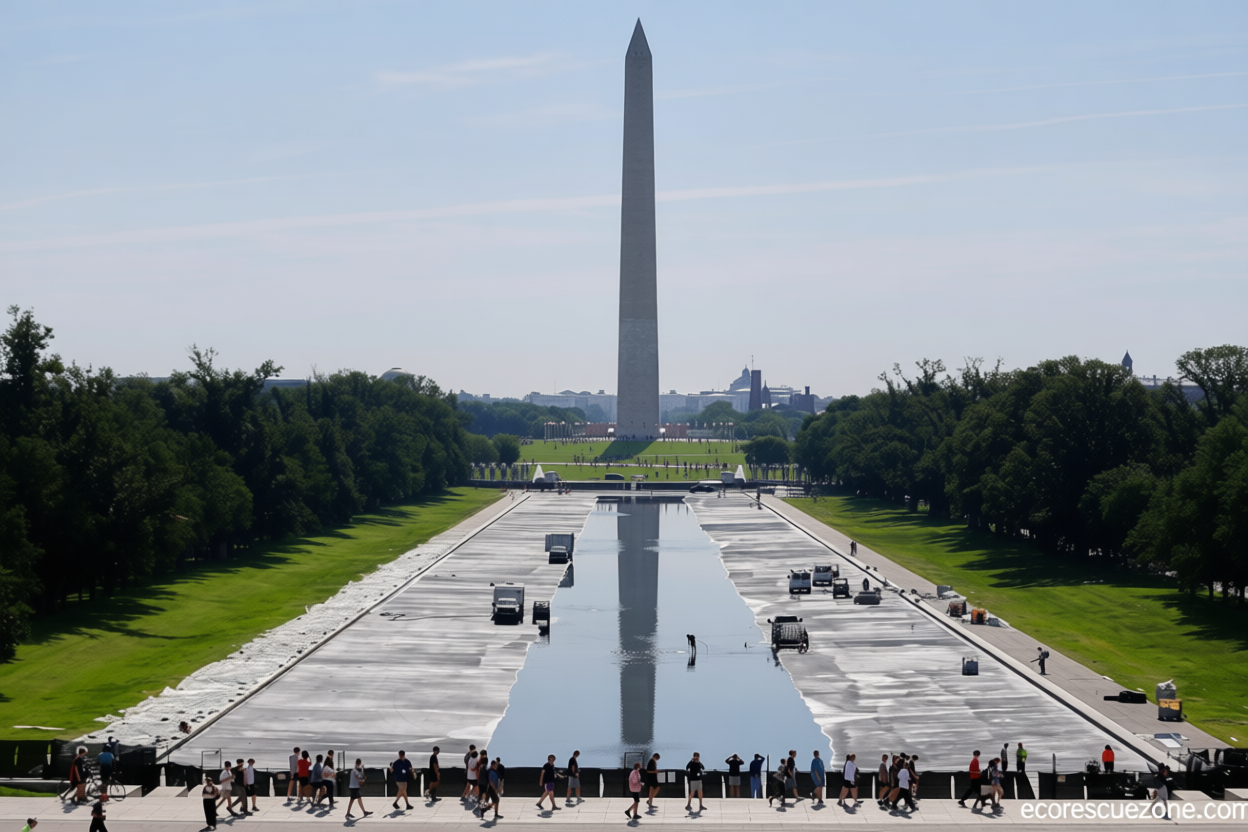
By the following day, Interior Secretary Doug Burgum shared a video showing water bubbling through a grate on the newly painted pool floor. The footage, released under bright sunlight, highlighted the gradual filling of the 2,028-foot-long pool, which had been drained for maintenance. Trump’s vision of a “American flag blue” surface aimed to replace the muted gray tones that had long characterized the monument’s iconic water feature.
A Closer Look at the Refilling Process
As the water level rose, visitors gathered at the Washington Monument to watch the refilling progress. A worker, clad in rolled-up pants and holding a hose, stood in the center of the pool, guiding the flow of water into its shallow basin. The process, though methodical, raised questions about the final appearance of the pool. With temperatures climbing toward 90 degrees, onlookers paused to capture the moment, though their reactions were mixed.
Many noted that the pool’s color, while darker than before, did not appear drastically altered. Luisa Córdoba, a D.C. resident and frequent visitor, remarked, “The more water it fills, the more similar it looks [to before]. I’m just happy it’s not that bright blue we saw the first days, which was so alarming … if it stays like this, it’s fine.”
“I’m colorblind, so it doesn’t look blue — yet,” said Terry Barzanti, a Maryland resident working nearby.
His coworker, Edgar Sadsad, laughed as he described the hue as “more grey.” Others, however, suggested the color leaned toward black, with some speculating that the difference would become more apparent once the pool was fully restored. Despite the uncertainty, both Barzanti and Sadsad praised the project, noting that the pool now seemed cleaner and more inviting.
Controversy and Historical Context
The repainting initiative was met with skepticism from preservationists, who argued that the pool’s historic aesthetic had been compromised. Early renderings of the project had already raised concerns, with critics warning that the monument might resemble a modern swimming pool rather than a symbolic reflection of the nation’s ideals. Yet, as of Friday, the changes appeared modest.
Trump had cited the pool’s deteriorating condition as a key reason for the project. According to his claims, an unnamed friend from Germany had described the pool as “filthy” and “not representative of the country.” The pool, opened in 1923, had last undergone major repairs between 2010 and 2012. Since then, it has faced recurring issues with broken pipes and water leaks, requiring frequent refills that cost millions.
Cost Overruns and Legal Challenges
While Trump initially estimated the cost at $2 million, the project’s final price tag has since been revealed as significantly higher. Interior Department records obtained by The New York Times show the administration plans to pay Atlantic Industrial Coatings, the Virginia firm selected for the work, $13.1 million. This discrepancy has fueled criticism, with some questioning whether the budget was stretched or mismanaged.
A large sign at the construction site, bearing National Park Service letterhead, informed visitors that the improvements were funded “using your fee dollars.” This raised further scrutiny, as the pool’s maintenance costs have long been a point of contention among locals and officials. The Department of the Interior has acknowledged that the project has not fully resolved the underlying issues with broken pipes, despite Trump’s claims of sealing crevices and removing 12 truckloads of debris.
Legal Hurdles and Public Perception
The repainting effort also faced legal challenges. In mid-May, the nonprofit Cultural Landscape Foundation sued the administration, alleging that the project had bypassed federal historic preservation reviews. The lawsuit argued that the redesign, while intended to enhance the pool’s appearance, risked altering its cultural significance. A judge heard arguments later that month but had not issued a ruling by the time the administration announced the project’s completion.
Despite these legal battles, the pool’s reopening has been celebrated by some. For Luisa Córdoba, the return of water and the ducks that inhabit it marked a positive step. “It’s a place I’ve been checking every day since the work started,” she said, expressing relief that the pool no longer appeared overly artificial. Others, however, remain critical, questioning whether the $13.1 million investment was justified.
A Legacy in Question
Trump’s decision to repaint the pool has sparked broader conversations about public infrastructure and aesthetic priorities. While he framed the project as a necessary upgrade, critics argue that the changes could detract from the pool’s historical value. The pool, a symbol of the nation’s unity and heritage, has long been a popular spot for visitors, with its reflective waters serving as a backdrop for countless photos and memories.
As the water continues to fill, the pool’s fate remains uncertain. Some hope the new color will harmonize with the surrounding landscape, while others fear it may overshadow the original design. The debate reflects a larger tension between modernization and preservation, a theme that has accompanied Trump’s administration in its approach to iconic landmarks.
For now, the pool stands as a testament to both the controversy and the persistence of its restoration. Whether its appearance will be met with widespread approval or further criticism depends on how the final result compares to the initial vision. But one thing is clear: the pool’s transformation has already sparked a wave of public discourse, with visitors eager to see what the future holds.