Russia and North Korea open the first road across their shared border

Daftar Isi
First Road Link Between Russia and North Korea Opens Over the Tumen River
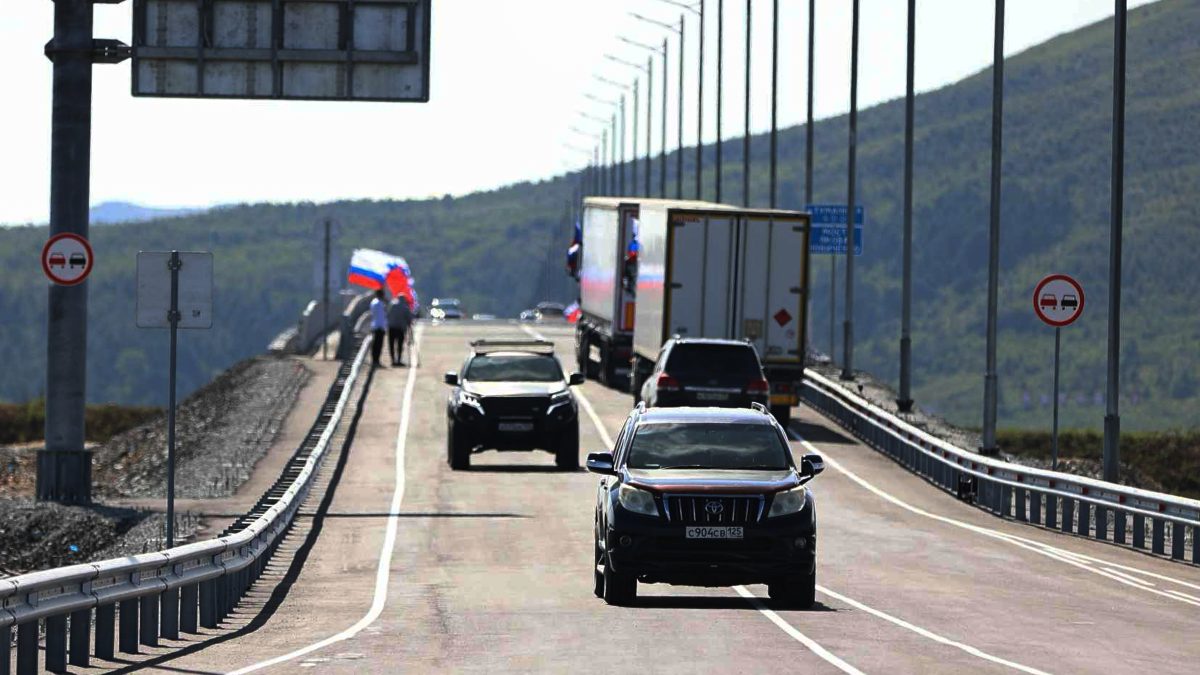
Ecorescuezone.com – For decades, the narrow stretch of water separating Russia’s Far East from North Korea’s coastal province has been crossed only by rail and by air. That changed on Monday, when both governments inaugurated the first dedicated automobile bridge spanning the Tumen River, a symbolic and practical milestone in a bilateral relationship that has deepened sharply since Moscow and Pyongyang formalized their strategic partnership in 2024.
The new crossing connects Rason, North Korea’s small port city in its Hamgyong province, with Khasan, a quiet Russian border town in Primorsky Krai. The structure measures one kilometer (roughly 0.6 mile) in length and carries two lanes of traffic. According to a statement released by the Russian government, the adjacent border checkpoint is designed to process up to 300 vehicles per day, a capacity that will support both commercial freight and private travel between the two sides.
A Ceremony Split Across Two Cities
The opening was staged simultaneously in Rason and Khasan. Russian Prime Minister Mikhail Mishustin and North Korean Premier Pak Thae Song each appeared at their respective venues through video link, underscoring the ceremonial weight both governments attached to the event. Mishustin framed the bridge as a catalyst for broader cooperation:
“I am convinced that the expansion of transport infrastructure near the border will give a powerful boost to the further development of trade, economic, technological, scientific and cultural cooperation between the Russian Federation and the Democratic People’s Republic of Korea.”
Pak, speaking from the North Korean side, described the completion as
“a significant event adding a new dynamic movement to the overall bilateral cooperation.”
Both leaders emphasized that the bridge would accelerate not merely the movement of goods but also people-to-people contacts, scientific collaboration, and cultural exchange across what had long been one of the world’s least trafficked international boundaries.
Geographic and Historical Context
The Tumen River forms much of the natural boundary between North Korea and both Russia and China, flowing from its source in the mountains of northeastern China before emptying into the Sea of Japan near Vladivostok. For most of the twentieth century, the river’s course between Rason and Khasan was crossed only by a single railway bridge built during the Soviet era. A limited air service linking the two cities supplemented rail travel for passengers and small consignments. An automobile crossing had been discussed for years but never realized until the two governments signed a joint construction agreement in 2024. Groundwork and bridge fabrication began in 2025, and the structure was completed within roughly a year of active construction.
The new road bridge thus adds a third mode of cross-border transport to a corridor that previously relied on rail and air alone. For a region where trucking and small-scale commercial logistics have long been constrained by the absence of a paved road link, the addition of two lanes and a dedicated customs point represents a meaningful expansion of daily connectivity.
Military and Economic Dimensions of the Partnership
The bridge arrives at a moment when Moscow and Pyongyang have moved well beyond diplomatic pleasantries into substantive material cooperation. Since the outbreak of full-scale war in Ukraine, North Korea has supplied Russia with large quantities of artillery shells, rockets, and other munitions, while also dispatching units of troops to support operations on the eastern front. In return, Russia has extended economic aid, energy supplies, and military-technical assistance to Pyongyang. The road bridge is widely read as the latest physical expression of that reciprocal arrangement: a piece of infrastructure that shortens supply-chain distances and lowers the cost of moving goods in both directions.
North Korea’s state news agency, the Korean Central News Agency, noted that the new crossing would facilitate tourism, human exchange, and the circulation of commodities between the two countries. That framing is consistent with a broader pattern that has emerged since early 2024, when Russian tourists began visiting North Korea in modest numbers as pandemic-era travel restrictions gradually eased. The flow of visitors, though still small by global standards, has given both governments a civilian channel of interaction that complements the military and economic tracks.
What the Bridge Changes on the Ground
In practical terms, the Rason–Khasan road link will permit trucking operations that were previously impossible or prohibitively expensive. Small manufacturers, agricultural producers, and service firms on either side of the river gain a direct overland route that bypasses the need to route cargo through Chinese territory or to depend on limited rail slots. The 300-vehicle daily capacity at the new checkpoint is modest by European or North American standards, but for a border that historically saw very little road traffic, it represents an order-of-magnitude increase in throughput.
Analysts also note the strategic signaling value. By investing in permanent, high-capacity civilian infrastructure along a frontier that borders both China and, further south, South Korea, both Moscow and Pyongyang are cementing a long-term physical presence in a region where logistics have historically been thin. The bridge does not alter the geopolitical map, but it does make the existing partnership harder to reverse: once trucks, buses, and passenger cars are running daily across the Tumen, the economic and social inertia of that traffic becomes a stabilizing force in its own right.
For the residents of Rason and Khasan—small communities of a few thousand people each—the most immediate effect will be a gradual increase in cross-border commerce, a modest uptick in tourism, and a visible reminder that their towns now sit at the terminus of a new artery linking two states that, until recently, had very little reason to build roads toward one another.
Related Reading
Frequently Asked Questions
What is Russia and North Korea open the first?
Russia and North Korea open the first is the main topic of this guide. The article explains the context, practical details, and next steps readers should understand.
Why does Russia and North Korea open the first matter?
Russia and North Korea open the first matters because readers are looking for a useful answer, not just a short summary. Good content should match search intent and help them decide what to do next.