
New species of giant dinosaur identified from remains found in Thailand
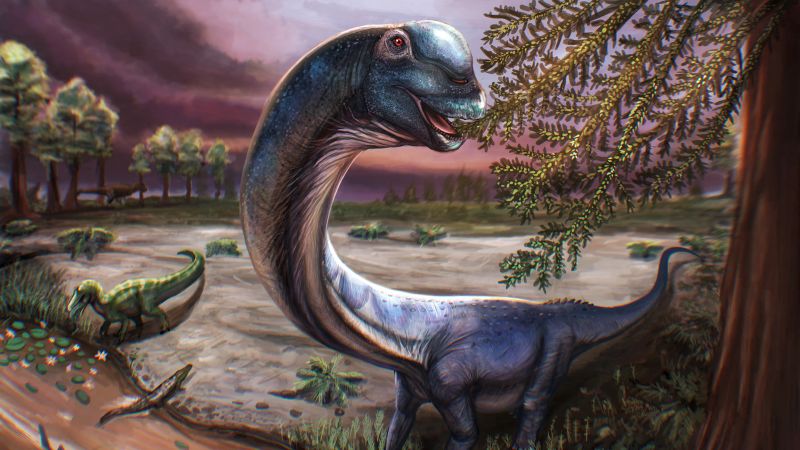
Unearthing a Giant: The Discovery of Nagatitan chaiyaphumensis
New species of giant dinosaur identified – A groundbreaking revelation in paleontology has emerged from a modest pond in northeastern Thailand, where a decade of careful investigation has unveiled the existence of a previously unknown dinosaur species. Dubbed *Nagatitan chaiyaphumensis*, this colossal creature is the biggest dinosaur ever unearthed in Southeast Asia, challenging prior assumptions about the region’s prehistoric biodiversity. The discovery, detailed in a study published in the journal *Scientific Reports* on Thursday, highlights the significance of fossil hunting in areas once thought to hold limited dinosaur remains.
A Name Rooted in Myth and Science
The dinosaur’s name, *Nagatitan chaiyaphumensis*, combines elements of cultural heritage and scientific nomenclature. “Naga” references the serpentine deities of South and Southeast Asian folklore, which are often tied to water—a fitting nod to the location of the find. “Titan,” meanwhile, alludes to the legendary giants of Greek mythology, underscoring the animal’s immense size. The *chaiyaphumensis* suffix honors the Thai province of Chaiyaphum, where the fossils were uncovered.
“Naming a dinosaur from Thailand fulfills a kind of childhood promise,” said Thitiwoot Sethapanichsakul, a paleontologist and lead author of the study. “I wanted to ensure it was a species that would reflect the country’s own ancient history.”
Dimensions That Defy Expectations
The newly identified species measures approximately 27 meters in length, or nearly 89 feet, and is estimated to have weighed around 27 metric tons—equivalent to roughly 60,000 pounds. For comparison, a large *Tyrannosaurus rex* typically ranges between 9,000 and 15,000 pounds, with a body length exceeding 12 meters. This makes *Nagatitan* not only larger than its T. rex counterparts but also a towering figure among sauropods, the group of herbivorous dinosaurs known for their elongated necks, lengthy tails, and massive, pillar-like legs.
Sauropods, which once dominated the landscapes of ancient Earth, included species like *Diplodocus* and *Brontosaurus*. These dinosaurs were characterized by their robust torsos, which housed enormous digestive systems adapted for processing vast quantities of plant matter. *Nagatitan* is described as roughly twice the size of another sauropod species found in Thailand, emphasizing its role as a prominent member of the region’s prehistoric fauna.
From Pond Edge to Scientific Breakthrough
The journey to identify *Nagatitan* began in 2016, when a local resident stumbled upon a massive leg bone near a communal pond in Chaiyaphum province. The dry season at the time had lowered water levels, exposing the fossil to discovery. Over the following years, a collaborative effort between researchers from University College London (UCL) and Thai institutions such as the Department of Mineral Resources, Mahasarakham University, and Suranaree University of Technology led to further excavations. These efforts spanned from 2016 to 2019, with additional work conducted in 2024 to complete the fossil analysis.
The team employed advanced 3D scanning technology to study the remains, which included leg bones, a spine, ribs, and the pelvis. These scans allowed for precise measurements and comparisons, revealing that the fossils belonged to a species never documented before. “We don’t have many specimens of this scale in Thailand,” Sethapanichsakul noted, recalling the moment he first saw the humerus. “It was taller than me, and that was quite a surprise.”
Ecological Context of a Prehistoric Giant
The *Nagatitan* is believed to have thrived during the late Early Cretaceous period, roughly 120 to 100 million years ago. This era was marked by a warm and arid climate, with ecosystems dominated by sprawling river systems and diverse aquatic life. The site where the dinosaur was found suggests it inhabited a region rich in freshwater habitats, teeming with fish, sharks, crocodiles, and turtles. Its coexistence with smaller herbivores, such as *Iguanodon* and early *Ceratopsians* (the ancestors of Triceratops), indicates a complex food web in the area.
Sethapanichsakul highlighted the unique geological conditions of Thailand that contributed to the preservation of such fossils. “The Mesozoic-era sedimentary rocks in our region are remarkably well-preserved,” he explained. “They are exposed to less rainfall and vegetation, which minimizes erosion and helps maintain the integrity of the bones.” This combination of environmental factors and tectonic activity has made Thailand a hotspot for dinosaur discoveries, with Sethapanichsakul asserting that the country holds some of the highest fossil diversity in Asia.
A Legacy of Exploration and Preservation
Following the discovery, a dedicated research center has been established at the site, facilitating ongoing studies of sauropods in Southeast Asia. Sethapanichsakul, who is currently pursuing his PhD at UCL, continues to work closely with Thai paleontologists to uncover more about the region’s prehistoric ecosystems. The center not only aids in analyzing existing fossils but also supports future excavations and conservation efforts.
The findings also contribute to broader debates about dinosaur evolution and distribution. While *Nagatitan* is a significant addition to the sauropod family, its discovery raises questions about how such large herbivores thrived in tropical environments. “It’s fascinating to see how these creatures adapted to their surroundings,” Sethapanichsakul remarked. “Their size suggests they had access to vast food sources, which aligns with the rich vegetation of the time.”
From Fossil to Exhibit: A Visual Story
To bring *Nagatitan* to life, a life-sized reconstruction has been unveiled at the Thainosaur Museum in Bangkok. This model allows visitors to grasp the sheer scale of the dinosaur, which would have been a dominant presence in its ancient habitat. The museum’s exhibit also includes contextual information about the Cretaceous period, the river systems where *Nagatitan* lived, and the other dinosaurs that coexisted with it.
Sethapanichsakul expressed pride in the project, noting that it represents a milestone for Thai paleontology. “This discovery is a testament to the potential of local researchers to lead global scientific breakthroughs,” he said. The name *Nagatitan*, he added, symbolizes both the cultural richness of the region and its geological legacy. “It’s a bridge between ancient myths and modern science, and I’m honored to have played a part in that connection.”
Implications for Dinosaur Research
The identification of *Nagatitan* has sparked renewed interest in Southeast Asia as a key region for uncovering prehistoric giants. Its existence challenges previous notions that sauropods were predominantly found in the Americas or Europe, suggesting a more widespread distribution. Researchers are now exploring how such large herbivores might have navigated their environments, given their long necks and tails, which likely served as tools for reaching high vegetation and balancing their massive bodies.
Additionally, the discovery provides insights into the climate and ecosystems of the late Early Cretaceous. The presence of freshwater species alongside the sauropod indicates a dynamic interaction between land and aquatic environments. As more fossils are unearthed, scientists hope to piece together a clearer picture of the region’s ancient biodiversity and the factors that shaped it. For Sethapanichsakul, this work represents more than just a scientific achievement—it’s a personal fulfillment of a lifelong dream.
Looking Ahead
With the establishment of the research center and the growing body of evidence from Thailand, the future of sauropod studies in the region appears promising. Sethapanichsakul and his colleagues plan to continue excavating the site, aiming to uncover more remains that could refine their understanding of *Nagatitan*’s behavior and physiology. The collaboration between international and local teams underscores the importance of cross-border efforts in paleontology.
Meanwhile, the Thainosaur Museum in Bangkok serves as a hub for public engagement with the discovery. The life-sized model of *Nagatitan* not only captivates visitors but also educates them about the ancient world. As the study’s findings gain attention, they may inspire a new wave of exploration and appreciation for Thailand’s hidden prehistoric treasures. The story of *Nagatitan* is far from over, and its legacy will undoubtedly shape the field of paleontology for years to come.
