New Facial Recognition Tool Expands Local Police Role in Immigration Enforcement
Some local police have access – The Department of Homeland Security has unveiled plans to equip local law enforcement agencies with advanced facial recognition technology, expanding their ability to identify immigrants during routine operations. This development follows a recent report revealing that federal immigration agents have long used the tool to locate individuals in the field. The new initiative would enable local officers, working under the federal agency’s authority, to access the same capabilities through a mobile application known as the ICE Task Force Module.
The Privacy Threshold Analysis
The proposal is detailed in a newly disclosed document titled a Privacy Threshold Analysis, a federal assessment designed to determine if a technology’s privacy risks justify deeper scrutiny. First reported by the tech news outlet 404 Media earlier this month, the report suggests that the app’s deployment is already underway, having launched in September. This raises questions about the extent of its current use and the potential for widespread application.
How the App Functions
The ICE Task Force Module allows law enforcement to capture facial scans of individuals they encounter in their communities. These scans are then matched against a database containing over 250 million records, including Visa information from the State Department and identity verification files from the Transportation Security Administration’s Traveler Verification Service. Once a match is found, the app provides officers with a reference code to retrieve additional details from ICE, or instructs them to proceed with detention or arrest.
The app’s design enables real-time processing, streamlining the identification process for local agencies. According to the document, facial images captured through the tool are retained in an internal DHS system for 15 years, raising concerns about data retention and long-term surveillance. While the agency has not provided detailed insights into the app’s operation, its statement emphasizes ICE’s commitment to empowering local partners in its broader deportation efforts.
Program Context and Legal Framework
The Task Force Module is part of the federal 287(g) program, which authorizes local police to enforce immigration laws on ICE’s behalf. This program, active in over 1,300 agencies nationwide, allows officers to detain individuals suspected of being undocumented during their regular duties. The new app’s integration into this framework could further enhance the program’s efficiency, though it also intensifies debates about the balance between security and civil liberties.
Expert Concerns and Questions
Clare Garvie, deputy director of the Technology Law and Policy Program at New York University School of Law’s Policing Project, noted that the analysis “raises more questions than I think it answers.” She highlighted uncertainties surrounding the app’s deployment, such as whether a prior suspicion of wrongdoing is necessary before using it. “Can they walk up to someone in a public space and take a photo as part of a dragnet effort?” Garvie questioned, underscoring the potential for broad, untargeted surveillance.
“It’s unclear to me whether a pre-existing stop based on some level of suspicion is required before law enforcement can use this app,” Garvie said. “Can they walk around taking photos of whoever as sort of a dragnet way to attempt to identify individuals who might be in the country unlawfully?”
Garvie also pointed to the app’s similarity to Mobile Fortify, a facial recognition tool already utilized by ICE and Customs and Border Protection officers. While the new app’s technology may differ, its functionality aligns with existing systems, prompting skepticism about its implications for privacy and oversight.
Surveillance in Action
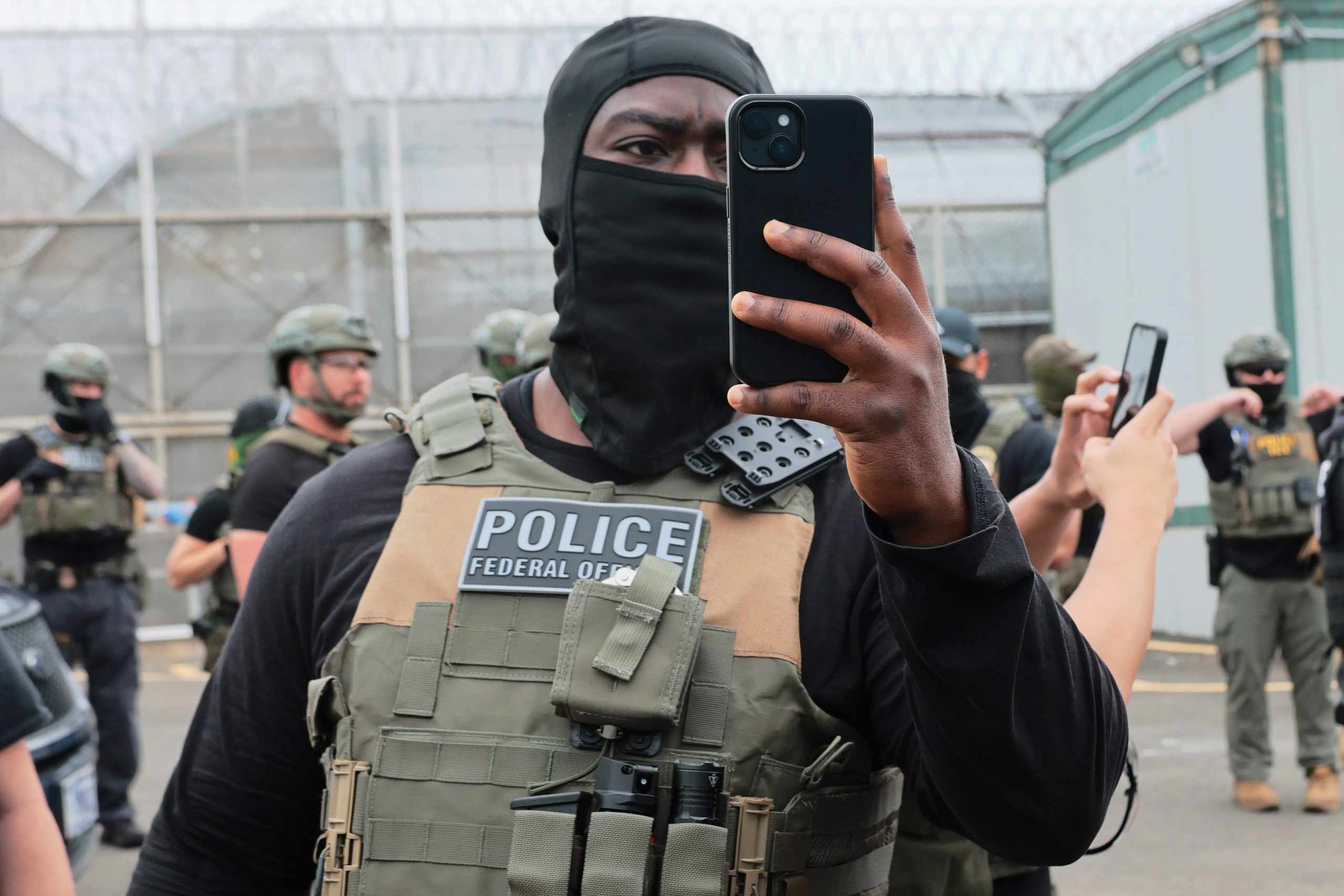
Reports from community members in states like Minnesota and Maine indicate that federal immigration officers have already engaged in facial recognition practices. These individuals described how officers would photograph faces and license plates during encounters, often with detailed knowledge of personal information such as names and addresses. Such actions suggest the potential for similar surveillance to occur at the local level, with implications for everyday citizens.
Chilling Effect on Free Speech
Privacy advocates warn that granting local police access to facial recognition tools could deter people from participating in public activities, including protests. Patrick Eddington, a senior fellow at the Cato Institute, described the situation as a “Bill of Rights disaster pretty much waiting to happen.” He argued that the scalability of the technology poses significant risks, as it could be used to monitor and identify individuals across vast networks of data.
“This kind of technology which can impact individual rights, when it’s scaled, it can have potentially very, very large effects affecting lots and lots of people,” Eddington said.
Homeland Security Secretary Markwayne Mullin confirmed at a congressional hearing this month that facial recognition has been used to track protesters. His agency has reportedly identified individuals present at protests in Oregon who also attended demonstrations near the Delaney Hall Detention Facility in Newark, N.J. This example illustrates the app’s potential to link public participation with immigration status, even in non-English-speaking contexts.
Accuracy and Fairness Issues
Garvie also emphasized concerns about the app’s accuracy, citing instances where individuals were wrongly identified by ICE. “Facial recognition is not always reliable,” she said, noting that errors could lead to unjust detentions. The lack of transparency in the app’s operation and data handling further complicates efforts to address these issues, leaving room for potential bias or misuse.
As local police agencies adopt this technology, questions remain about training, oversight, and the safeguards in place to prevent overreach. The app’s integration into daily policing could create a new layer of surveillance, where individuals are scanned without explicit consent, raising ethical and legal challenges for the system.