Archaeologists find huge Viking textile production site in Denmark

Archaeologists Uncover Massive Viking Textile Production Site in Denmark
Archaeologists find huge Viking textile production – Located in Søften, a village on the Jutland peninsula, a groundbreaking discovery has revealed a sprawling Viking Age textile production site that dates back over a millennium. This site, situated 10 kilometers north of Aarhus, Denmark’s second-largest city, provides new insights into the complex organization of Viking society, highlighting their advanced economic systems and craftsmanship.
Key Findings and Site Structure
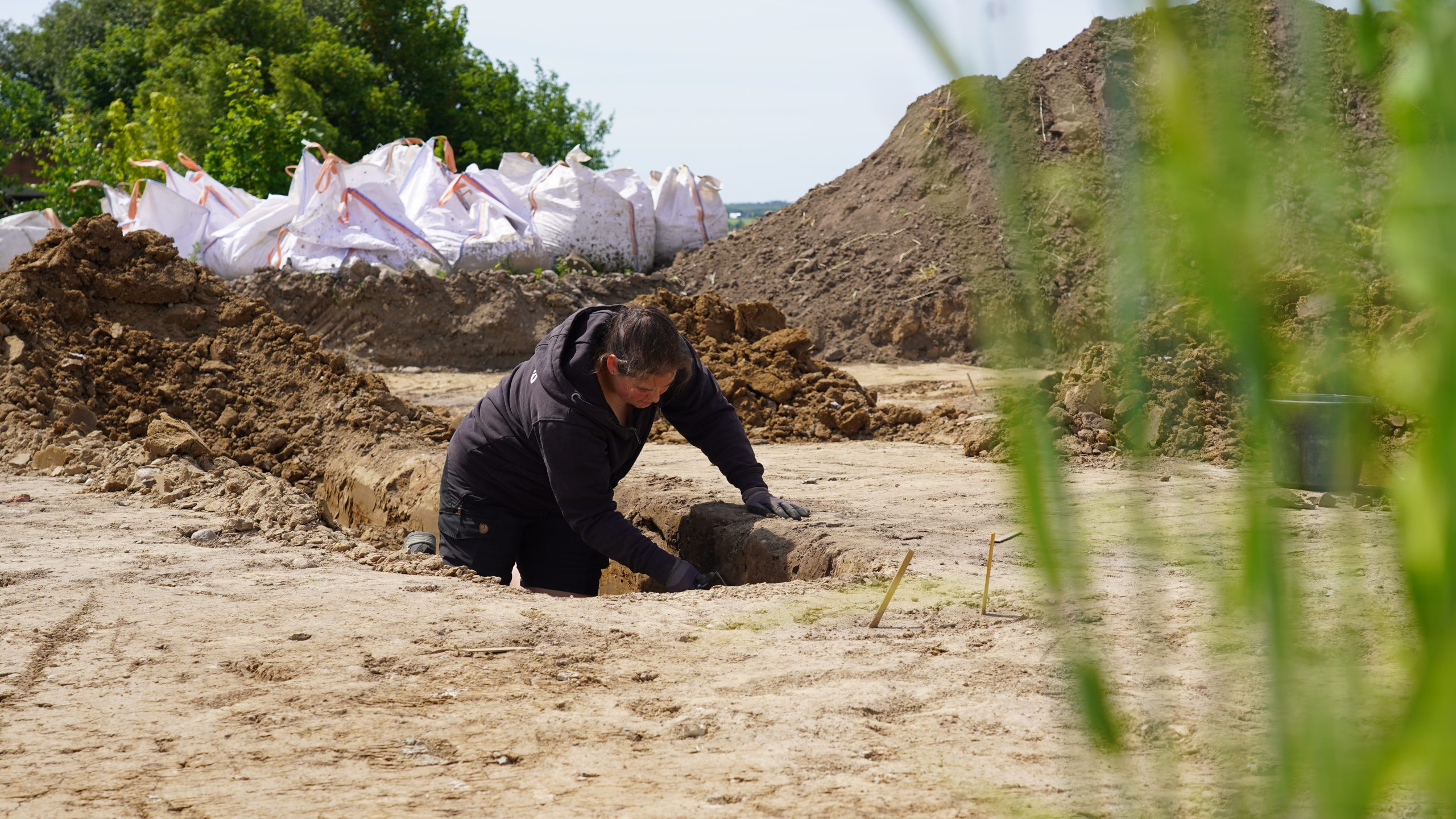
The excavation, led by experts from the Moesgaard Museum, uncovered a remarkable settlement spanning 100,000 square meters—equivalent to more than a million square feet. Among the site’s features, archaeologists identified areas dedicated to processing flax, a crucial raw material for textiles, as well as over 80 pit houses. These semisubmerged structures served dual purposes, functioning both as workshops and living quarters for the community. The scale of the site suggests a high level of specialization and coordination, indicating that textile production was a significant industry in the region.
“This settlement stands out because of its clear emphasis on textile manufacturing,” explained Liv Stidsing Reher-Langberg, the lead archaeologist on the 10-month dig. “Unlike other Viking-era settlements, the layout and artifacts here point to a structured focus on producing goods for trade or export.”
Reher-Langberg emphasized that the presence of tools such as spindle whorls and weight looms within the pit houses underscores the site’s role as a center for weaving and fabric production. These tools, often associated with domestic crafts, hint at both the technical expertise and the systematic approach of the artisans. Additionally, the discovery of silver coins, glass beads, and pottery adds a layer of economic activity, suggesting connections beyond the local area.
Historical Context and Strategic Location
The site’s origins trace back to the late Iron Age and early Viking Age, a period spanning from around A.D. 600 to 950. During this time, the Jutland region was a hub of activity, with Søften’s proximity to Aarhus likely enhancing its strategic importance. Aarhus, known historically as Aros, was a key center for royal power and international trade, and the Søften settlement may have played a vital role in supporting these networks.
Reher-Langberg noted that the site’s location near Aarhus aligns with the broader historical context of the area. “The discovery of this production center is significant because it reflects the interconnectedness of local and regional economies during the Viking era,” she added. “It’s not just a place for daily living; it’s part of a larger system that involved resource management and trade.”
Organized Society and Economic Networks
Experts believe the settlement’s design reveals a highly organized society. The presence of distinct zones for production and crafts, alongside a single residential home, implies that the site was overseen by a central authority figure. This individual may have managed resources, coordinated labor, and ensured the efficient flow of goods to external markets. Such a structure suggests that the Vikings were not merely raiders or nomadic groups, but a society with established hierarchies and economic planning.
“The organization of this site speaks to the sophistication of Viking communities,” said Kasper Andersen, a historian at the Moesgaard Museum. “Having separate areas for production and living, along with evidence of long-distance trade, shows they were deeply integrated into regional and international networks.”
Andersen highlighted the broader implications of the find, noting that the textiles from Søften likely entered an extensive trade system. “This site is a critical piece in understanding how Viking society functioned economically and politically,” he stated. “Textiles were a valuable commodity, and their production required not only skilled labor but also access to raw materials and markets.”
Excavation Insights and Future Research
The discovery of the site was initially sparked by a trial excavation conducted 1.5 years ago, prior to the construction of a new road and industrial area. Archaeologists observed that the settlement extended far beyond the initial trenches, prompting further investigation. “The site just keeps expanding,” Reher-Langberg said. “It’s clear that this was a major center of activity, and we’re only beginning to uncover its full scope.”
Over the past three decades, metal detector enthusiasts in the region had already uncovered several silver coins, hinting at the site’s economic significance. These coins, often used as currency, suggest that the Vikings engaged in trade with distant regions, possibly even across the North Sea. The presence of glass beads and pottery further supports the idea that goods were exchanged with other cultures, enriching the site’s historical narrative.
“We’ve found tools and artifacts that tell a story of both local craftsmanship and external trade,” Reher-Langberg said. “This isn’t just a village; it’s a node in a larger economic web that connected Viking communities to broader markets.”
Future research, including carbon dating and pollen analysis, aims to refine the timeline of the site’s activity and clarify its role in the Viking economy. “These techniques could reveal more about the types of textiles produced here and how they were distributed,” she noted. “Understanding the scale and specialization of this production will help us map the Viking trade networks more accurately.”
Reassessing Viking Society
Andersen’s remarks challenge traditional perceptions of the Vikings as a simple, barbaric people. “The evidence from Søften shows that they had a complex, organized society capable of large-scale production,” he said. “This site is a testament to their ability to manage resources, create goods, and participate in international trade.”
The Viking Age, traditionally dated from A.D. 793 to 1066, was marked by both conquest and commerce. Søften’s textile production site exemplifies the Vikings’ adaptability and innovation, as they transitioned from raiders to traders and settlers. The site’s scale and the variety of artifacts found indicate that it was a thriving center of activity, contributing to the region’s economic and cultural landscape.
Archaeologists have also found a nearby Viking site in Lisbjerg, just 4 kilometers away, which is believed to have housed nobility. This proximity suggests a collaborative relationship between the two settlements, with Lisbjerg possibly serving as a distribution hub for goods like those produced in Søften. Such findings reinforce the idea that Viking communities were interconnected, with specialized roles and shared resources.
As the excavation continues, the Søften site offers a unique window into the daily lives and economic systems of the Vikings. The combination of flax processing, specialized workshops, and trade artifacts paints a picture of a society that was both industrious and expansive in its influence. This discovery not only enriches our understanding of Viking life but also underscores the importance of Denmark as a key player in the medieval trade networks of Europe.
Reher-Langberg’s work at Søften is part of a growing body of evidence that reshapes how we view Viking culture. “This site challenges the old notion of Vikings as isolated warriors,” she said. “It shows that they were part of