Daftar Isi
Where Machines Meet Imagination: Inside Dataland
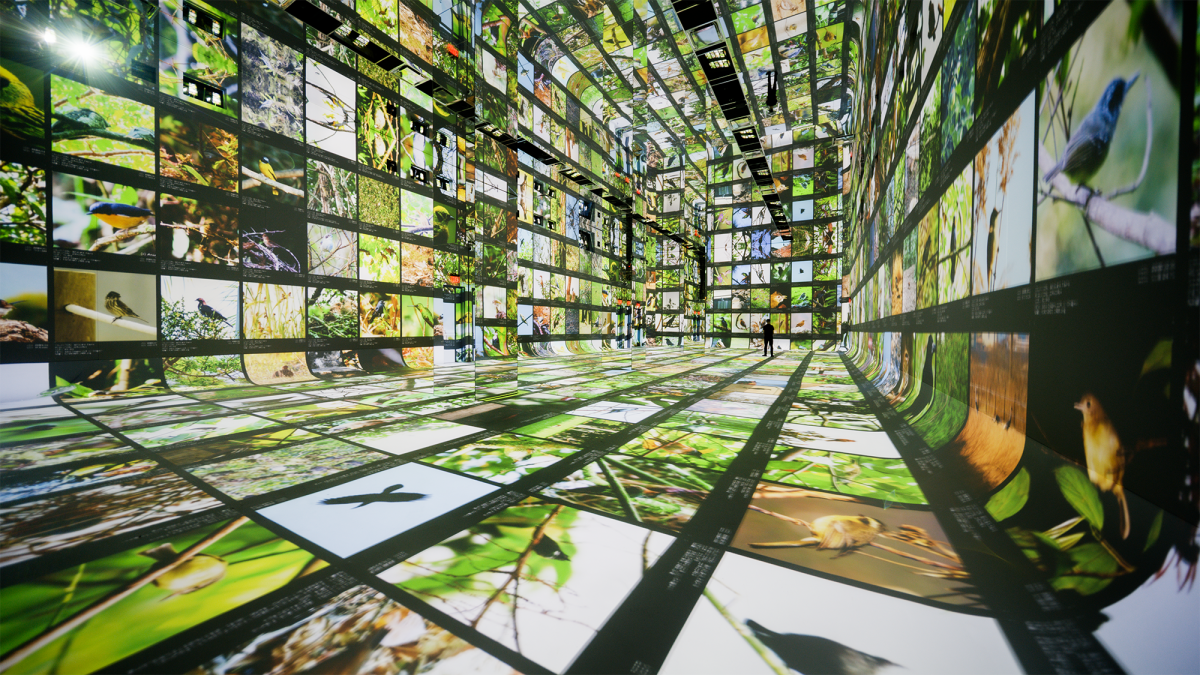
Ecorescuezone.com – Stepping through the doors of Dataland in downtown Los Angeles feels less like entering a traditional gallery and more like wandering into a vivid dreamscape that exists somewhere between waking life and pure fantasy. The space envelops visitors in darkness, creating cavernous environments where sound becomes as tangible as sight. As you navigate these shadowy corridors, the air fills with the calls of Amazonian wildlife, the rumble of tropical storms, and haunting passages from Mahler’s Third Symphony performed by the Los Angeles Philharmonic.
Each room offers something entirely different. One chamber transforms visitors into hummingbirds soaring through kaleidoscopic forests. Another presents a colossal three-dimensional canvas where abstract forms burst beyond their boundaries, reacting instantaneously to biometric information collected from wrist-worn sensors. The experience extends beyond vision and hearing—Dataland engages smell and taste as well, creating what can only be described as complete sensory immersion.
A Singular Vision Realized
While no two journeys through Dataland unfold identically, every visitor encounters the unmistakable imprint of Refik Anadol. This forty-year-old artist, now rooted in Los Angeles but born in Istanbul, has dedicated ten years to harnessing artificial intelligence for transforming enormous datasets into spectacular multidimensional works combining light, sound, and movement.
Anadol describes his creation as “the world’s first museum of AI arts,” a title he earned through years of experimentation. For Dataland, he trained a custom neural network using visual and auditory materials drawn from museum collections, research laboratories, and his personal expeditions to Brazil’s Amazon region. The system then generated particular scenarios, including the ethereal narrative experienced through the hummingbird’s perspective.
“Every artist in their practice has their own heavy question,” Anadol explained during a conversation with NPR at the museum he established alongside his partner Efsun Erkılıç. “My heavy question is: What is beyond reality?”
This philosophical inquiry traces back to his childhood in Istanbul, when he first encountered computers through games on a Commodore 64 and watched Ridley Scott’s science fiction classic Blade Runner. A single line from that 1982 film resonated deeply: Harrison Ford’s character Deckard tells Rachael, portrayed by Sean Young, “Implants. Those aren’t your memories. They’re somebody else’s.” The revelation—that machines might process human recollections—never left Anadol’s mind.
Football, Data, and Dreams
That fascination with memory and technology found new expression through his collaboration with Lionel Messi. Last summer in New York, the Argentinian soccer legend partnered with the bespectacled, cherubic-faced artist to create an immersive installation. Using game footage, biometric measurements, and motion-capture technology, they reconstructed Messi’s recollection of scoring what became a defining moment in 2009.
The resulting room-sized artwork surrounded visitors with a swirling fantasy of bouncing spheres, transforming nets, and frozen moments of athletic brilliance. It functioned as an interior journey through the athlete’s consciousness. “Growing up in Istanbul, football is in the DNA,” Anadol reflected. “But I didn’t know I would one day work with Messi.”
Anadol has achieved celebrity status comparable to Messi within contemporary art circles. His installations have graced the Grammy Awards ceremony. Time Magazine recognized him on their 2025 roster of one hundred most influential figures in artificial intelligence. His 2022-2023 piece titled “Unsupervised” holds the distinction of being the first artwork generated entirely by AI to enter the permanent collection at New York’s Museum of Modern Art.
Art in the Age of Capitalism
Not everyone embraces Anadol’s technological approach. New York magazine’s Jerry Saltz dismissed “Unsupervised” as merely “a glorified lava lamp.” Critics also question his close ties to technology giants like Nvidia and Google, alongside his utilization of freely accessible archival materials from institutions such as The Smithsonian and Oxford University to develop the AI systems powering his commercial ventures. Dataland charges standard admission beginning at forty-nine dollars.
“To me, it’s like the perfect picture of art in late capitalism,” observed artist and researcher Deniz Johns, who co-wrote a 2025 book chapter examining Anadol’s contributions.
Anadol defends his methods, noting that his studio makes models available to everyone at no cost and pointing out that contemporary artists have always maintained relationships with wealthy supporters. “Let’s go six centuries back to the Renaissance,” he argued. “When art has breakthroughs, there’s always a patron.”
Amit Sood, vice president at Google and founder of Google Arts & Culture, offers a different perspective. “His ideas are pleasingly bonkers,” Sood remarked, noting that Google has backed Anadol’s creative endeavors for approximately ten years. Through this enduring partnership, Anadol’s studio continues to push boundaries, proving that machines are indeed collaborators in the artistic process.
Related Reading
Frequently Asked Questions
What is Machines are collaborators at this new museum?
Machines are collaborators at this new museum is the main topic of this guide. The article explains the context, practical details, and next steps readers should understand.
Why does Machines are collaborators at this new museum matter?
Machines are collaborators at this new museum matters because readers are looking for a useful answer, not just a short summary. Good content should match search intent and help them decide what to do next.