The Taliban has taken a terrible toll on the education of girls — and boys as well

Taliban’s Hidden Toll on Afghan Boys’ Education
Ecorescuezone.com – The Taliban has taken a terrible toll on education in Afghanistan, though most attention focuses on girls. For Hashmat Mubariz, the classroom gradually transformed from a space of intellectual curiosity into an environment where learning felt disconnected from purpose. By the time he reached Grade 11, regular attendance had become a struggle, even though official enrollment remained intact. While the Taliban’s most visible restrictions targeted girls—barring them from secondary education entirely—Mubariz discovered that boys faced their own form of educational displacement.
“I felt I was wasting my time at school rather than learning,” he said.
Before the Taliban’s return to power on August 15, 2021, Mubariz’s public school represented something distinctly different. Students engaged with English, science, mathematics, biology, and literature alongside religious coursework. The classroom atmosphere encouraged dialogue—students spoke freely, shared perspectives, and asked questions without hesitation. It was not flawless, but it provided a sense of safety and educational purpose.
Now 19 years old, Mubariz observes how that atmosphere eroded incrementally. He has since taught himself English, taken on a role as an English instructor, hosts a podcast, and assists in managing a nongovernmental organization. His journey reflects both personal resilience and the broader transformation occurring within Afghan education.
More Than Just Girls’ Education
International attention has focused heavily on the Taliban’s restrictions affecting females—secondary school bans for girls and university prohibitions for women have captured global headlines. Yet interviews with young males across Afghanistan reveal a parallel crisis that receives far less scrutiny.
“Many people believe that only girls’ education is affected,” Mubariz said. “But boys are also facing a serious education crisis.”
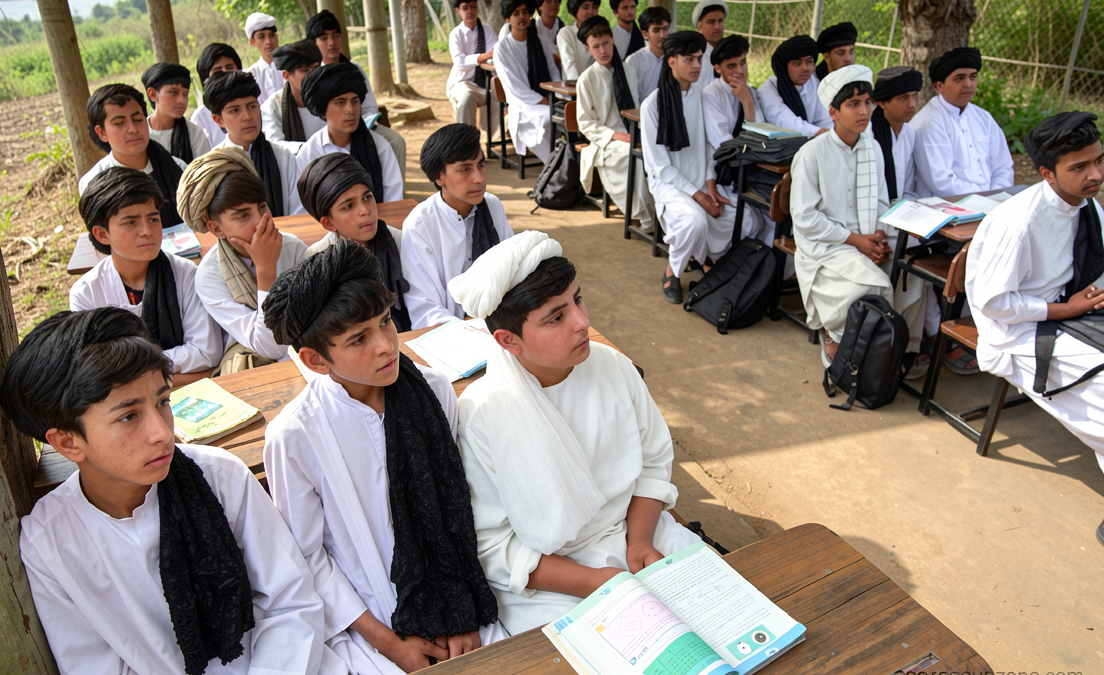
Boys remain permitted to attend school, but the quality and direction of education has shifted dramatically. Students report diminished emphasis on scientific disciplines, foreign languages including English and Persian, and civic studies. Meanwhile, religious instruction has expanded beyond dedicated Islamic studies classes into nearly every subject area.
Teachers of mathematics, science, and English now incorporate Quranic verses, prophetic traditions, and religious messages into their lessons. This integration has fundamentally altered how students engage with secular knowledge.
“Religion became part of almost every class,” he said.
Geographic Variations and Deepening Pressures
Research conducted across seven Afghan cities—Kabul, Herat, Helmand, Ghazni, Ghor, Mazar-e-Sharif, and Bamiyan—revealed consistent patterns among 15 middle and high school students. However, the intensity of change varied by region. Southern provinces, particularly Helmand and Kandahar, experienced more pronounced shifts. These areas already maintained stronger traditions of religious education, and Taliban governance has amplified those existing cultural priorities.
Physical changes appeared first. Male educators received directives to grow longer beards and adopt traditional turbans and clothing. Students followed suit, adhering to new appearance standards that reflected Taliban expectations.
The Madrasa Expansion
For countless Afghan children, especially in regions with limited public school access, madrasas represent the primary—or sometimes only—educational option. Under Taliban administration, religious education has ascended to central importance while modern schools have received comparatively minimal attention.
The Taliban’s Ministry of Education reports overseeing 22,972 religious education centers, a substantial increase from approximately 5,000 registered under the previous government. However, this figure requires nuance. The Afghanistan Human Rights Center indicates that only 316 centers were newly constructed during this period. The majority represent existing institutions incorporated into the Taliban’s educational framework. In contrast, the ministry acknowledges establishing just 269 new modern schools over the same timeframe.
Generational Implications
Shabana Basij-Rasikh, an Afghan educator and co-founder of the School of Leadership Afghanistan (SOLAx), emphasizes that evaluating boys’ educational decline requires looking beyond curriculum changes alone.
Young males are absorbing lessons from a society where girls disappear from classrooms after sixth grade and women face increasing exclusion from public life. Her primary concern centers on younger boys who possess no recollection of Afghanistan prior to the Taliban’s return.
“Their only normal is not seeing girls in school. Their only normal is not seeing women in universities or workplaces,” Basij-Rasikh noted.
Looking Forward
The challenges facing Afghan boys extend beyond classroom walls. Economic pressures, limited career pathways, and evolving social expectations create additional burdens for young men navigating this transformed landscape. Without intervention, experts warn that a generation may emerge with narrower worldviews and fewer opportunities.
As international organizations continue monitoring the situation, the full scope of what the Taliban has taken from Afghan education—both for girls and boys—remains to be understood. The story of Afghan education is still being written, and its chapters will shape the country’s future for decades to come.
Frequently Asked Questions
How has boys’ education changed under the Taliban?
Boys can still attend school, but the curriculum has shifted toward religious instruction. Scientific disciplines, foreign languages, and civic studies have received less emphasis, while religious content now appears in nearly every subject area.
What regions are most affected?
Southern provinces like Helmand and Kandahar show more pronounced changes due to stronger pre-existing religious education traditions that Taliban governance has amplified.
How many madrasas exist now versus before?
The Taliban’s Ministry of Education oversees 22,972 religious education centers compared to approximately 5,000 under the previous government, though only 316 were newly built.
What concerns do experts have for boys?
Educators worry that younger boys growing up without seeing girls in schools or women in public life may develop narrower perspectives and fewer opportunities in the future.