As wildfires get worse, some states are struggling to pass fire protection rules

Daftar Isi
Western States Face a Patchwork Problem as Wildfire Rules Stall in Legislatures
Ecorescuezone.com – Across the American West, homeowners are left to figure out their own wildfire survival playbook because statehouses have repeatedly failed to enact comprehensive fire-protection mandates. Unlike flooding, where the federal government publishes national inundation maps and sets uniform standards, wildfire regulation falls squarely to state and local authorities. The consequence is a fragmented landscape of rules — or, more often, the absence of rules — that leaves millions of residents in high-burn zones without clear guidance on how to shield their homes from ember-driven flames.
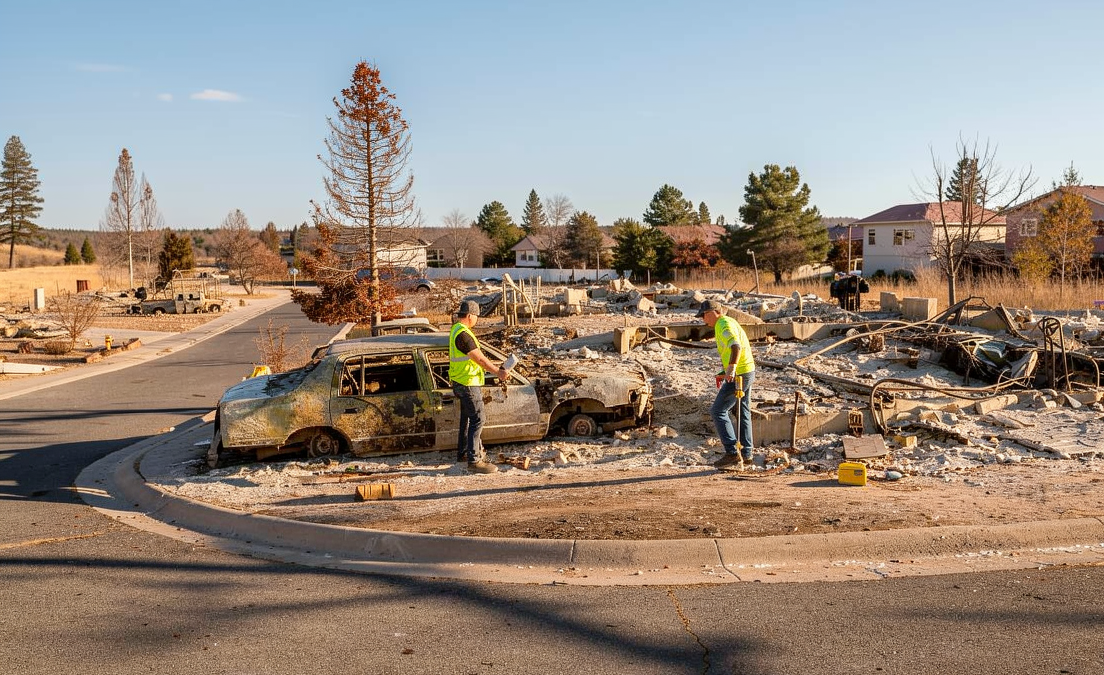
The gap became painfully visible in Spokane, Washington, in August of this year, when two separate wildfires swept through neighborhoods that many residents had long assumed were immune to fire. More than 800 homes and structures were destroyed in the event. The city had endured a drought following a winter of below-average precipitation, and forecasters had warned in the days before ignition about a volatile combination of gusty winds, near-zero humidity, and soaring temperatures. The result was a rapid, ember-fueled advance through residential areas that caught many residents off guard.
A Homeowner’s Hard-Won Lesson
Dave Kokot, a longtime fire protection engineer with the Spokane Fire Department, watched both fires approach his own property. He and his family gathered keepsakes and prepared to evacuate, though his anxiety centered less on the structure itself than on the uncertainty of what the flames would do to it.
“You don’t know how the house would go through a fire, but I think ours would have done fine,” Kokot says.
That confidence was earned through deliberate preparation. The siding on his home is composed of fire-resistant materials rather than untreated wood. He had cleared flammable vegetation along the property’s perimeter and ensured that overhanging tree limbs did not contact the structure. Decades of research confirm that such measures reduce the likelihood that wind-carried embers — the primary vector by which wildfires leap from tree to tree and into neighborhoods during extreme conditions — will ignite a dwelling.
Kokot’s career has been spent thinking through exactly these questions. In recent years he has lobbied Washington state regulators to make the precautions he took voluntarily into mandatory requirements for residents living in mapped high-risk zones.
Years of Regulatory Back-and-Forth
Washington has been drafting wildfire-safety regulations for several years, covering building codes for new construction in hazard areas and rules governing vegetation management around existing homes. Yet mandates that reach into people’s yards and gardens tend to generate political friction. After sustained public pushback, state legislators walked back portions of the proposed requirements and repealed certain provisions.
The pattern is not unique to Washington. Multiple Western states have experienced similar legislative gridlock over wildfire rules that touch private property. The absence of a federal backstop means each jurisdiction interprets risk differently, producing what one land-use analyst describes as a deeply inconsistent regulatory environment.
“It’s up to the political will of a community to adopt a building code to address wildfire,” says Ryan Maye Handy, who works on community wildfire planning at Headwaters Economics, a land-use think tank. “What we’re increasingly seeing is many different interpretations of how to reduce that risk. It is literally all over the map.”
The 2023 Hearings and Conservation Pushback
In 2023, Washington building-code officials opened a public comment period on the state’s newly drafted wildfire hazard maps and associated regulations. Under the proposed framework, homes newly constructed in mapped at-risk areas would have been required to incorporate fire-resistant roofing, siding, and other protective measures. Existing homeowners would additionally have been obligated to manage flammable vegetation to create what fire scientists call “defensible space” — for example, keeping tree branches at least ten feet away from any structure.
A series of public hearings produced organized opposition. Conservation organizations argued that mandatory vegetation clearing would conflict with regional goals to expand the urban tree canopy and provide shade that mitigates heat-wave impacts on buildings. Other commenters contended that the hazard maps were drawn too broadly and did not accurately reflect localized fire probability.
“Our greatest concern at Audubon is preserving bird habitat,” testified Eric Seibel on behalf of the Tahoma Audubon Society, a wildlife conservation group now operating as the Tahoma Bird Alliance. “I’m concerned that trees, which are our best defense against climate change, will be destroyed en masse if the provisions of the code pass.”
The 2024 Compromise and Its Consequences
By 2024, Washington enacted a bill directing state regulators to produce revised wildfire hazard maps while scaling back the number of rules that would carry enforcement teeth. New construction would still be required to use fire-resistant roofing and siding, but the vegetation-management obligation for existing homeowners was dropped entirely.
“That got the fire service pretty concerned, because that’s our primary protection,” Kokot says.
Firefighters consistently report that reduced vegetation immediately surrounding a burning structure makes structural defense safer and more effective. Without that buffer, crews face denser fuel loads, faster ember showers, and shorter reaction windows — conditions that elevate risk for both responders and neighbors.
Why the Gap Matters
The broader implication is that Western communities are entering an era of longer, hotter fire seasons without a coherent regulatory floor. Federal flood maps give homeowners a shared baseline; no equivalent exists for wildfire. States that rely on complex computer models to estimate ignition probability from vegetation type, slope, and historical fire behavior produce maps that are inherently uncertain and politically contestable. When those maps then become the basis for mandatory yard rules, the resulting hearings attract every constituency with a stake in trees, shade, aesthetics, and property rights.
The result is a cycle: regulators propose, communities object, legislatures retreat, and the next fire season arrives with fewer protections in place. For homeowners like Kokot, the practical advice remains unchanged — clear the perimeter, choose fire-resistant materials, keep branches away from the roofline — but the question of whether those steps will be required, recommended, or left entirely to individual judgment continues to shift with each legislative session.
Related Reading
Frequently Asked Questions
What is As wildfires get worse some states?
As wildfires get worse some states is the main topic of this guide. The article explains the context, practical details, and next steps readers should understand.
Why does As wildfires get worse some states matter?
As wildfires get worse some states matters because readers are looking for a useful answer, not just a short summary. Good content should match search intent and help them decide what to do next.