In Portland, this soap box derby combines downhill speed with extreme pageantry

Portland’s Soap Box Derby: Speed, Pageantry, and Chaos
Ecorescuezone.com – In Portland this soap box derby transforms a hillside in southeast Portland into something between a racetrack, a sculpture garden, and a neighborhood block party every August. The 27th annual edition of the event drew thousands of spectators to Mt. Tabor Park to watch 42 hand-built vehicles thunder down the flank of an extinct volcano. The spectacle blends engineering, theater, and communal celebration, and organizers report that attendance has climbed steadily year after year.
A Century-Old Tradition, Reimagined
The impulse to build a wheeled contraption and let gravity do the work stretches back further than most Americans realize. Charlie Chaplin appeared in a 1914 short called Kid Auto Races in Venice, one of his earliest screen roles, in which children raced gravity-powered carts. The activity was also colloquially dubbed a “pushmobile” race in its earliest incarnations. What crystallized the pastime into a distinctly American competition, however, was the launch of a national event in Ohio during the 1930s. That Ohio venue still hosts the World Championships today.
By midcentury, the hobby had migrated into popular television. Episodes of Dennis the Menace, Bewitched, and The Danny Thomas Show all featured racing segments, embedding the image of a kid or adult careening down a hill in a homemade cart into the cultural lexicon.
From Streamlined Speed to Spectacle
The original engineering brief for a derby car was aerodynamic efficiency: sleek, streamlined bodies designed to shed drag. Over decades, builders pushed the technical envelope further — fiberglass shells, titanium bushings, and other refinements that produced genuinely startling velocities. The local event, by contrast, deliberately tilts the balance away from pure speed and toward creative expression. Most of the 42 entries that lined up on Saturday were built to maximize whimsy rather than terminal velocity.
This year’s field included a car shaped like a giant sloth head, a zamboni themed around the NBA’s “Heated Rivalry” marketing campaign and christened “The Ice Melter,” a full-scale replica of the flying car from The Flintstones, and a vehicle depicting Oregon’s infamous exploded dead whale that washed ashore in 2021. Other shapes ranged from a giant athletic sock to a deep-sea anglerfish.
Rules, Materials, and the Builders
The competition enforces a short list of safety requirements: helmets, pre-event safety training, and functional brakes. Beyond those mandates, construction is essentially unconstrained. Builders work in wood, metal, and plastic, and finish surfaces run the gamut from faux fur to hot-glued mirror tiles. The result is a fleet of vehicles that look like they escaped from a fever dream.
John Nurse spent weeks converting the chassis of a 1979 Honda Odyssey ATV into a dragon, using hula hoops for the frame and spray insulation foam for the scales. The design brief came from his 10-year-old, who sketched the creature and handed the drawing over.
“My kid drew a picture, and then it was up to me to figure out how to build it,” Nurse said. “How many times do you get to race a dragon down a volcano?”
The volcano reference is literal. Mt. Tabor, the park where the race takes place, is the remnant of a long-dormant volcanic cone. The hillside provides a natural gradient that requires no artificial ramp or launch mechanism.
A Community Event Run Entirely by Volunteers
David Paulsen, who serves as president of the organizing nonprofit, first attended the event in 1997 and was immediately converted. He has since described the spectacle in terms that capture its chaotic charm:
“I saw it, and I knew that they were my kindred spirits.”
Paulsen characterizes the whole affair as “booger-welded garbage cars racing down a mountain” — a phrase that has become something of a motto for the organization. Every operational task, from clearing brush off the course before race day to hauling away trash afterward, is handled by volunteers. No paid staff manage the event.
Spectators arrive hours before the first car launches. They bring folding chairs, spread blankets across the grass, and settle in for what amounts to a multi-hour outdoor festival. Organizers note that crowd sizes have climbed steadily over the event’s 27-year run.
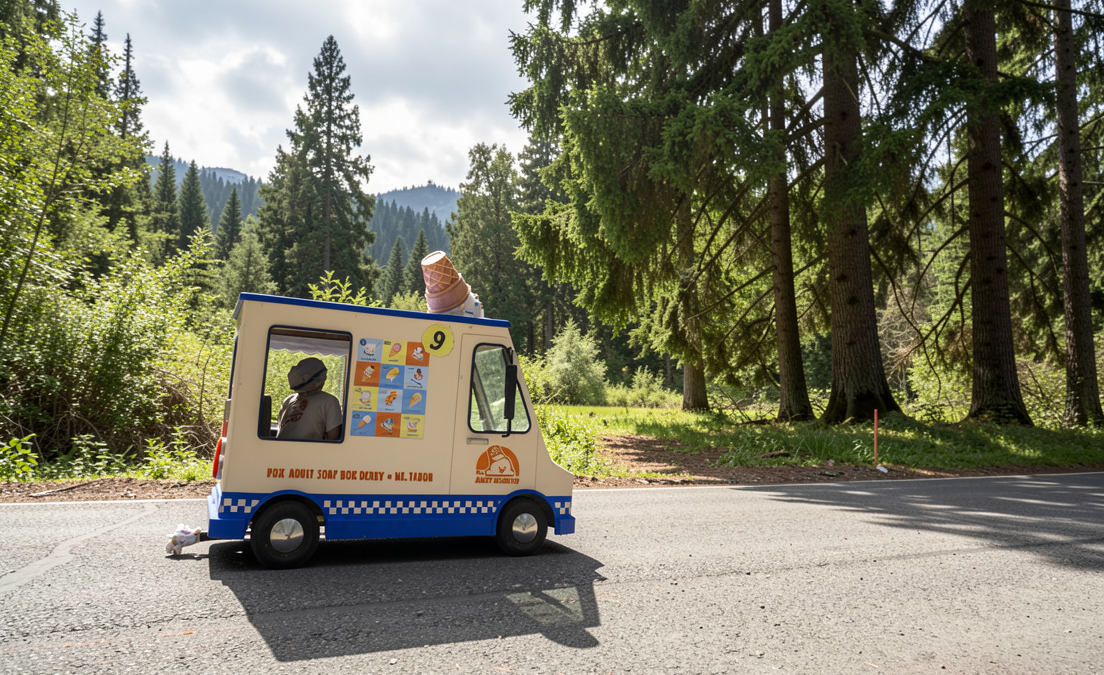
“It’s always so much fun,” said Brittany England, who built a vehicle called the Rocky Roadster, styled as an ice cream truck. “There’s so many people, the vibes are great, the energy’s awesome.”
FAQ: Practical Details for Spectators
Where and when does the event take place? The race runs on the slopes of Mt. Tabor Park in southeast Portland, Oregon, typically in August. Gates open well before the first launch so attendees can claim a spot on the grass.
Is admission free? The event operates as a nonprofit and has historically been free to attend. All operations are volunteer-run, so donations at the gate help cover course preparation and cleanup.
Can I bring my own vehicle to race? Entries are limited and require advance registration through the organizing body. Builders must complete a pre-event safety training session and demonstrate functional brakes before their car is cleared for the course.
What should spectators bring? Folding chairs, blankets, sunscreen, and water are standard. The event runs several hours, and the hillside offers limited shade, so planning for a full afternoon outdoors is advisable.