Striking hospital employees sound alarm over workplace violence

Daftar Isi
Healthcare Workers Walk Out as Violence on Hospital Floors Reaches a Breaking Point
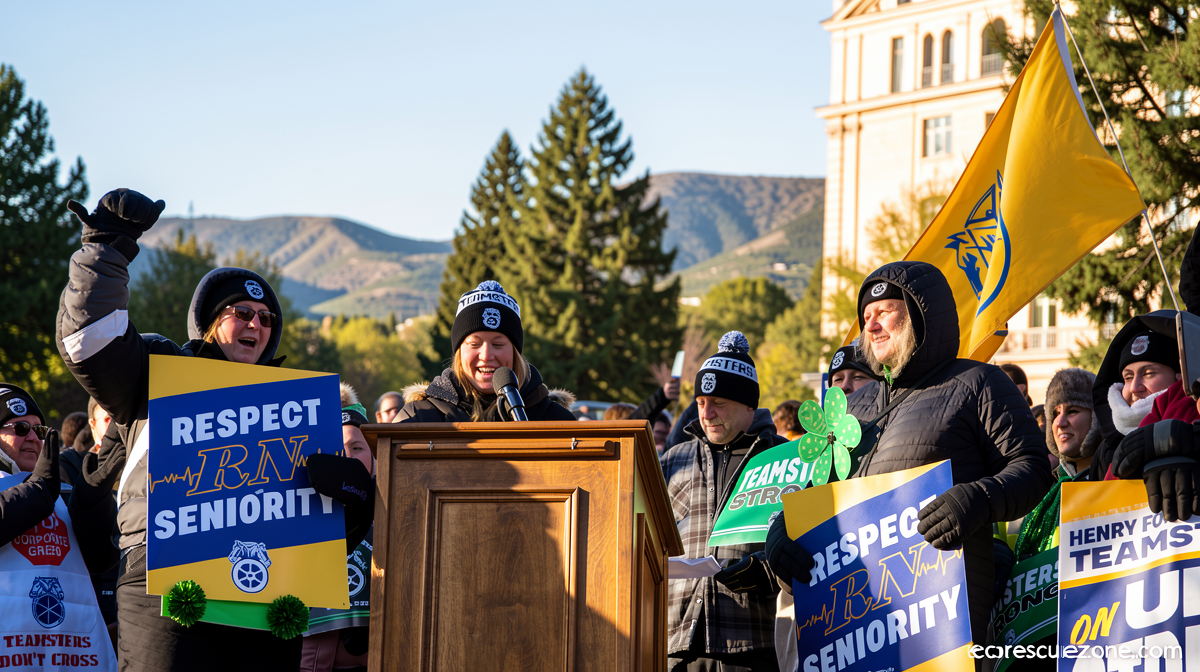
Ecorescuezone.com – Across at least five states — Louisiana, New York, Pennsylvania, Rhode Island, and Michigan — hospital employees have taken to the picket line, demanding that employers finally treat workplace violence as the systemic crisis it has become. The most recent Bureau of Labor Statistics data shows that hospital workers are seven times more likely to sustain a job-related injury from a violent act than members of the general working population. For many of those workers, the statistics are no longer abstract; they are a daily reality measured in bruises, fractures, and concussions.
A Nurse’s View from the Picket Line
Crystal Dhooghe, a nurse at Henry Ford Genesys Hospital in Grand Blanc, Michigan, has spent her career managing blood, shattered bones, and the chaos of the emergency department. What she did not anticipate was watching colleagues become the targets of that chaos.
“I’ve seen nurses get shoved, pushed, scratched. The biggest one is bitten.”
Dhooghe and a large cohort of her coworkers have been striking since Labor Day of last year. She survives on strike benefits plus extra shifts at a separate hospital, a precarious arrangement that underscores how thin the safety net has become for unionized healthcare workers in active disputes.
“People will question me and be like, ‘Why are you still working in a place if you’re treated like this?'”
Her answer is blunt: the alternative is no safer. Other facilities, she says, offer the same conditions under different signage.
The Institutional Response
Hospital administrators are not unaware of the problem. In a written statement, Henry Ford spokesperson Dana Jay described violence against healthcare workers as a “national epidemic” and outlined measures already in place: metal detectors at entry points, armed security officers trained to make misdemeanor arrests, and de-escalation training for clinical staff.
“We have zero tolerance for violence of any kind,” Jay wrote, characterizing the walkout as “simply an economic strike” rather than a safety action.
That framing — economic grievance versus safety grievance — has become a recurring fault line in labor disputes across the sector. Workers argue that understaffing, inadequate training, and cost-cutting pressures create the conditions in which violence flourishes. Operators counter that they are investing in physical security infrastructure. Both sides, in effect, are describing different layers of the same problem.
When the ER Becomes a Powder Keg
The frequency of violent episodes in hospital settings has become so normalized that it now features as a plot device on the medical drama The Pitt. Rachel Odes, an assistant professor at the University of Wisconsin–Madison School of Nursing, puts the clinical reality in sharper terms:
“Emergency rooms right now are like a powder keg.”
In hospital parlance, a combative or violent patient triggers what staff call a “code gray.” Outbursts can be spontaneous and nearly impossible to predict. Yet research consistently shows that the probability of violence climbs when units are understaffed, when employees lack sufficient experience, or when training on de-escalation and physical safety has been deferred to save budget.
Butler Hospital: A Case Study in Injury and Organizing
Andrew Kimball-Mirzaie, a mental health worker, arrived at Butler Hospital in Providence, Rhode Island, roughly six weeks before a February 2024 incident that would later fuel a major labor action. He had not yet worked in the emergency room when management sent him to “monitor” a man in his 20s who was waiting for an inpatient bed.
The patient sat alone in a back room watching a New York Knicks basketball game on television. Kimball-Mirzaie brought him a drink and a snack. They were watching the broadcast when, without warning, the patient stood and punched him in the face. The assault left Kimball-Mirzaie with a concussion and a broken nose, injuries recorded in the hospital’s incident log.
“I understand that there is an inherent danger with the job,” Kimball-Mirzaie said. “We should have had at least another staff member with us, and I should have been adequately trained on the unit.”
He did not blame the patient, who was severely ill at the time. What he questioned was the staffing decision that placed a single, newly oriented worker alone with an agitated individual.
The Strike and Its Aftermath
The incident galvanized Kimball-Mirzaie to join approximately 700 other unionized Butler workers in a months-long strike during the following spring and summer. The walkout forced the hospital to close nearly half of its beds. Service Employees International Union 1199 New England ultimately declared the action a victory.
Contract terms included wage increases that union leaders said would help the hospital attract and retain staff. Butler also agreed to provide financial support to workers violently injured on the job, and the hospital and union committed to jointly funding a “time bank” — a supplemental mechanism to extend compensation for injured workers requiring extended recovery periods.
Five months after the strike ended, however, a nurse supervisor at Butler was forced to call 911 when an unarmed patient in the emergency room began assaulting staff. Police records indicate that by the time officers arrested the patient, he had injured two nurses, a security guard, and a police officer.
“Butler recognizes the importance of being proactive in protecting those who provide care,” Mary Marran, the hospital’s president and chief operating officer, said in a statement, adding that hospital leadership meets regularly with staff to review safety protocols.
What the Pattern Suggests
The Butler episode illustrates a structural tension that runs through every hospital labor dispute in the country: contract language can mandate staffing ratios, training hours, and compensation mechanisms, but it cannot eliminate the underlying economic pressures that drive cost-cutting, schedule compression, and the slow erosion of experienced workforce. Until the financial incentives that reward volume over safety are recalibrated, strikes will continue to function less as isolated labor events and more as pressure valves for a system that has, for years, externalized the cost of workplace violence onto the bodies of the people doing the work.
Related Reading
Frequently Asked Questions
What is Striking hospital employees sound alarm over?
Striking hospital employees sound alarm over is the main topic of this guide. The article explains the context, practical details, and next steps readers should understand.
Why does Striking hospital employees sound alarm over matter?
Striking hospital employees sound alarm over matters because readers are looking for a useful answer, not just a short summary. Good content should match search intent and help them decide what to do next.