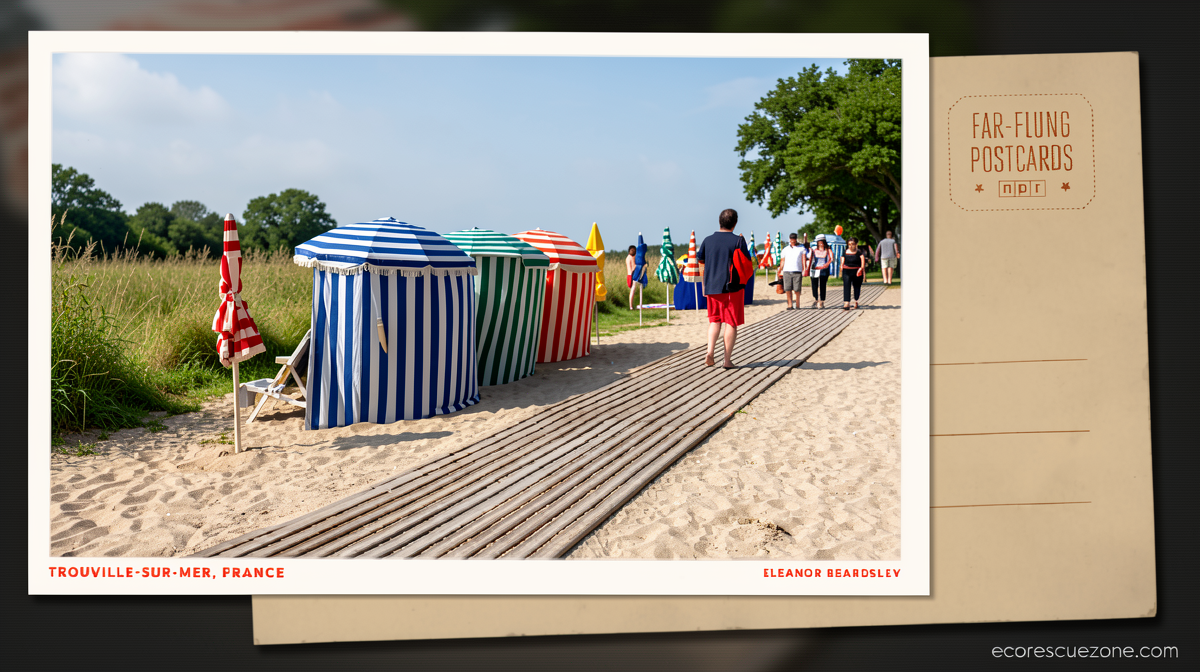
Greetings from Trouville-sur-Mer, a beach town little changed since Monet painted it

Daftar Isi
A Two-Hour Escape into the Channel Wind: Trouville-sur-Mer Endures
Ecorescuezone.com – Step off the train at Trouville-sur-Mer and the urban machinery of Paris dissolves almost instantly. The platform gives way to cobbled lanes where gulls wheel overhead in sharp, metallic cries, and the air carries the salt-heavy pull of the English Channel rather than exhaust fumes. The town sits in Calvados, Normandy, roughly two hours by rail from the capital, yet the psychological distance between the two places feels far greater than the mileage suggests. What greets the arriving traveler is not a suburb or a commuter stop but a working seaside resort whose rhythms are set by tide tables and wind direction, not by office hours.
The Norman Riviera in Context
Trouville occupies a stretch of coastline that locals and tourism boards alike call the Côte Fleurie, or the “Norman Riviera.” Unlike its Mediterranean namesake, this shore is defined by broad, flat sand beaches subject to some of the largest tidal ranges in western Europe. The water temperature rarely invites prolonged swimming, which is precisely why the town’s appeal has always been atmospheric rather than aquatic: the walk along the boardwalk, the sight of the horizon, the particular quality of light on a grey afternoon. Adjacent Deauville, sharing the same continuous beach, draws its own crowds for a celebrated film festival each June, but Trouville retains a quieter, older character. The two towns together form one of France’s earliest purpose-built seaside destinations, predating the mass tourism infrastructure of the Côte d’Azur by several decades.
When the Impressionists Came to Paint the Tide
The mid-nineteenth century transformed French coastal towns from modest fishing settlements into fashionable health resorts. “Sea bathing” — the practice of entering the ocean for therapeutic purposes, wrapped in elaborate wool costumes and carried in by servants — became a marker of bourgeois respectability. Trouville, with its wide sands and sheltered harbor, attracted artists and writers in equal measure. Gustave Flaubert, Guy de Maupassant, and Honoré de Balzac all spent time in the area, embedding the coast in French literary memory long before the camera made it a postcard.
Claude Monet arrived in the 1860s and produced a series of beach scenes that remain among his most recognizable works. His canvases depict turreted seaside houses, the pale geometry of bathing machines, and figures strolling the promenade in the full regalia of the era. The skies in those paintings are restless, layered with cloud formations that shift minute by minute — the very phenomenon that drew the Impressionist eye to coastal light. Standing before a reproduction of one of those Trouville compositions today, the uncanny persistence of the scene is immediate: the architecture, the boardwalk, the orientation of the beach toward the open Channel, all remain essentially as Monet rendered them.
The only visible alteration between Monet’s strollers and those who walk the same promenade now is the wardrobe. The wool bathing costumes have given way to lycra and board shorts; the parasols have become brightly printed nylon canopies. The geometry of the scene, however, is untouched.
Why the Town Has Resisted Modernization
Trouville’s compact footprint — a handful of streets radiating from the harbor and the beach — has made large-scale redevelopment both difficult and culturally unwelcome. The town’s identity is inseparable from its nineteenth-century layout: the low-rise hotels, the narrow lanes, the small harbor where fishing boats still moor alongside pleasure craft. Municipal planning has favored maintenance over expansion, preserving the scale and texture that make the place feel like a frozen frame from a period drama. This is not stagnation so much as a deliberate choice to protect the very quality that draws visitors: the sense of stepping into a different century.
The Day-Tripper Economy and the Boardwalk Culture
For many Parisians, Trouville functions as a Saturday ritual. The train departs the capital in the morning, and by midday the boardwalk is lined with chaise lounges beneath a dense canopy of multicolored umbrellas. Visitors spread blankets, read, nap, and watch the tide retreat to reveal vast expanses of wet sand. The big tides that make the beach so dramatic also mean that the usable swimming area changes dramatically with the clock, so most visitors treat the shore as a landscape to be observed rather than entered. This observational culture — looking at the sea rather than bathing in it — is, in a sense, the direct descendant of the Impressionist impulse: the beach as subject, the viewer as spectator.
The town’s small casino, its handful of seafood restaurants serving local mussels and sole, and its modest retail strip along the main avenue complete a commercial ecosystem that has changed little in structure since the Belle Époque. Prices have risen, of course, and the clientele has diversified beyond the original Parisian bourgeoisie, but the underlying grammar of the place — its scale, its pace, its orientation toward the water — remains intact.
What Persists
Trouville-sur-Mer endures not because it has been frozen in amber but because its particular combination of geography, scale, and cultural memory resists the homogenizing pressures that have flattened most European seaside towns into interchangeable chains of sunbeds and snack bars. The Monet connection provides a brand that no marketing department could manufacture: a genuine, centuries-adjacent artistic association that anchors the town in a specific moment of Western visual culture. For the traveler who steps off the train and walks the cobbled streets into the Channel wind, the experience is less a vacation than a brief, salt-scoured immersion in a world that has, in its essential contours, refused to update.
Related Reading
Frequently Asked Questions
What is Greetings from Trouville sur Mer a beach?
Greetings from Trouville sur Mer a beach is the main topic of this guide. The article explains the context, practical details, and next steps readers should understand.
Why does Greetings from Trouville sur Mer a beach matter?
Greetings from Trouville sur Mer a beach matters because readers are looking for a useful answer, not just a short summary. Good content should match search intent and help them decide what to do next.