Judge clears the way for Postal Service work on Trump’s mail-in voting order for now

Daftar Isi
Postal Service Green-Lit to Implement Trump’s Ballot-Mailing Mandate After Judge Walks Back Nationwide Block
Ecorescuezone.com – The U.S. Postal Service can now move forward with its finalized plan for handling federal mail-in ballots under President Trump’s March executive order, after a federal judge in Boston vacated a sweeping injunction that had frozen the agency’s work on the directive. The development, handed down Wednesday by U.S. District Judge Indira Talwani, hands the White House a temporary operational opening weeks before the November midterm elections begin accepting absentee ballots.
Talwani’s order cancels the nationwide ruling she herself had previously issued, which had prevented USPS from acting on any of the president’s instructions regarding ballot delivery. In doing so, she aligned her court with the Supreme Court’s earlier procedural intervention, which had already signaled that lower courts were jumping the gun before the postal agency had published a concrete implementation plan.
The Supreme Court’s Procedural Gatekeeping
The high court’s prior ruling did not address whether the executive order is lawful. Instead, it focused on timing. In June, Talwani had issued a narrower injunction covering only the 23 predominantly Democratic-led states and Washington, D.C., that had joined the lawsuit challenging the order. The Supreme Court stepped in and paused that June ruling, concluding that Talwani had weighed in prematurely—before USPS had released any finalized operational framework for carrying out the president’s directives.
On Wednesday, the judge invoked that same reasoning. Because USPS published its final rule for federal ballot mail on August 21, the precondition the Supreme Court had identified as missing was now satisfied. With a concrete plan on the table, Talwani granted the administration’s motion to cancel her earlier nationwide block.
What the Final Rule Actually Requires
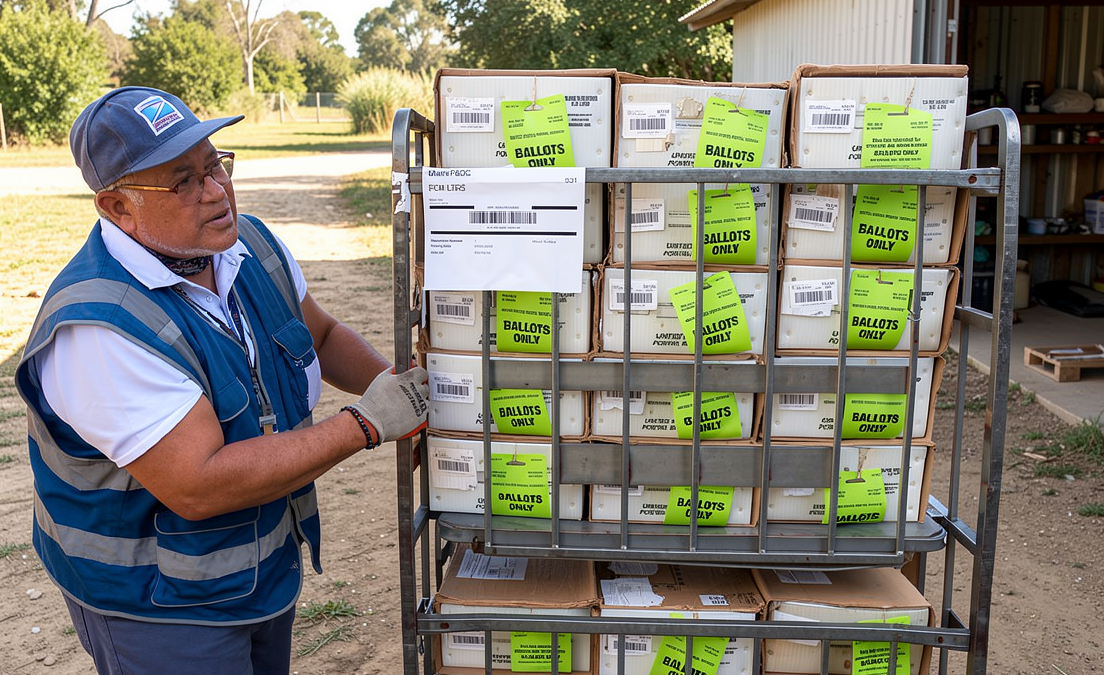
The August 21 rule contains a provision that has drawn the sharpest criticism from voting-rights advocates and state election officials. Under that provision, USPS would deliver mail-in ballots exclusively to individuals appearing on absentee-voter rosters that states are obligated to furnish to the mailing agency. In practice, this means the postal service would act as a gatekeeper, cross-referencing its delivery lists against state-compiled voter rolls before any ballot reaches a mailbox.
Critics argue this transforms the postal agency into an unofficial election administrator—a role for which no statute grants it authority. The challengers maintain that the Constitution vests the power to set federal election rules in the states and in Congress, not in the executive branch or in a cabinet-level postal agency.
Trump’s Stated Rationale and the Empirical Record
Trump, who has himself cast ballots by mail while residing in Florida, signed the executive order in March and has publicly framed it as a measure to prevent non-citizens from voting illegally in federal elections. He has pointed to isolated incidents of foreign nationals appearing on voter rolls as justification for sweeping federal intervention.
Independent audits and peer-reviewed studies of state election records, however, consistently find that non-citizen voting is exceedingly rare—typically a fraction of one percent of ballots cast, and often attributable to clerical errors rather than deliberate fraud. The gap between the scale of the problem documented in the data and the scale of the federal response has been a central point of contention in the litigation.
What Happens Next: A Legal Gauntlet Ahead
The Wednesday ruling does not end the fight. It merely removes one obstacle and opens the door for USPS to begin operationalizing its plan. Multiple lawsuits remain active, filed by Democratic lawmakers, voting-rights organizations, and roughly two dozen state governments led by Democrats. Those challengers are pressing Talwani, as well as a separate federal judge in Washington, D.C., to issue fresh injunctions that would again halt the postal agency’s finalized plan.
Any such new rulings would almost certainly be appealed to the Supreme Court, which has already shown willingness to intervene procedurally in this case. Whether the justices will ultimately reach the merits—whether the executive order exceeds presidential constitutional authority—remains an open question. Until they do, the administration holds a narrow but real window to begin implementing its ballot-mailing protocol.
Implications for Voters in Weeks Before the Midterms
With the November elections now a matter of weeks away, the practical stakes are immediate. Millions of Americans rely on mail-in and absentee ballots, particularly in states where that method is the default or where military, overseas, and disabled voters depend on it. If USPS begins enforcing the roster-matching requirement before courts issue further relief, voters whose names are not yet reflected on the lists states transmit could face delayed or undelivered ballots.
The interplay between state election offices, the federal postal agency, and the courts creates a layered compliance problem that has no clear historical precedent. States must decide how quickly and in what format to transmit absentee-voter data; USPS must build verification workflows on compressed timelines; and voters must navigate a system whose rules may shift again before Election Day.
For now, the postal agency’s work is unblocked. The next chapter of this dispute will be written in the next round of briefings, hearings, and appeals—a process that will likely run parallel to the election calendar itself, leaving voters and election administrators to operate in a state of legal uncertainty until the courts reach a final word on the order’s constitutionality.
Related Reading
Frequently Asked Questions
What is Judge clears the way for Postal?
Judge clears the way for Postal is the main topic of this guide. The article explains the context, practical details, and next steps readers should understand.
Why does Judge clears the way for Postal matter?
Judge clears the way for Postal matters because readers are looking for a useful answer, not just a short summary. Good content should match search intent and help them decide what to do next.