Nepal warns of possible fresh flooding as communities grapple with devastation

Nepal Warns of Possible Fresh Flooding
Ecorescuezone.com – Nepal warns of possible fresh flooding after Chinese hydrologists relayed data showing a sharp rise in upstream discharge along the Bhotekoshi River. Mobile-phone alerts reached residents in the hardest-hit districts early Sunday, instructing them to remain vigilant as water levels climbed. Rescue crews were already working around the clock to clear a critical highway connecting Kathmandu to communities devastated by Wednesday’s catastrophic flash floods, which have killed at least 760 people and left more than 3,000 unaccounted for across Nepal and the Tibetan plateau.
Dharam Raj Uprety, chief executive of the National Disaster Risk Reduction and Management Authority, confirmed that the renewed alert stemmed from intelligence shared by Chinese officials indicating a surge in upstream flow. For families still processing the initial catastrophe, the notification set off another exhausting round of evacuation and uncertainty.
Rebuilding Amid the Debris
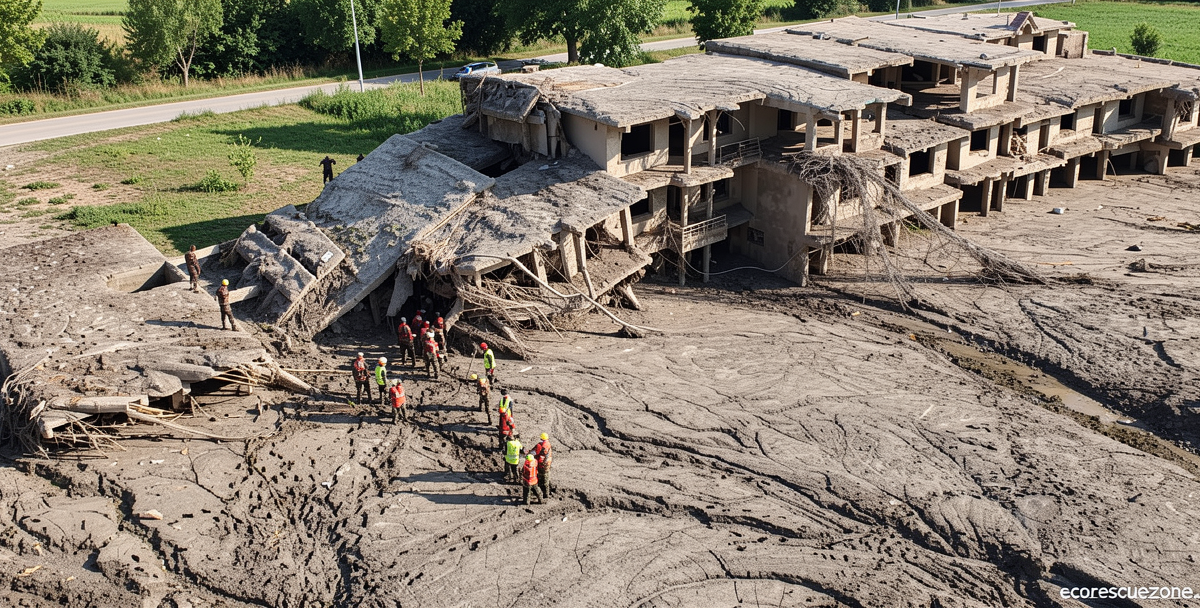
In Dhading, one of the districts struck most severely, residents made their first tentative return to shattered neighborhoods on Sunday. Families sat amid homes whose walls had been stripped away, using shovels to clear sludge-thick mud from balconies and window frames. Others combed the saturated ground for anything recognizable — a pot, a tool, a photograph — rinsing items free of the gray-brown silt now blanketing entire villages. One man went back specifically for his chickens, found them alive amid the wreckage, and loaded them into his truck cab.
“Everything is finished. Nothing is left. Not even our home,” said Sharmila Tamang, a Dhading resident attempting to salvage what remained of her household belongings.
Along the riverbanks the scale of destruction was laid bare: homes, vehicles, and farm tractors jutted at odd angles from thick sediment deposits. Sections of rice terraces that had followed the riverside contours for generations slumped into the water after landslides tore away the supporting earth. In the town of Galchhi, clusters of residents gathered on a nearby bridge to watch the river roar past, pointing at enormous boulders hurled downstream during the earlier surge. On a suspension bridge nearby, whistles sounded to warn people to step back from the railing.
What Triggered the Torrent
Wednesday’s flood originated high in the Himalayan range, far above the valleys. Scientists examining satellite imagery determined that bedrock beneath a glacier had fractured and collapsed, dragging a portion of the ice sheet with it. The resulting rockfall was so massive that it registered as a magnitude 5.2 seismic event. The cascade of rock and rapidly melting ice then swelled the rivers in the valleys below, unleashing a wall of water that swept buildings, bridges, and topsoil downstream through both Nepal and Tibet.
The Bhotekoshi, one of the largest transboundary rivers in the region, carries meltwater from glaciers on both sides of the Nepal-Tibet border. Its seasonal and event-driven surges have long posed a hazard to downstream communities, but the scale of this particular collapse — combining a structural rock failure with accelerated glacial melt — pushed the river far beyond anything in recent recorded history.
Infrastructure and International Toll
A key power plant serving more than 20,000 residents across four districts sustained severe damage in the initial floods. Workers began inspecting the facility Sunday to assess the extent of destruction. Even structures that survived the water intact remained without electricity, as twisted utility poles and tangled wires lay buried in mud. The Prithivi Highway, a vital artery carrying food, fuel, and commercial goods into Kathmandu from Nepal’s interior, faced mixed conditions: most stretches were operational, but segments still required repair, slowing supplies into already strained communities. Large concrete spans and smaller suspension crossings were destroyed, cutting off villages on either side of the river.
“Those who are there are now stuck there. Those who are here are stuck here. It’s going to be very difficult,” said Sattan Singh Tamang, 47, who was working near a bridge when Wednesday’s flood struck.
Nepal’s disaster agency updated its toll Sunday to 752 confirmed deaths and 2,502 missing. Chinese authorities reported 16 fatalities and 546 missing on their side of the border. Among the missing are hundreds of individuals from more than a dozen nations who had been in the region for work, mountaineering, or pilgrimage to a sacred site.
Frequently Asked Questions
Where is the flooding happening? The worst impacts are concentrated in Nepal’s Dhading district and surrounding river valleys along the Bhotekoshi, with additional damage reported on the Tibetan plateau side of the border.
What caused the initial flood? A structural failure of bedrock beneath a Himalayan glacier triggered a massive rockfall (registered as a magnitude 5.2 seismic event), which dragged ice downstream and generated a sudden surge of meltwater through the Bhotekoshi River system.
How many people have been affected? At least 760 deaths have been confirmed (752 in Nepal, 16 in China), and more than 3,000 people remain missing. Hundreds of foreign nationals from over a dozen countries are among the unaccounted-for.
What should residents in affected areas do right now? Follow official mobile-phone alerts, stay on elevated ground, avoid riverbanks and damaged bridges, and keep essential documents, medications, and supplies within reach in case another evacuation order is issued.