Nepal’s hesitance to accept foreign help for flood relief comes under scrutiny

Daftar Isi
Nepal’s Flood Catastrophe: Rescue Delays Spark Fury Over Foreign Aid Hesitation
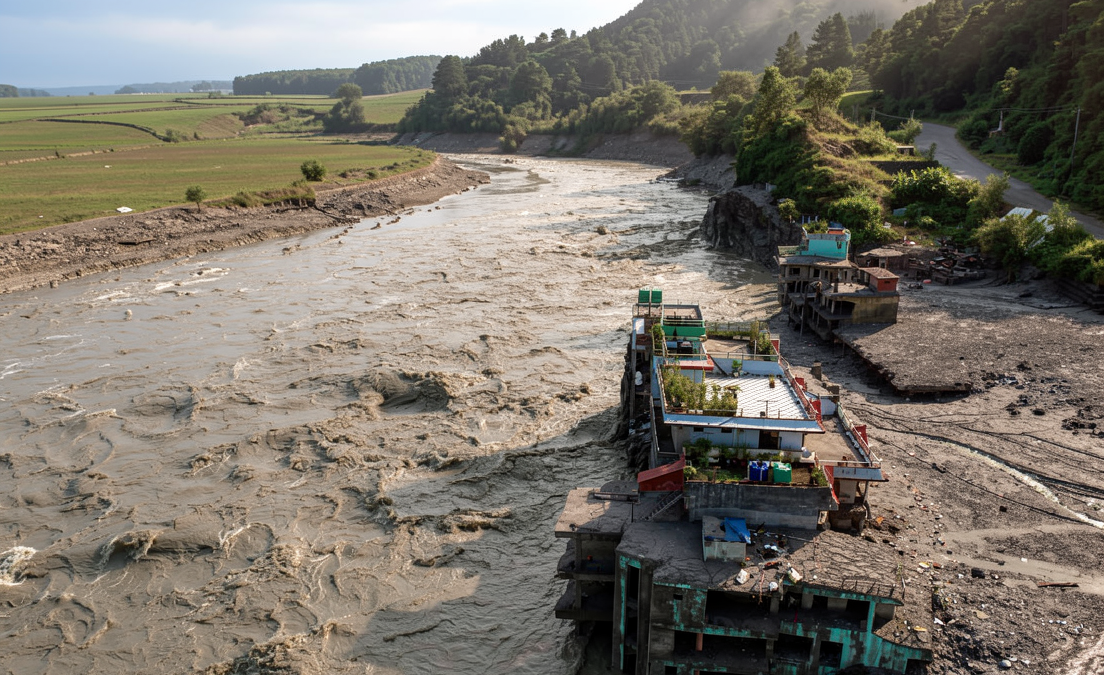
Ecorescuezone.com – More than 900 construction workers remain sealed inside hydropower tunnels across Nepal’s Rasuwa and Nuwakot districts as rescue crews battle through debris left by a massive ice-and-rock avalanche that triggered cascading floods and mudslides last week. The disaster has buried entire Himalayan villages along the Nepal-Tibet border, and the death toll has climbed sharply: Nepal’s disaster management department announced Monday morning that 903 people have been confirmed dead while 4,247 are still missing. The U.S. State Department confirmed on Sunday that at least 85 of the missing are American citizens.
Yet as the human toll mounts, a second crisis has emerged — one of politics and perception. Nepal’s private power industry has publicly faulted the government for what it describes as an initial reluctance to welcome rescue teams from abroad, arguing that the delay cost precious time and lives.
Industry Leaders Call for Foreign Rescue Capacity
Bhim Gautam, chief executive of the Independent Power Producers Association of Nepal, laid bare the operational gap facing domestic responders. In remarks made to journalists in Kathmandu, he stated plainly that the country lacks the specialized technology, heavy equipment, and technical expertise required to conduct effective extractions from collapsed hydropower infrastructure.
“Our expertise is only in dealing with small flooding. We have never faced a situation like this before,” Gautam said.
He explained that the avalanche debris did not merely seal tunnel entrances; it obscured their locations entirely, forcing rescue teams to search blindly through rubble. In several instances, crews spent three full days simply locating the tunnels before any extraction attempt could begin.
Gautam said industry executives had to push the government directly to authorize foreign rescue teams. Late last week, approvals finally came for teams from China, India, and Australia.
“But it is so late now,” he added.
Finance Minister Swarnim Wagle had earlier dismissed media reports — both domestic and international — claiming Nepal had turned away foreign assistance. He maintained that help was accepted strictly “according to the needs on the ground,” framing the sequencing as a matter of operational triage rather than political calculation.
Geopolitical Ghosts of the 2015 Earthquake
Political analyst Chandradev Bhatta, based in Kathmandu, offered a different reading. He argued that Prime Minister Balen Shah’s government appears to have resisted early foreign involvement for geopolitical reasons, drawing a direct line to the aftermath of the April 2015 earthquake that killed nearly 9,000 people and devastated much of the country’s mountainous interior.
“During the reconstruction phase, there was a huge competition, not only between our two neighbors China and India, but also the Western powers, who wanted to project their geopolitical power in Kathmandu,” Bhatta said. By the end, he noted, “China managed to gain a geopolitical foothold in the country.”
That memory, Bhatta explained, makes foreign interference a particularly charged subject for the Shah administration. The government rose to power after mass student-led protests in late 2025 toppled the previous leadership and traditional political parties, many of which had been perceived as aligned with India, China, or Western blocs. In that climate, accepting large-scale foreign rescue operations early in a disaster could be read as ceding narrative control to outside actors.
Bhatta contended that the hesitation ultimately backfired. Social media erupted with criticism as citizens watched rescue timelines slip day after day. One widely shared post from the Instagram account gen.znepal — created during last year’s anti-government protest movement — captured the mood:
“Please put your ultranationalism somewhere else and urge the government to accept whatever support we receive, from whichever country, right now.”
Bhatta summed up the cost of the delay in blunt terms: had foreign support been deployed from the outset, more lives might have been saved.
Rescue Operations Underway; China Defends Its Transparency
Prime Minister Shah posted a statement on Facebook on Sunday confirming that the Nepali army, police, and specialists from India, China, and South Korea are now conducting joint rescue operations across multiple tunnel sites. Footage released by the Nepali military shows crews operating rotary drills and excavator arms to bore through compacted rock and debris.
The Nepali government did not respond to requests for further comment on the criticism.
In Beijing, the Foreign Ministry moved quickly on Monday to counter reports that Chinese officials had ignored early warning indicators of the avalanche or minimized casualty details. The ministry insisted its information releases about the floods and mudslide near the shared border had been both transparent and timely. China’s most recent official update, carried by state news agency Xinhua on Saturday, placed confirmed deaths at 16 and missing persons at 546 — figures that had not been revised in more than 48 hours as of Monday.
What Comes Next
With thousands still unaccounted for and nine tunnels partially or fully blocked, the coming days will test whether the expanded international rescue capacity can overcome the time already lost. For Nepal’s hydropower sector — a pillar of the country’s energy independence strategy and a major employer of skilled labor from Nepal, South Korea, and China — the disaster also raises urgent questions about tunnel design standards, early-warning sensor networks, and evacuation protocols in high-altitude construction zones. The political fallout, meanwhile, may reshape how Kathmandu balances sovereignty concerns against the practical realities of a geography that makes domestic-only disaster response increasingly untenable.
Related Reading
Frequently Asked Questions
What is Nepal s hesitance to accept foreign?
Nepal s hesitance to accept foreign is the main topic of this guide. The article explains the context, practical details, and next steps readers should understand.
Why does Nepal s hesitance to accept foreign matter?
Nepal s hesitance to accept foreign matters because readers are looking for a useful answer, not just a short summary. Good content should match search intent and help them decide what to do next.