Attacks flare between the U.S. and Iran after a monthlong pause

Daftar Isi
U.S. and Iran Trade Strikes After Month of Relative Calm, Reigniting Tensions Across the Gulf
Ecorescuezone.com – After roughly thirty days of quiet following a ceasefire brokered through Gulf-state mediation, the United States and Iran exchanged their most significant military blows since late July. On Sunday, American forces hit what they described as two Iranian rocket launchers positioned on Larak Island in the Strait of Hormuz, units they said were preparing to deploy sea mines into the narrow waterway. Within hours, Tehran answered with ballistic missile salvos aimed at American installations in Jordan and the United Arab Emirates, marking the sharpest escalation since the two sides paused hostilities in early August.
The Sunday Exchange
The Pentagon confirmed the operation in a written statement, specifying that the targeted launchers on Larak Island were in the process of preparing sea mines for emplacement in the strait’s shipping channels. Iran’s armed forces pushed back on the characterization, asserting that the American strikes killed both military personnel and civilians at the island’s installations. Larak sits at the western mouth of the strait and commands a view over the approaches to Bandar Abbas, Iran’s principal deep-water port, making it a node of considerable strategic value for Tehran’s naval and coastal-defense planners.
In retaliation, Iran fired ballistic missiles at U.S. forces and helicopters stationed at an air base in the UAE and directed additional salvos toward bases in Jordan. Tehran justified the Jordanian targets by stating that those facilities had been used to launch and support the American attack on Larak Island.
Gulf States Respond
The UAE initially pushed back against Iranian state-media claims that its al-Minhad Air Base had been directly hit by missiles. The emirate confirmed, however, that it intercepted drones over its territorial waters which it attributed to Iranian launch sites. Jordan’s armed forces announced that it shot down eight missiles that crossed into its airspace, though the Jordanian military declined to say whether additional drones or projectiles had penetrated its air defenses and reached the bases on their ground.
Both Jordan and the UAE host substantial U.S. military presences, and Gulf states including Kuwait, Bahrain, and Saudi Arabia maintain similar installations. Iran has struck at those facilities repeatedly since the American-Israeli war against Iran opened in February, making the Sunday salvos part of a pattern that regional capitals have grown accustomed to monitoring.
The Tanker, the Mines, and the Navigation Dispute
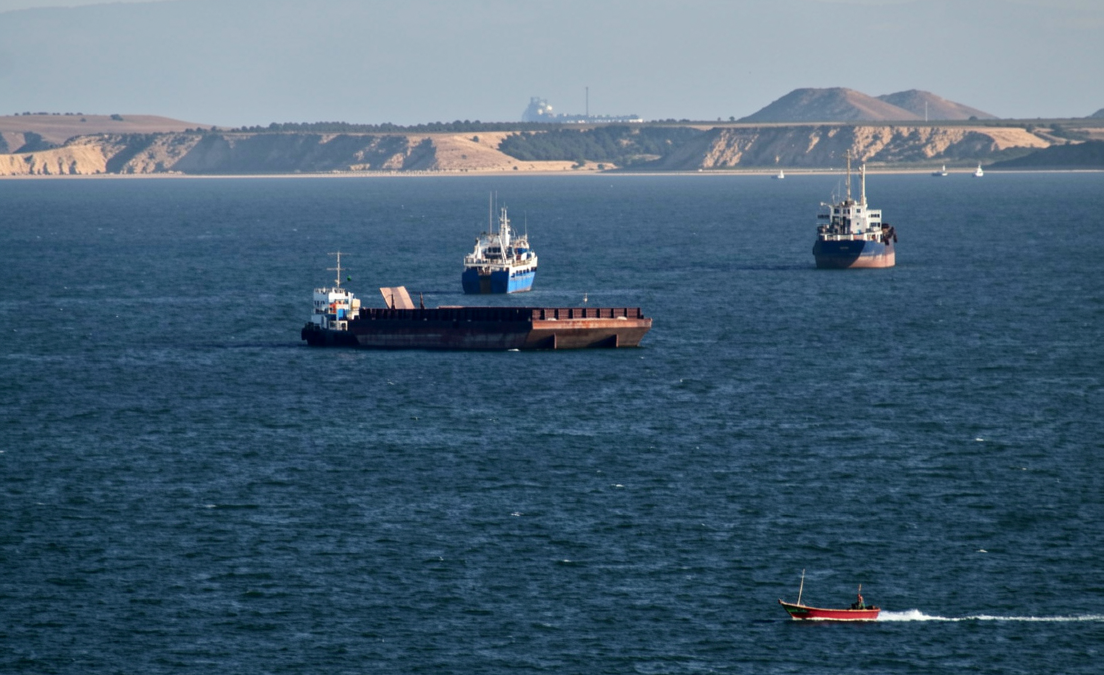
The backdrop to Sunday’s exchange was already tense. U.S. Central Command commander Adm. Brad Cooper had announced the previous week that American forces had completed clearing sea mines from the strait’s international shipping routes. Iran disputed the picture of a fully cleared waterway, pointing to a supertanker that caught fire over the weekend after, Tehran claimed, it struck two naval mines in the strait and came to a halt.
Iranian state television quoted the paramilitary Revolutionary Guard as saying the tanker had been attempting to transit the waterway
“illegally”
and warned that it would apply the same treatment to any other vessel violating what Tehran calls its navigation restrictions. Under international maritime law, the strait — shared between Iran and Oman — guarantees freedom of navigation. Iran, however, has maintained that passage without its explicit authorization constitutes an infringement of its sovereign rights, a position that has complicated every commercial transit since the conflict began.
President Masoud Pezeshkian struck a tone of measured resolve, saying Iran would answer attacks but was not courting a wider war:
“We will never remain silent in the face of any aggression and will respond decisively to the aggressors.”
Sanctions, Social Media, and Kharg Island
Sunday’s strikes followed weeks of escalating rhetoric and a new tranche of economic sanctions on Iran that President Trump announced the prior week. Overnight, Trump also posted what appeared to be an artificial-intelligence-generated video showing a large oil facility under missile attack, captioned
“Kharg Island being blown to smithereens.”
Kharg Island, Iran’s principal oil-export terminal, sits roughly 410 miles west of Larak Island, the site of the most recent American strikes. No independent confirmation emerged that Kharg had actually been hit. Hamid Bovard, head of the state-run National Iranian Oil Company, dismissed the claim:
“Trump’s tweets are laughable and conditions in Kharg are calm.”
Bovard added that workers were continuing repair operations on damage sustained during earlier attacks on the island’s export infrastructure.
What the Escalation Means
The last time American forces struck Iranian territory before Sunday was July 29, just before Trump ordered a halt to operations following consultations with Gulf leaders. Since then, the administration’s stated priority has shifted from regime change — a goal senior U.S. and Israeli officials had articulated openly — to reopening the Strait of Hormuz to unrestricted commercial traffic. The strait carries roughly a fifth of global oil shipments, and its partial closure over the past six months has driven sustained spikes in energy prices, rattling markets from Tokyo to Frankfurt.
Iran’s leadership, despite sustained pressure, has retained control of the state apparatus. The question now facing Washington, Tehran, and the Gulf states that host American forces is whether the monthlong pause represented a durable de-escalation or merely the lull between rounds. Sunday’s exchange suggests the latter, and the coming days will test whether diplomatic channels can reassert themselves before the next salvo.
Related Reading
Frequently Asked Questions
What is Attacks flare between the U S?
Attacks flare between the U S is the main topic of this guide. The article explains the context, practical details, and next steps readers should understand.
Why does Attacks flare between the U S matter?
Attacks flare between the U S matters because readers are looking for a useful answer, not just a short summary. Good content should match search intent and help them decide what to do next.