As Trump courts Kim, Pyongyang ups the price, while Seoul fears being sidelined

Daftar Isi
Pyongyang Fires Missiles, Then Tells Washington the Price Has Gone Up
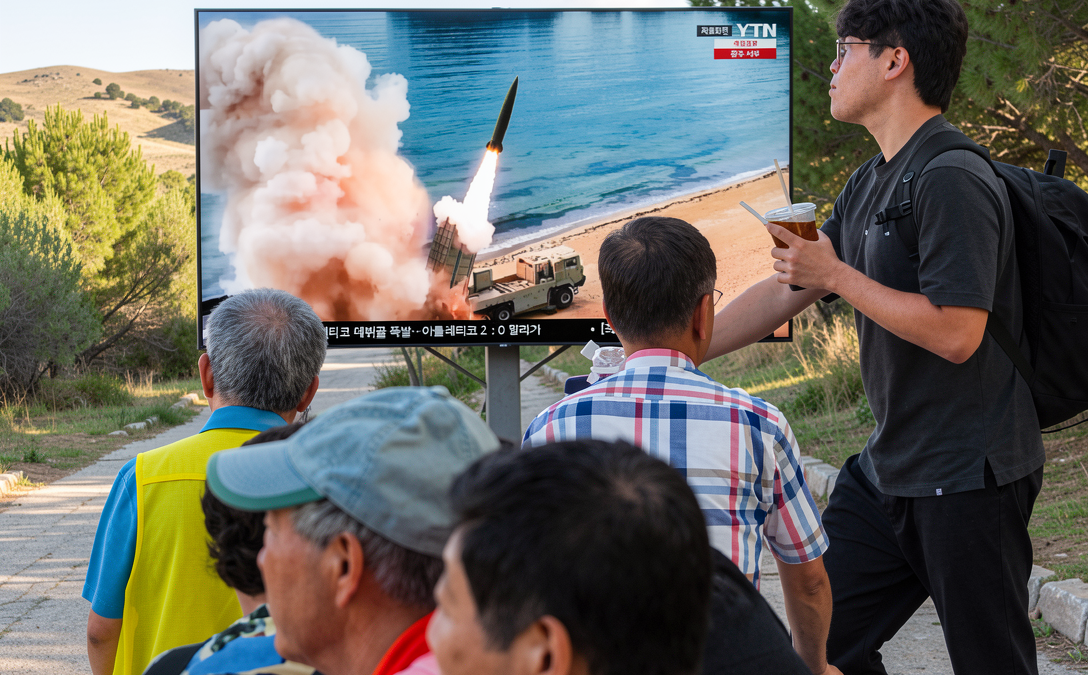
Ecorescuezone.com – A volley of roughly a dozen short-range ballistic missiles streaked eastward from launch sites surrounding the North Korean capital on Thursday, a kinetic punctuation mark appended to a diplomatic message delivered days earlier. South Korea’s Joint Chiefs of Staff confirmed the launches, which came hours after Pyongyang’s foreign ministry effectively waved away President Trump’s most recent attempt to reopen a direct channel with Kim Jong Un. The timing was deliberate: the missiles were not merely a show of force but a bargaining signal, telling the White House that any future summit would carry a steeper price tag than the one offered in 2018.
The Exercise Shortening and Kim Yo Jong’s Verdict
The trigger for this week’s exchange was Trump’s decision, announced on social media on Monday, to pull forward the conclusion of the annual U.S.-South Korea combined military drills by six days. The joint exercises wrapped up on Friday, well ahead of their original schedule, in what the president framed as a conciliatory step. He characterized the full-length drills as expensive and as sending a hostile signal to the North, and he added that he had contacted Kim about a face-to-face meeting and received what he described as a favorable reply.
Pyongyang’s response came through Kim Yo Jong, the leader’s sister and a senior figure in the Workers’ Party. In a statement distributed through state-run media, she declared the scaled-back exercises “unworthy of comment” and insisted the reduction did not alter the drills’ fundamentally “provocative and offensive” character. When pressed on Trump’s claim of direct contact with her brother, she offered a flat denial:
“I am not aware of it at all.”
Yet in the same breath she conceded that “the relationship between the two leaders is still excellent,” a formulation that left the door ajar even as she slammed the window shut.
Raising the Price, Not Closing the Door
Kuyoun Chung, a political scientist at Kangwon National University, reads the Kim Yo Jong statement as a negotiation tactic rather than a final verdict. In his assessment, the sister is “raising the price of reengagement, rather than closing the door to a summit” between the two leaders. The demand underpinning that price, he notes, has been consistent since Trump returned to the White House last year: Pyongyang insists on formal recognition of its status as a nuclear power before any diplomatic track resumes. Washington has resisted, because such recognition would effectively nullify decades of U.S. policy aimed at North Korean denuclearization and would sit uneasily alongside existing United Nations Security Council resolutions.
The impasse has grown harder to resolve as the North’s nuclear and missile programs have continued to advance. Pressure for denuclearization has eroded in practice, and Seoul’s own posture has drifted from demanding complete disarmament toward pursuing bilateral arms-control frameworks. Voices in Washington pushing a similar recalibration have gained ground, though no formal policy shift has been announced.
Seoul’s Anxiety: The Mediation Question
For South Korea, the week’s events sharpened a fear that has lingered since Trump’s return: that a bilateral deal between Washington and Pyongyang could be struck over Seoul’s head, with the United States collecting diplomatic credit while the South absorbs the security costs. The specific worry is that Trump might agree to withdraw U.S. forces stationed on the peninsula, lift economic sanctions on the North, and leave its nuclear arsenal untouched — a package that would leave South Korea exposed while its ally reaps the summit’s political dividends.
“The United States would simply reap the diplomatic benefits of the summit,” Chung observes, “while South Korea bears all the security consequences of the concessions to North Korea.”
Officially, Seoul’s Foreign Ministry expressed hope that Trump’s outreach would catalyze renewed multilateral engagement. Unofficially, the shock in the capital was palpable. The fear is not abstract; it is rooted in the architecture of North Korea’s post-2019 foreign policy, which has systematically removed South Korea from the equation.
How the Mediation Role Was Lost
During the first Trump term, South Korean diplomacy was the indispensable bridge that produced three Trump-Kim summits across 2018 and 2019. When the final meeting in Hanoi collapsed without a deal, Kim publicly accused the president of treating him like an “idiot,” a remark that crystallized a rupture. The aftermath reshaped Pyongyang’s strategic calculus. In 2023, North Korea formally dropped the long-standing goal of reunification with the South. Kim signed a mutual defense pact with Russia and reinvigorated ties with China, moves that collectively rendered Seoul’s traditional mediating role obsolete.
Joseph Yun, who stepped down as acting U.S. ambassador to South Korea last October, offered a tempered view of what might still occur. He suggested that “it is entirely possible, in my view, that there could be a pro forma meeting, in which the two sides shake hands, sit down, have a nice chat, agree to discuss again,” and then part ways without a binding agreement. Such a gesture, he implied, would satisfy domestic audiences in both capitals without requiring either side to concede the nuclear-recognition question.
Beijing’s Calculus
This week Seoul also turned to its northern neighbor for reassurance. Visiting Chinese Foreign Minister Wang Yi pledged that Beijing would continue to promote “peace and stability on the Korean Peninsula.” Asked directly whether China might broker a U.S.-North Korea summit, however, he deflected, saying the two countries concerned should manage their own relationship and that Washington ought to abandon what he characterized as hostile policies toward Pyongyang. The answer was polite but pointed: Beijing would not insert itself as intermediary unless invited, and it would not do so while the United States maintained what it views as a confrontational posture.
Alliance Unease and the Road Ahead
The shortening of the joint exercises, whatever its diplomatic intent, has fed a broader current of unease in Seoul about the durability of the U.S. alliance. South Korean Foreign Minister Cho Hyun addressed lawmakers on Wednesday to outline the government’s response, underscoring the need to maintain a credible deterrence posture even as diplomatic channels are explored. The underlying tension remains unresolved: a president eager for a historic photo-op, a regime that has spent three years building a nuclear deterrent and a Russian security umbrella, and a middle power watching from the sidelines, hoping its voice still carries weight in a conversation it helped make possible.
Related Reading
Frequently Asked Questions
What is As Trump courts Kim Pyongyang ups?
As Trump courts Kim Pyongyang ups is the main topic of this guide. The article explains the context, practical details, and next steps readers should understand.
Why does As Trump courts Kim Pyongyang ups matter?
As Trump courts Kim Pyongyang ups matters because readers are looking for a useful answer, not just a short summary. Good content should match search intent and help them decide what to do next.