What to know about this weekend’s IndyCar race on the National Mall

Daftar Isi
Open-Wheel Speed Meets American Iconography: The Freedom 250 Grand Prix Takes Over the National Mall
Ecorescuezone.com – For the first time in the history of American motorsports, a full-scale IndyCar race will thunder through the most recognizable stretch of public land in the United States. This weekend, dozens of single-seater formula cars and an estimated 140,000 spectators per day will converge on the National Mall in Washington, D.C., for the Freedom 250 Grand Prix — a two-day spectacle that organizers are framing as both a patriotic celebration and, quite possibly, a one-of-a-kind experiment.
The event marks the 15th round of an 18-race IndyCar championship season and caps Sunday with a 250-mile contest. Yet its singular placement in the nation’s capital, combined with the compressed planning window, has generated a wave of logistical questions that extend well beyond the usual tire-pressure and fuel-load debates.
A One-Time Celebration Tied to the 250th Anniversary
Bud Denker, president of Penske Corp. and chair of the event, made clear to reporters on Tuesday that the race is not intended as a recurring fixture on the calendar.
“This is a one-time-only event, because we’re celebrating the country’s 250th one time.”
The framing matters. IndyCar already stages street circuits in Detroit, St. Petersburg, Florida, and Long Beach, California, and its crown jewel remains the Indianapolis 500. A permanent D.C. stop would require navigating federal land-use restrictions, congressional oversight, and the sensitivities of dozens of cultural institutions lining the Mall. Denker’s language suggests the organizers see this weekend as a singular milestone rather than the opening act of a franchise.
The Course: Seven Corners, One Monumental Straight
Drivers will navigate an angular 1.7-mile layout featuring seven sharp turns and a long main straightaway whose vanishing point is framed by the U.S. Capitol dome and the Washington Monument. Over 147 laps, each competitor will cover just under 250 miles. The route threads directly past the National Archives Building, the National Gallery of Art, and three Smithsonian museums — the National Air and Space Museum, the National Museum of the American Indian, and the National Museum of American History.
Longtime motorsports journalist Marshall Pruett noted for a morning radio program that the geometry makes overtaking unusually difficult:
“Of all the non-ovals on the calendar this year in IndyCar, this has fewer turns than any other track … there’s far fewer opportunities per lap to try and overtake.”
That constraint shapes strategy. With limited passing zones, qualifying position and pit-stop execution become disproportionately decisive. The 25-driver field includes reigning series champion Alex Palou and former Indy 500 victor Felix Rosenqvist, among other top-tier names.
Speed, Spectacle, and Political Fanfare
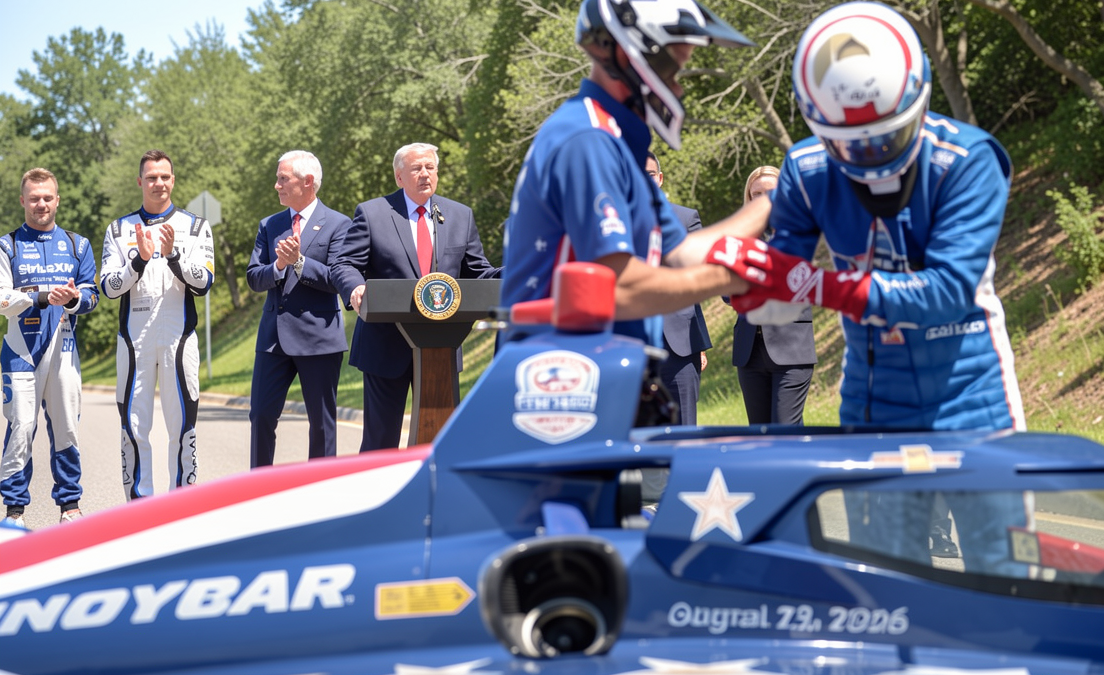
Organizers have promised flyovers, ceremonial elements, and what they describe as a patriotic production. At a July preview event, President Trump told attendees that drivers could reach speeds approaching 190 miles per hour along Pennsylvania Avenue.
“It wasn’t exactly designed for that, but what [Transportation Secretary] Sean Duffy has done with these incredible, brilliant people is really amazing,” Trump said.
IndyCar machines routinely top out near 230 mph on paved ovals, so the D.C. figure reflects the narrower street-circuit constraints rather than a mechanical limitation. Still, the sight of open-wheel cars at highway speed between federal monuments is a visual the capital has never hosted.
How the Idea Took Shape — and Nearly Died
Denker credits the concept to a casual conversation with Fox Sports CEO Eric Shanks, over a beer following a board meeting the previous year. The pair decided to explore whether a race celebrating the country’s 250th birthday could physically work on Washington streets.
“We were saying, ‘This is never going to happen, but let’s just check it out,'” Denker recalled.
They flew to the capital and spent several days measuring candidate roadways. Denker outlined four non-negotiable criteria for any viable street circuit: minimum 40-foot width, sound pavement condition, space for a pit lane, and clearance for oversize transport trucks and trailers. The corridor immediately adjacent to the Capitol satisfied all four. But a fatal legal wrinkle emerged: federal statute bars commercial advertising on Capitol grounds, and any race there would require congressional approval. Denker says he held more than 100 meetings on the Hill across a six-month stretch and could not secure the necessary votes.
Encouraged by Transportation Secretary Duffy, Denker returned to D.C. in January to survey alternative alignments farther from the Capitol. The resulting route — the one now under construction on the Mall — sidesteps the advertising prohibition while preserving the visual drama of the monuments.
Schedule, Broadcasting, and Access
Saturday opens with practice sessions, a qualifying race, and ancillary programming. Sunday’s main event is scheduled to begin shortly after 1 p.m. ET and run approximately two and a half hours. Fox will carry the race live, with post-race ceremonies slated for 3:40 p.m. ET.
Ticketing operated on two tiers. General-admission spots were distributed free of charge through a lottery; roughly 288,000 fans applied, and those allocations are now exhausted. Paid seating is divided into two grandstand zones designated “Stars” and “Stripes.” A premium hospitality package called the Champion’s Club carries a two-day price of $5,000 per person.
Unresolved Questions: Vibrations, Artifacts, and Legacy
Several art-conservation specialists have raised concerns that sustained vibration from track construction and the race itself could affect artifacts housed in the Smithsonian buildings and the National Gallery of Art that line the course. No public damage report has been issued, but the proximity of high-frequency tire noise and asphalt impact to centuries-old collections remains a point of active discussion among preservation professionals.
Beyond the weekend, the event’s existence tests how far federal land managers will bend for commercial motorsport. If the Freedom 250 Grand Prix proceeds without incident, it establishes a precedent — however narrow — for future large-scale sporting events on the Mall. If it stumbles, it may confirm Denker’s own framing: a singular, celebratory anomaly that will not be repeated.
Either way, the green flag drops Sunday afternoon, and for roughly two and a half hours the National Mall becomes something it has never been: a racetrack.
Related Reading
Frequently Asked Questions
What is What to know about this weekend?
What to know about this weekend is the main topic of this guide. The article explains the context, practical details, and next steps readers should understand.
Why does What to know about this weekend matter?
What to know about this weekend matters because readers are looking for a useful answer, not just a short summary. Good content should match search intent and help them decide what to do next.