Amid intense backlash, people are vandalizing Flock surveillance cameras

Daftar Isi
Citizens Take to the Streets to Blind Automated License Plate Readers
Ecorescuezone.com – Across American neighborhoods, a quiet form of civil disobedience is taking shape: residents are physically obstructing the small, box-shaped cameras mounted at intersections that scan every passing vehicle. What began as isolated acts of frustration has hardened into a visible, recurring protest against a surveillance infrastructure that many citizens feel was installed without their consent.
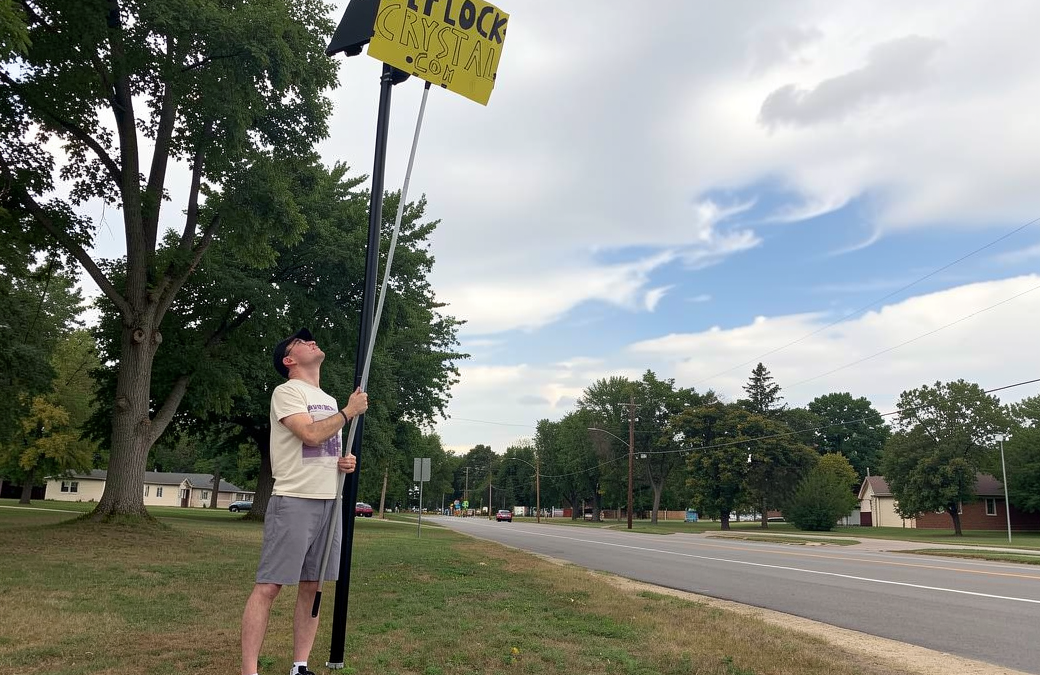
In Crystal, Minnesota, Brady O’Rourke makes a weekly pilgrimage to the busiest crosswalk near his home. He carries a long metal pole — a roof rake, the kind typically reserved for scraping accumulated snow from shingles — with a bright yellow sign taped to its tip. At the intersection, he raises the pole and holds the sign directly in front of a Flock camera, an automated license plate reader deployed by local police to log every vehicle that crosses the frame. He waves at passing motorists. Some smile back. A few honk in solidarity.
“I don’t want to pay to be surveilled,” O’Rourke says. “My tax dollars are funding cameras at the end of my block. I don’t want to live like that. I don’t think anybody should have to live like that.”
O’Rourke credits a Florida resident who first drew public attention by using a pool skimmer to do the same thing. His gesture is part of a broader, accelerating pushback against automated license plate readers (ALPRs) and the data ecosystems they feed.
Scale of the Surveillance Network
The numbers behind the technology are staggering. Flock Safety, the Atlanta-based company that manufactures the most widely deployed ALPR platform, reports that more than 5,000 law enforcement agencies rely on its cameras. The advocacy organization DeFlock, which tracks these devices nationwide, estimates that over 130,000 AI-powered automated license plate readers now line American streets. Each month, that network captures billions of plate readings along with ancillary vehicle details — make, model, color, visible modifications — building a longitudinal map of where drivers have been over weeks, months, and years.
Clare Garvie, deputy director of technology law and policy at New York University’s Policing Project, frames the stakes in plain terms:
“They monitor, quite simply, when we go to and from work, where we go to the doctor, where we drop our kid off at daycare. What we’ve enabled in practical reality is law enforcement to go back and look at where any of us was at any given point in time.”
Law Enforcement’s Case
Police leaders defend the technology as a practical investigative asset. Jeff Potts, executive director of the Minnesota Chiefs of Police Association, acknowledges the utility: “There’s no question that license plate readers can be very helpful tools for law enforcement.” A recent preliminary study indicates that Flock cameras can deter car theft in areas where they are installed, and departments cite the technology’s role in locating stolen vehicles and missing persons.
Yet the same capabilities that make the system useful for investigations also make it attractive for purposes far removed from any specific case. Jay Stanley, senior policy analyst with the ACLU’s Speech, Privacy and Technology Project, warns that the combination of expanding deployment, advancing AI analytics, and centralized cloud data storage has amplified the risk of abuse.
Documented Misuse
The concern is not hypothetical. Officers in several jurisdictions have used ALPR data to track former romantic partners. In at least one instance, data was accessed for immigration enforcement without the local government’s consent. A Texas sheriff’s office employed the system to monitor a woman who may have had an abortion — a use that drew sharp criticism from privacy advocates and civil-liberties groups.
“The potential for police fishing expeditions is unlimited,” Stanley says. “What a lot of these AI, big data techniques do is they try to boil the ocean, to reduce huge amounts of data down to various people who they think could be involved. The problem with that, of course, is it sweeps up potentially enormous numbers of innocent people.”
Accuracy compounds the problem. A 2024 analysis conducted by a California police department found that Flock misread license plates in 71 percent of the alerts it transmitted to officers — meaning nearly three out of four notifications pointed to the wrong vehicle.
Constitutional Questions
Garvie argues that the indiscriminate, warrantless collection of location data for every driver on a given street raises serious Fourth Amendment questions. The amendment protects citizens from unreasonable searches, and she contends that the current legal framework was never designed to accommodate a system that logs every plate reading in perpetuity.
“We did not set up a system of governance in this country that says, ‘Just don’t do anything wrong and you won’t have anything to worry about.’ What we said is, ‘No, actually, law enforcement is affirmatively restricted against getting up in our business as we go about our daily lives,'”
Garvie calls for stronger legislative oversight of ALPR deployment, including mandatory retention limits, audit trails, and public reporting requirements.
Flock’s Response
Last week, Flock announced a set of feature changes aimed at curbing misuse: shorter recommended data-retention windows and automated cutoffs that revoke an officer’s access when usage patterns suggest the tool is being exploited beyond its intended scope.
Garrett Langley, the company’s chief executive, addressed the backlash directly:
“We are so transparent about the business. We don’t own this data. We don’t sell this data. Cities have control over how long it’s stored. And who it’s shared with.”
Whether those adjustments will satisfy the growing cohort of residents who see the cameras as an overreach — or whether they will simply prompt the next round of roof rakes and pool skimmers at the intersection — remains to be seen. What is clear is that the era of passive, invisible plate-reading infrastructure is giving way to one in which citizens are actively, visibly, and repeatedly saying no.
Related Reading
Frequently Asked Questions
What is Amid intense backlash people are vandalizing?
Amid intense backlash people are vandalizing is the main topic of this guide. The article explains the context, practical details, and next steps readers should understand.
Why does Amid intense backlash people are vandalizing matter?
Amid intense backlash people are vandalizing matters because readers are looking for a useful answer, not just a short summary. Good content should match search intent and help them decide what to do next.