Germany’s far-right poised for power in state election

Daftar Isi
A TikTok Governor: How a 35-Year-Old Marketer May Hand Germany’s Far-Right Its First State Government Since 1945
Ecorescuezone.com – Sunday’s state election in Saxony-Anhalt carries a weight that extends well beyond one small eastern German state. If the polls hold, the Alternative for Germany (AfD) will become the first far-right party to command a state government in Germany since the end of World War II. The man most likely to shepherd that outcome into reality is not a career politician or a party elder. He is a former marketing executive who built his political brand on short-form video and who, by his own account, answers follower questions from his back porch.
The Candidate Who Out-Streams the Electorate
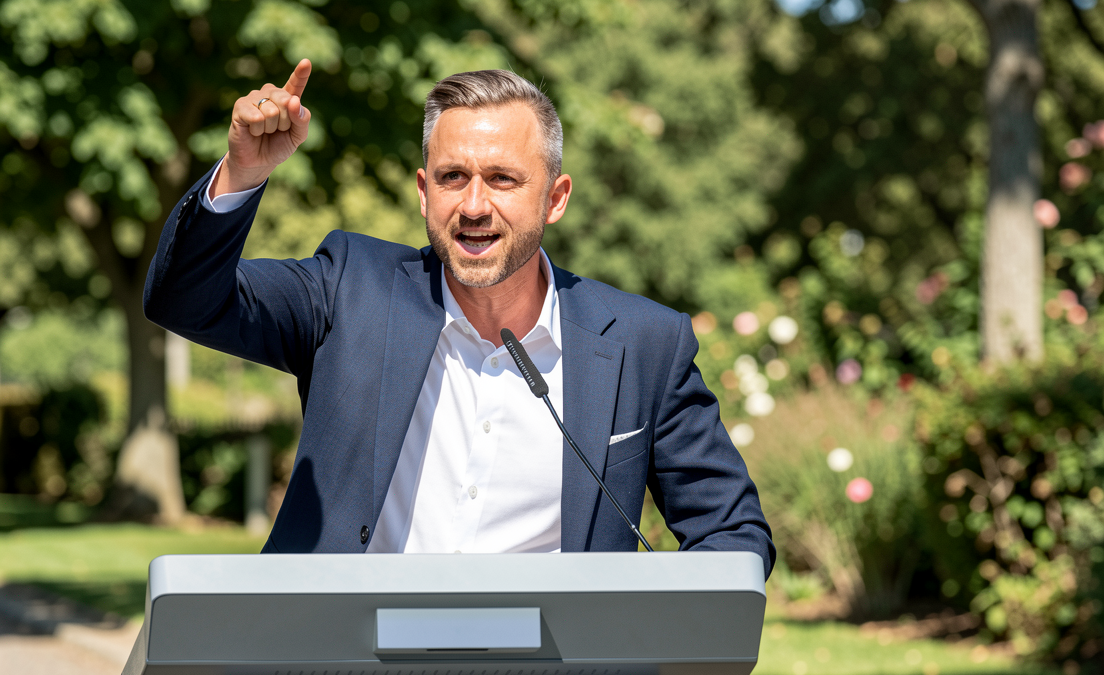
Ulrich Siegmund, 35, runs for the governorship of Saxony-Anhalt with a digital following that approaches half the size of the state’s entire eligible voting population. In a political landscape where most candidates still rely on television interviews and newspaper op-eds, Siegmund has made the algorithm his primary campaign organ. Influencers trail him through rallies and town halls, broadcasting live to audiences that dwarf traditional media reach.
His on-screen presentation is meticulously controlled. Every clip features a flawlessly pressed white polo or a starched white dress shirt — what observers have begun calling the uniform of Germany’s newly professionalized far-right. His hair, parted to one side with surgical precision, frames a smile that rarely falters, even when he articulates some of the most hardline positions in contemporary European politics.
That contrast is the defining tension of his candidacy. The affable, polished young man on camera is simultaneously the party’s standard-bearer on mass deportation of migrants and a vocal opponent of what the AfD calls “culturally foreign” labor. In one recent TikTok post, he declared:
“It is unacceptable that our doctors are leaving for Switzerland, Norway, or elsewhere because they cannot tolerate the conditions here, while we bring in doctors from India or other places to replace them.”
The party’s written platform goes further, asserting that such health workers “often fail to meet German medical standards” and “endanger patient well-being.” Siegmund himself keeps his campaign speeches brief and upbeat — pep talk rather than policy detail — leaving the granular arguments to party literature and lower-profile speakers.
The Dissenter at the Beer Table
Not every voice amplifying the AfD’s message is a loyalist. Hannes Kreschel, a 23-year-old law student in Halle, once voted for the party as a protest gesture against established politicians. After reading the full policy documents, however, he concluded that the Alternative for Germany was not, in his words, a viable alternative for him.
He now attends AfD rallies specifically to engage voters on camera, often over a beer and bratwurst, pointing out what he sees as gaps between the party’s polished campaign rhetoric and its actual economic program — which, he argues, benefits only the financially well-off.
“They try to hit the microphone and they try to hit me,” Kreschel says of some exchanges. “Of course we’re confronting them with facts, but I try to be nice because I think you should separate the people from their talking points.”
He posts those encounters on his own channels, which attract a devoted but smaller audience than Siegmund’s. His stated goal is simple: if he can be persuaded to leave the party, others can be too.
“I figured out that this is not the country I would like to live in,” he explains, referring to the AfD’s anti-immigration, nationalistic vision. “I would like to live in an open country which is friendly and not full of hate.”
The Swing Voter on the Main Square
For many residents of Halle, however, the AfD’s message reads less like hatred and more like common sense. Alexander Winsek, a 49-year-old aviation engineer, told reporters while waiting in line at a market stall on the city’s central square that he was seriously considering voting AfD for the first time.
“I think the AfD has some very good ideas, like limiting the influx of migrants,” Winsek says.
He is not, however, a wholesale convert. He wants Germany to remain in NATO, to keep the euro, and to distance itself from Moscow. What tips the scale for him, he says, is Siegmund himself — a candidate who, in Winsek’s view, breaks from the rest of the AfD’s doom-and-gloom register.
“He’s younger than all the others and stands out from the crowd,” Winsek adds, describing Siegmund as the breath of fresh air democracy needs.
What the Polls Actually Say
At Martin Luther University Halle-Wittenberg, political scientist Marcel Lewandowsky studies democratic resilience and authored the book What Populists Want. He cautions against the easy assumption that AfD supporters are yearning for an autocratic strongman. Polling data, he notes, shows that the largest share of AfD voters still want a functioning parliamentary democracy — they simply want it to deliver different outcomes on migration, economic policy, and national identity.
The implication for Sunday’s vote is significant. If Siegmund wins the governorship, the AfD will move from opposition benches to executive power in a state of roughly 2.2 million people, testing whether its campaign promises can survive contact with budgeting, coalition arithmetic, and the daily machinery of government. For the rest of Germany, the result will serve as a referendum on whether the country’s postwar political consensus — built on multilateralism, open borders within the EU, and a social market economy — can absorb a far-right executive without fracturing.
Whether Siegmund’s white polo shirts and back-porch Q&A sessions represent a genuine modernization of right-wing politics, or merely a more effective packaging of positions that have been circulating in European politics for decades, will become clear in the months after the count. What is already clear is that the old rules of German state politics no longer apply, and that a 35-year-old former marketer with a TikTok following is about to find out whether the algorithm translates into legislative authority.
Related Reading
Frequently Asked Questions
What is Germany s far right poised for power?
Germany s far right poised for power is the main topic of this guide. The article explains the context, practical details, and next steps readers should understand.
Why does Germany s far right poised for power matter?
Germany s far right poised for power matters because readers are looking for a useful answer, not just a short summary. Good content should match search intent and help them decide what to do next.