An Israeli paraglider tries to save migrating swifts that nest in the Western Wall

Jerusalem’s Swifts: A Living Bridge Between Faith and Nature
Ancient Visitors Return Each Spring
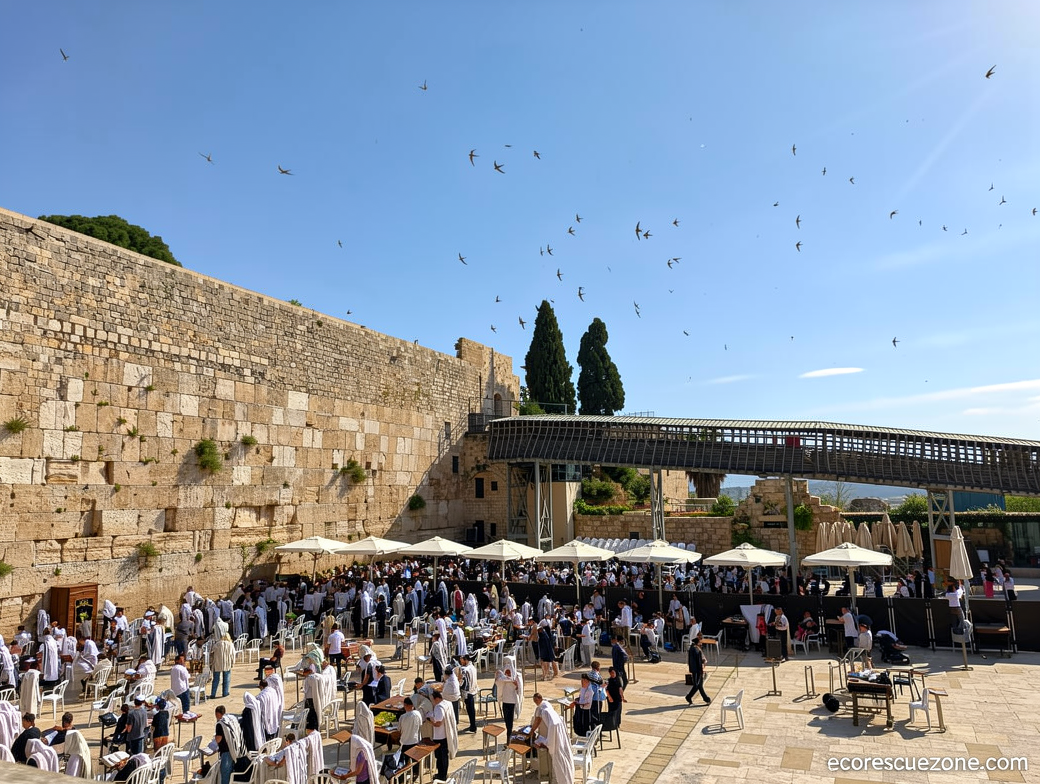
ecorescuezone.com – Each spring season brings a remarkable convergence of devotion and wildlife at Jerusalem’s Western Wall. A rabbi leads a traditional ceremony honoring the arrival of common swifts, which travel approximately 2,800 miles from their African wintering grounds. During the months spanning February through June, the spiritual atmosphere of the ancient site becomes enriched by the presence of these agile birds. As worshippers offer prayers from both men’s and women’s sections, the swifts perform their characteristic aerial displays, swooping and weaving through the air above this sacred location.
Scientific evidence suggests these distinctive scythe-winged birds have been raising their offspring within the stone crevices of the Western Wall since the Herodian period, roughly two thousand years ago. Recent surveys have documented eighty-eight distinct nests within the wall’s structure. Biblical scholars note that modern translations of the Book of Jeremiah draw a meaningful parallel between the swifts’ reliable annual visits and the inconsistent pilgrimage habits of Jerusalem’s faithful population. The scripture reads: “Even the stork in the heavens knows her appointed times / And the turtledove, the swift, and the swallow / Observe the time of their coming / But My people do not know the judgment of the Lord.”
Personal Connections and Spiritual Meaning
Sarah Wurtzel, an Israeli resident originally from New York, has brought her family to the Western Wall specifically to witness this phenomenon. She describes a profound spiritual connection between the presence of these birds and her sense of divine proximity. “The connection between birds and the Torah is very deep,” she explains. “Every moment he is allowing these creatures to stay in the air and live, how much more so is he hovering over us every moment? And it’s that protection that I feel when I see them and hear them.”
This personal testimony reflects a broader cultural significance that swifts have acquired in contemporary Jerusalem. In a city marked by political and religious complexity, these birds have emerged as powerful symbols of unity. They transcend human divisions, existing freely within a landscape that houses holy sites for Judaism, Christianity, and Islam. Beyond the Western Wall, swifts have established nesting colonies at both the Al-Aqsa Mosque and the Church of the Holy Sepulchre, demonstrating their remarkable adaptability to diverse sacred environments.
Artistic Tributes and Conservation Efforts
British artist Mark Coreth channeled this symbolism into tangible form through a collaborative sculpture project involving Jewish, Christian, and Muslim communities. His creation features an olive tree whose canopy consists of swift figures serving as leaves, and it currently stands in the courtyard of St. John Eye Hospital within Jerusalem’s Old City. Coreth extended his work beyond Jerusalem, mounting bronze swift sculptures on hospital walls throughout Gaza and the West Bank.
Amnonn Hahn, who serves as chair of the Friends of the Swifts Association in Israel, provided consultation for Coreth’s project. “Where the white dove failed to bring peace, we hope the swift will,” Hahn observes, capturing the hopeful sentiment behind the artistic tribute.
Threats and Rescue Initiatives
The swifts arriving in Israel during spring follow a migration corridor extending from East Africa through the Jordan Valley, a route particularly abundant with insect prey. However, this population faces mounting challenges. Across Europe, swift numbers have plummeted dramatically—Britain alone has experienced a seventy percent decline since the mid-1990s. Researchers identify multiple contributing factors: collapsing insect populations, increasingly unpredictable weather patterns associated with climate change, and critically, the disappearance of appropriate nesting locations.
Hahn, now seventy-two years old, has witnessed these changes firsthand. He notes that swifts historically adapted to human settlements, nesting beneath roof tiles and around window shutters. Modern construction methods, however, have eliminated much of this habitat. Glass-fronted skyscrapers and precisely engineered urban buildings offer “no space for swifts,” forcing adults to utilize increasingly inadequate locations such as small gaps between fractured bricks.
When nestlings hatch in these cramped quarters, overcrowding becomes inevitable. “Within two or three weeks, there isn’t enough room for all of them, and at least one falls out,” Hahn explains. By 2018, the crisis had reached critical levels, with numerous nestlings being delivered to the Israeli Wildlife Hospital. The hospital contacted Hahn seeking innovative solutions for these displaced young birds.
Hahn’s response was remarkably successful. He began placing rescued nestlings into specially constructed boxes positioned around his home, where swift families were already raising their own offspring. The foster parents accepted the newcomers without hesitation. “To my amazement, they fed the newcomer before their own,” Hahn recalls. “The parents noticed the new one is hungrier than the others.”
A Personal Transformation Through Flight
Hahn’s dedication to swift conservation stems from a transformative experience during a national paragliding championship in 1999. While following these birds to locate thermal currents necessary for lift, he maneuvered toward a group of swifts and was suddenly caught in an updraft. He remained airborne alongside them for approximately twenty-five minutes, reaching altitudes exceeding 6,500 feet.
“I was circling with them in the thermal. It was like magic,” he reflects, describing the moment that ignited his lifelong passion for these extraordinary birds and inspired his subsequent conservation work.