NASA has successfully launched its newest space telescope

Daftar Isi
A Million-Mile Telescope Sets Out to Map the Invisible Universe
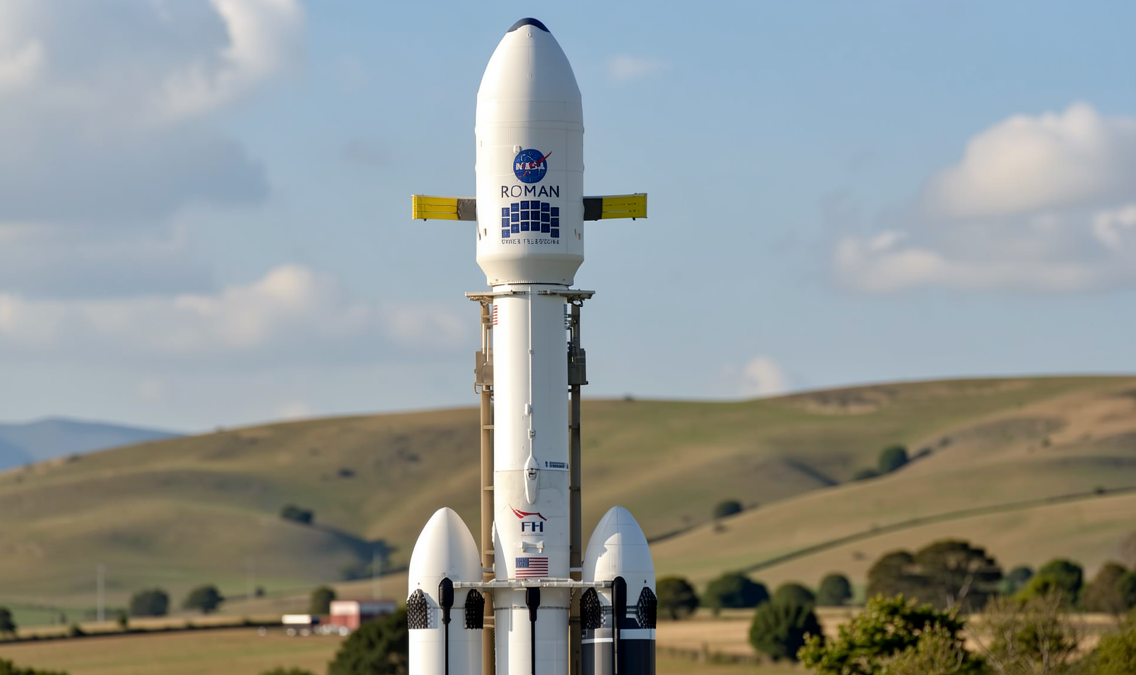
Ecorescuezone.com – Sunday morning at the Kennedy Space Center in Florida marked the departure of a spacecraft whose primary job is to look at things nobody can see. The Nancy Grace Roman Space Telescope, a vehicle roughly the dimensions of a city transit bus, climbed aboard a SpaceX Falcon Heavy rocket and cleared the pad at 7:26 a.m. Eastern Time. At approximately 18,000 pounds, the observatory is now coasting along a trajectory that will carry it roughly a million miles from Earth, where it will spend the next five years interrogating the cosmos’s most stubborn secrets: dark matter, dark energy, and the vast population of worlds orbiting distant stars.
From Spy Instrument to Public Science
The telescope’s path to the sky was anything but straightforward. Roman was originally conceived as a reconnaissance asset for the National Reconnaissance Office, the agency responsible for American military and intelligence satellites. Rather than remaining a classified instrument, the spacecraft was transferred to NASA, where it was retooled for open scientific inquiry. Its namesake, Nancy Grace Roman, served as the agency’s first chief astronomer and earned the informal title “Mother of Hubble” for her decades-long advocacy of what became the Hubble Space Telescope. The new observatory inherits Hubble’s optical sharpness while expanding the field of view by at least a factor of one hundred, meaning it can capture enormous swaths of sky in a single exposure rather than stitching together narrow strips.
The Long Road to Lagrange Point Two
Roman’s destination is the second Sun-Earth Lagrange point, commonly abbreviated L2, a gravitational equilibrium roughly a million miles beyond Earth’s orbit. At that location, the competing pulls of the Sun and Earth conspire to hold a spacecraft in a relatively stable configuration, requiring only minimal propellant to maintain position. The James Webb Space Telescope already occupies a nearby orbit at L2, and Roman will join it in what amounts to a shared observation post with an unobstructed view of the sky.
The transit to that position will consume more than three months. During that interval, the engineering team will run exhaustive checks on every subsystem.
“It takes us a good three-plus months to get out there, and we’re spending that time checking everything out and doing a whole bunch of calibrations and making sure everything is working the way we know it can,” said NASA’s Jeremy Perkins, an integration and test scientist on the mission. “It’s basically like our time to kick the tires and just make sure that the focus is right, the pointing is right.”
Hunting the Invisible: Dark Matter and Dark Energy
The telescope’s most ambitious target is dark matter, the hypothetical substance whose gravitational fingerprint appears to bind galaxies into coherent structures and sculpt the large-scale architecture of the universe. Roman will probe its distribution by measuring how gravity along vast light-travel distances subtly bends and distorts the paths of starlight — a technique known as weak gravitational lensing. By surveying enormous areas of sky with high angular resolution, the observatory will produce maps of both ordinary and dark matter simultaneously, sharpening scientists’ picture of what this elusive component actually is.
Equally central to the mission is dark energy, the mysterious repulsive influence believed to accelerate the universe’s expansion. Astronomers infer its properties by studying Type Ia supernovae, thermonuclear detonations of white dwarfs that burn at a characteristic, predictable luminosity. Because their intrinsic brightness is well understood, these events function as “standard candles”: measure the apparent dimming, calculate the distance, and reconstruct the expansion history of space itself. Roman’s wide field of view will catalogue far more of these explosions than previous surveys, tightening the constraints on how dark energy behaves and potentially reshaping cosmological models.
A Census of Alien Worlds
Since the first confirmed detections in the 1990s, astronomers have catalogued more than 6,000 exoplanets. Roman is designed to multiply that number by an order of magnitude. By monitoring millions of stars simultaneously and detecting the minute dips in brightness produced when a planet transits in front of its host star, the observatory expects to identify well over 100,000 new worlds. A secondary technique called gravitational microlensing — which exploits the tiny amplification of background starlight caused by the gravity of a distant planet — should yield roughly another 1,000 detections.
Beyond mere counting, the spacecraft carries a coronagraphic instrument that suppresses the glare of a star and directly photographs the planet beside it, a capability that moves exoplanet science from statistical inference to actual imaging.
Petabytes for Everyone
Each day Roman will downlink 1.4 terabytes of raw science data through a high-gain antenna roughly the size of a household refrigerator. Rather than gating that archive behind institutional subscriptions, NASA has built a cloud-based distribution platform called Roman Nexus, making the full dataset immediately accessible to researchers and the general public alike. After the five-year prime mission, the accumulated archive will dwarf the libraries of mainstream music-streaming services.
“Roman’s database at the end of its prime mission after five years is going to be bigger than your standard music streaming platform,” Perkins said.
For the mission team, that openness is the defining feature. The most consequential discoveries, Perkins argues, will not be the ones anyone predicted.
“It’s all the things that we are not expecting to see,” he said. “It’s all these one-in-a-million things that we’re going to be able to see with Roman that really excites me.”
As the Falcon Heavy’s upper stage faded from view over the Atlantic, the telescope began its slow drift outward, carrying with it the accumulated ambition of two decades of design work and a mandate to look at the universe’s blind spots with unprecedented breadth.
Related Reading
Frequently Asked Questions
What is NASA has successfully launched its newest?
NASA has successfully launched its newest is the main topic of this guide. The article explains the context, practical details, and next steps readers should understand.
Why does NASA has successfully launched its newest matter?
NASA has successfully launched its newest matters because readers are looking for a useful answer, not just a short summary. Good content should match search intent and help them decide what to do next.