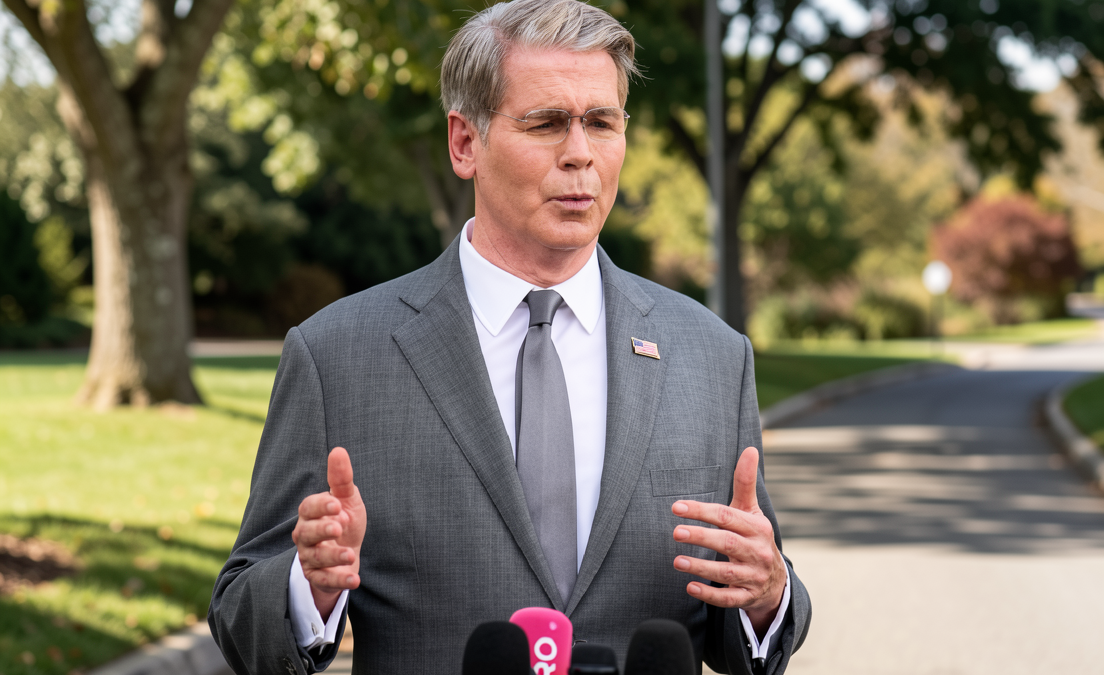
Treasury Secretary Scott Bessent to unveil new economic sanctions on Iran

Daftar Isi
Washington Prepares What Officials Call the Most Aggressive Financial Strike Against Tehran Yet
Ecorescuezone.com – Treasury Secretary Scott Bessent is set to announce a fresh tranche of economic sanctions targeting Iran on Monday, a move he has framed as the “single greatest financial offensive ever.” President Trump, for his part, has branded the initiative an “economic D-Day” and vowed to pursue penalties against any nation that continues to extend an economic lifeline to Tehran. The announcement lands at a moment when the Iranian Rial has already collapsed to an all-time low, underscoring how quickly market confidence in the country’s currency has evaporated.
A Layered Architecture of Pressure
The United States has maintained a sprawling sanctions regime against Iran for nearly five decades, with some restrictions dating back to the early 1980s. In June alone, Washington imposed additional penalties on entities caught helping Tehran circumvent existing financial controls. Compounding that financial isolation, a months-long U.S. naval blockade has effectively severed most external goods flows into the country, tightening the noose on an economy already strained by war.
What distinguishes this latest round, however, is its stated focus: not merely the Iranian firms and banks already under penalty, but the foreign governments and sovereign entities that shelter the cash channels keeping the Iranian state afloat. In an editorial published in the Financial Times over the weekend, Bessent laid out the logic plainly.
“Our objective is to sever every economic lifeline that sustains the tyrannical regime until Tehran stands alone.”
He added that nations still trading with Iran should “consider the consequences of doing so.” The most obvious referent is China, which has historically purchased roughly 90 percent of Iran’s oil exports. Bessent singled out Beijing last week for that dependency, signaling that Washington views the Sino-Iranian energy pipeline as a primary artery the new measures aim to constrict.
Skepticism Inside the Policy Community
Not everyone in the foreign-policy establishment is convinced that another sanctions package will move the needle. Alan Eyre, a former American diplomat who served on the U.S. negotiating team for Iran’s nuclear program through 2015, offered a blunt assessment: the United States has already picked “the low-hanging fruit, the mid-hanging fruit, the high-hanging fruit, the tree,” and in his view “there are no new sanctions that are effective.” His comment captures a growing unease among practitioners who worry that incremental tightening, layered atop decades of existing restrictions, yields diminishing returns while deepening civilian hardship.
Tehran Vows a “Seismic” Response
In Tehran, the reaction was swift and combative. Mohsen Rezaei, Iran’s new security chief and a former commander of the Islamic Revolutionary Guard Corps who now serves as military adviser to Supreme Leader Ayatollah Mojtaba Khamenei, told state television over the weekend that Iran would answer the latest round of economic warfare in a “seismic manner.” He directed a pointed warning at Gulf states: any country that partners with Washington on these restrictions will be treated as an enemy of Iran and a legitimate target.
The threat carries weight given recent history. Since the United States and Israel opened their military campaign against Iran nearly six months ago, Iranian forces have struck U.S. installations in Jordan and across the Gulf — including in the United Arab Emirates, Kuwait, and Saudi Arabia — with several attacks producing serious injuries and deaths. Rezaei specified that retaliation would focus on oil tankers transiting the Omani side of the Strait of Hormuz, declaring that “not even a single drop of oil will leave the region.”
Iran has not yet interfered with those shipping lanes, so a shift in posture would compound an already historic disruption. Gulf energy exports have suffered their largest disruption on record owing to the war and Iran’s closure of the Strait of Hormuz. Regional states that invested billions in pipeline infrastructure designed to bypass the strait have not yet publicly commented on Washington’s plans for the new sanctions.
The Human Cost Inside Iran
For ordinary Iranians, the arithmetic is simple: each additional layer of restriction deepens an economic crisis that has persisted, in various forms, since the Islamic Revolution of 1979. The economy was already buckling before the February war began, with double-digit inflation and steady currency devaluation. According to the Statistical Centre of Iran, the government’s own data agency, inflation now sits at nearly 90 percent.
One 30-year-old woman, speaking on condition of anonymity for fear of government retaliation, described a daily reality in which most households now purchase food on credit because cash simply runs out.
“Since I am in debt to the grocery store, I couldn’t even buy tomato paste to cook pasta.”
She added that lifesaving medicines such as insulin have become unaffordable for many families, that frequent power outages have become routine, and that unemployment continues to climb. The convergence of economic pain and soaring living costs was among the factors that drove waves of street protest across the country in recent months.
The broader implication for regional markets is significant. If the new sanctions succeed in pressuring third-country buyers — particularly China — to reduce or halt Iranian oil purchases, Tehran’s primary revenue stream narrows further. That, in turn, could accelerate currency collapse, deepen inflation beyond the already staggering 90 percent mark, and intensify the political pressures that have already pushed segments of the population into open dissent. Whether the added financial pressure translates into measurable policy concessions in Tehran, or simply compounds civilian suffering without altering the regime’s calculus, remains the central question the coming weeks will answer.
Related Reading
Frequently Asked Questions
What is Treasury Secretary Scott Bessent to unveil?
Treasury Secretary Scott Bessent to unveil is the main topic of this guide. The article explains the context, practical details, and next steps readers should understand.
Why does Treasury Secretary Scott Bessent to unveil matter?
Treasury Secretary Scott Bessent to unveil matters because readers are looking for a useful answer, not just a short summary. Good content should match search intent and help them decide what to do next.