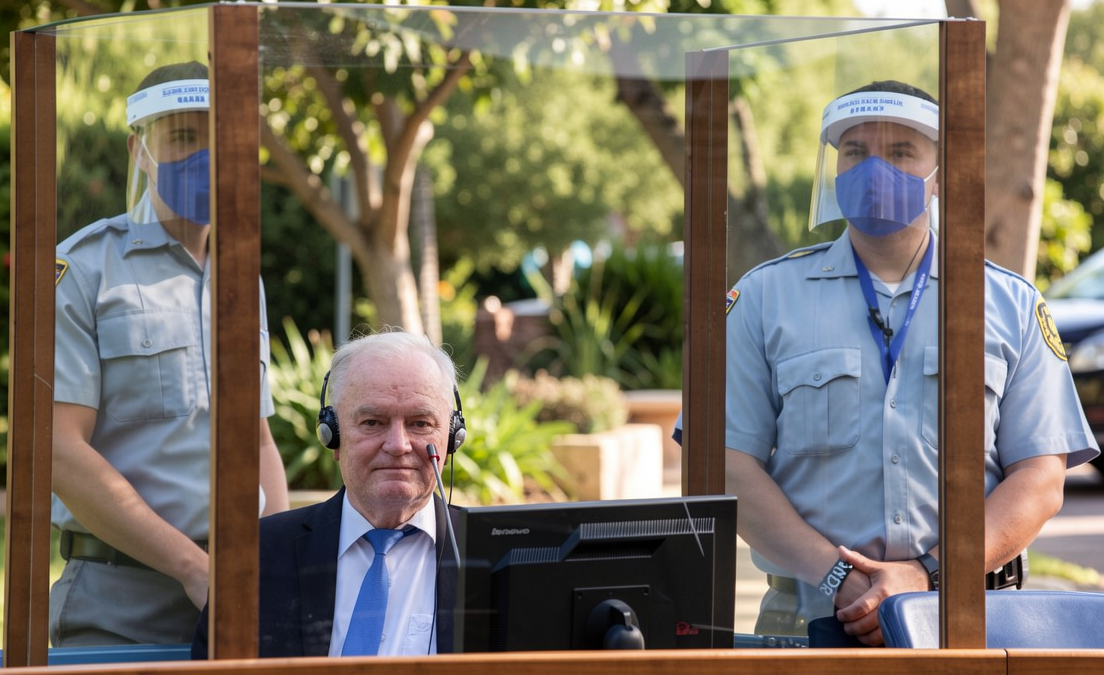
Ratko Mladic, ex-Bosnian Serb warlord who oversaw atrocities, has died at 84

Daftar Isi
Bosnian Serb Warlord Ratko Mladic Dies at 84 While Serving Life Sentence
Ecorescuezone.com – The man whose troops turned the Bosnian capital into a sniper’s killing field and whose forces carried out Europe’s worst mass slaughter since the Second World War has died. Ratko Mladic, the blue-eyed former communist officer who rose to command Bosnian Serb forces during the 1990s wars, passed away at age 84 while serving a life sentence for war crimes, according to U.N. officials. His death came in a prison hospital in The Hague, Netherlands, where he had been held since his capture in 2011 after years of evading international justice.
A close family member, speaking on condition of anonymity given the sensitivity of the moment, confirmed the death and noted that Mladic’s son, Darko Mladic, was already traveling to The Hague to be with his father’s remains. The announcement closed a chapter that had stretched across more than three decades of Balkan conflict, displacement, and unresolved grief.
A Life Sentence in 2017, After Years on the Run
The International Tribunal for the former Yugoslavia handed down Mladic’s life sentence in 2017, a verdict widely regarded as a landmark moment in the long effort to deliver accountability to victims of the Yugoslav wars. Before that conviction, however, Mladic had spent years as a fugitive, slipping through the very communities that had once cheered him. His eventual arrest in 2011 ended a period of international pursuit that had consumed diplomatic resources and kept families of victims in a state of suspended justice.
At trial, Mladic displayed the same combative temperament that had defined his military career. He addressed the bench with open defiance, shouting at judges when the life sentence was read. Admirers among Bosnian Serbs continued to frame him as a patriot who fought to build the first pan-Serbian state since the medieval era, rather than as a war criminal. That narrative persists in pockets of Bosnian Serb society even now, a fact that continues to wound survivors.
The Siege and the Slaughter
When ethnic war erupted in Bosnia in 1992, Mladic assumed command of Bosnian Serb troops and moved swiftly to seize territory across the country, carving out a Serb-dominated enclave. Under his direction, forces laid siege to Sarajevo and numerous other towns and villages, isolated civilian populations, and established detention camps where non-Serb civilians and captured soldiers were systematically executed.
In Sarajevo, the siege lasted years. Snipers picked off residents in streets and stairwells, and artillery shells fell daily on neighborhoods. Mladic reportedly ordered his troops to “scorch the brains” of Bosnian Muslims and styled himself a “Serbian God” in private and public remarks alike.
The conflict as a whole left more than 100,000 people dead and pushed over one million from their homes. Yet no single event matched the horror of Srebrenica in July 1995. There, Mladic’s forces overran a U.N.-designated safe haven, separated Muslim men and boys from women and children, forced them to strip, shot them, and bulldozed their bodies into mass graves over a period lasting more than a week. More than 8,000 men and boys were killed. It remains the only case of genocide recognized in Europe since World War II.
Origins, Ideology, and the Ottoman Shadow
Mladic was born on March 12, 1942, in Bozinovici, a small village in the hills roughly 40 kilometers south of Sarajevo. His own father was killed by Croats during World War II, and like many figures who would later dominate the Yugoslav wars, Mladic absorbed a fierce nationalism from that family trauma. He served as an officer in the communist-era Yugoslav army before siding with the Serb cause as the federation began to fracture.
He first led a Serb insurgency in Croatia before taking command of the Bosnian Serb army, which enjoyed the backing of Belgrade and then-President Slobodan Milosevic. Milosevic himself would later die in the custody of the same Hague court in 2006, still awaiting trial for genocide.
Mladic harbored a deep obsession with what he perceived as centuries of Serbian subjugation under Ottoman rule — a period he characterized as lasting roughly 500 years. He frequently referred to Bosnia’s Muslim population as “Turks” and framed military operations as acts of long-overdue retribution.
“The time has come … for revenge against Turks in these regions,” Mladic declared after his troops overran Srebrenica in 1995.
Survivors of Srebrenica have described one image that never fades: Mladic distributing candy to Muslim children gathered in the town square, reassuring them that all would be well, even patting a child on the head — moments before the men and boys were led away to be killed.
“When I give you guarantees, it’s as if they are given by God,” he told his soldiers, reflecting his absolute conviction in military supremacy.
Grief That Has Not Passed
Munira Subasic, a member of the Mothers of Srebrenica group, described mixed emotions upon learning of Mladic’s death. She deplored the fact that, thirty-one years after the massacre, many Bosnian Serbs still deny what happened.
“Today, a major war criminal died, the criminal of the Balkans,” Subasic said. “But while mothers of victims are still carrying the pain in our souls, we are still listening to denials, we are still listening to how Ratko Mladic was a hero for the Serbs.”
“I am sorry that he died and that he did not suffer for a little while longer, that he didn’t wait for more and dream about the eyes of our children,” she added.
Mladic’s death, coming while he was still behind bars, underscores a broader question that haunts post-conflict societies across the former Yugoslavia: whether incarceration alone can ever satisfy the need for acknowledgment, or whether the persistence of heroic myths around figures like Mladic will continue to fracture reconciliation for generations yet to come.
Related Reading
Frequently Asked Questions
What is Ratko Mladic ex Bosnian Serb warlord?
Ratko Mladic ex Bosnian Serb warlord is the main topic of this guide. The article explains the context, practical details, and next steps readers should understand.
Why does Ratko Mladic ex Bosnian Serb warlord matter?
Ratko Mladic ex Bosnian Serb warlord matters because readers are looking for a useful answer, not just a short summary. Good content should match search intent and help them decide what to do next.