Rwandans love their milk bars. The health minister wishes they’d drink a little less

Rwandans Love Their Milk Bars — A Health Dilemma
Ecorescuezone.com – Walk any street in Kigali’s Nyamirambo district after midday and the dominant sound is not beer taps or soda cans but the soft clink of oversized glass mugs being handed across counters. Inside these small storefronts — locally called milk bars — patrons receive chilled, pasteurized dairy drawn straight from a wall-mounted tank. What began roughly a decade ago as a stopgap for newly urbanized families who lost daily access to their own cattle has hardened into a cultural institution, and Rwandans love their milk bars with a devotion that now worries the country’s top health official.
Cattle, Currency, and a Thousand-Year-Old Respect
Long before formal currency took hold, Rwandan wealth was tallied in headcount. Ten cows marked a household as prosperous, and the animal carried spiritual weight far beyond its caloric output. That legacy survives in everyday Kinyarwandan speech: to wish someone well you say kajirinka — “may you have a cow” — a phrase carrying the same sincerity an English speaker might pour into “may your table always be full.”
The reverence shapes how the drink is consumed. Patrons sit before they sip; standing over a glass is read as a small breach of etiquette between drinker and the creature whose life produced the liquid. JP Sagahutu, a daily regular, consumes roughly four eight-ounce servings and, pressed to describe the beverage in English, pauses before settling on a French word — sacré, sacred. The linguistic slip is itself a historical artifact: Rwanda was administered as a Belgian colony until 1962, and French remains widely spoken alongside English and Kinyarwandan.
“I can’t drink milk in a box. No way,” Sagahutu says, dismissing packaged supermarket dairy outright.
His stance mirrors the majority. The milk must come from the bar’s tank or, ideally, from a cow drawn fresh that morning. Shelf-stable cartons simply do not register as the real thing.
Behind the Counter: Lab Coat, Faucet, and a Full Menu
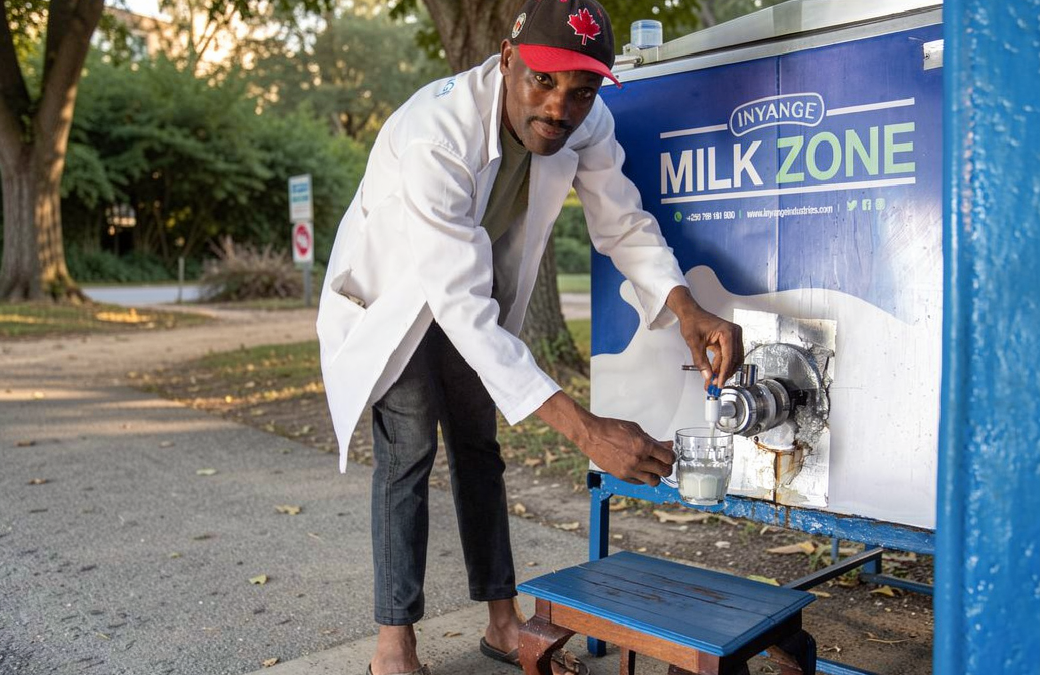
Moses Sansiman, a 52-year-old operator in Nyamirambo, dispenses cold whole milk from a large pasteurized tank fitted with a single tap, all while wearing a white lab coat that lends the transaction an almost clinical air. His offerings extend well past plain dairy: hot milk sweetened with honey, fermented varieties, and flavored options in chocolate, strawberry, or vanilla. Low-fat and skim versions accommodate those who want the ritual without the full caloric load.
The vessel itself — roughly the size of a traditional Oktoberfest stein — delivers a first sip of unexpected richness: creamy, well-rounded, carrying a faint floral note and an unmistakable freshness that signals minimal time between tank and glass. Several regulars claim they prefer it to tea, coffee, or even plain water, citing perceived nutritional superiority.
“I don’t think I ever saw my grandfather drink anything other than milk,” says Gilles Bertrand Niyomwungeri, another frequent customer.
The Minister’s Counterargument
Dr. Sabin Nsanzimana, Rwanda’s minister of health, acknowledges the protein and calcium benefits but insists that volume changes the equation. Epidemiological research links excessive dairy intake to obesity, cardiovascular disease, and elevated overall mortality risk — risks that compound in a rapidly urbanizing country where sedentary routines are displacing the physical labor of rural life.
“Now we’re seeing more people going to hospital for chronic diseases that could have [been] prevented by less milk drinking, less alcohol drinking, [by] exercising,” Nsanzimana says.
Asked for a concrete daily guideline, the minister picks up a sixteen-ounce water bottle and gestures to roughly the halfway mark — about one standard cup. That, he says, is the ceiling. The challenge, he concedes, is communicative rather than scientific: telling Rwandans to drink less of what their grandparents, their language, and their daily ritual all tell them to drink more of.
FAQ: Practical Questions About Milk Bars in Kigali
Where can visitors find milk bars? They cluster in dense urban neighborhoods such as Nyamirambo, Kigali, and are increasingly common in other Rwandan cities. Look for small storefronts with a visible pasteurized tank and a single dispensing tap.
Is the milk safe to drink? Operators pasteurize their stock before it enters the serving tank. As with any fresh-dairy product, hygiene at the point of service matters; choose busy, well-maintained establishments.
What should a first-time visitor order? A standard cold glass of whole milk is the default. If you want to explore, ask for the honey-sweetened hot version or a small fermented serving. Low-fat and skim options are available on request.
Is there a recommended daily limit? Rwanda’s health minister suggests no more than roughly one standard cup (about 8 oz / 240 ml) per day for adults who are not otherwise relying on dairy as a primary protein source.