Nuclear regulator prepares to abandon a decades-old radiation safety rule

Daftar Isi
Nuclear Workers May Face Higher Radiation Doses as Regulator Moves to Scrap Half-Century Safety Principle
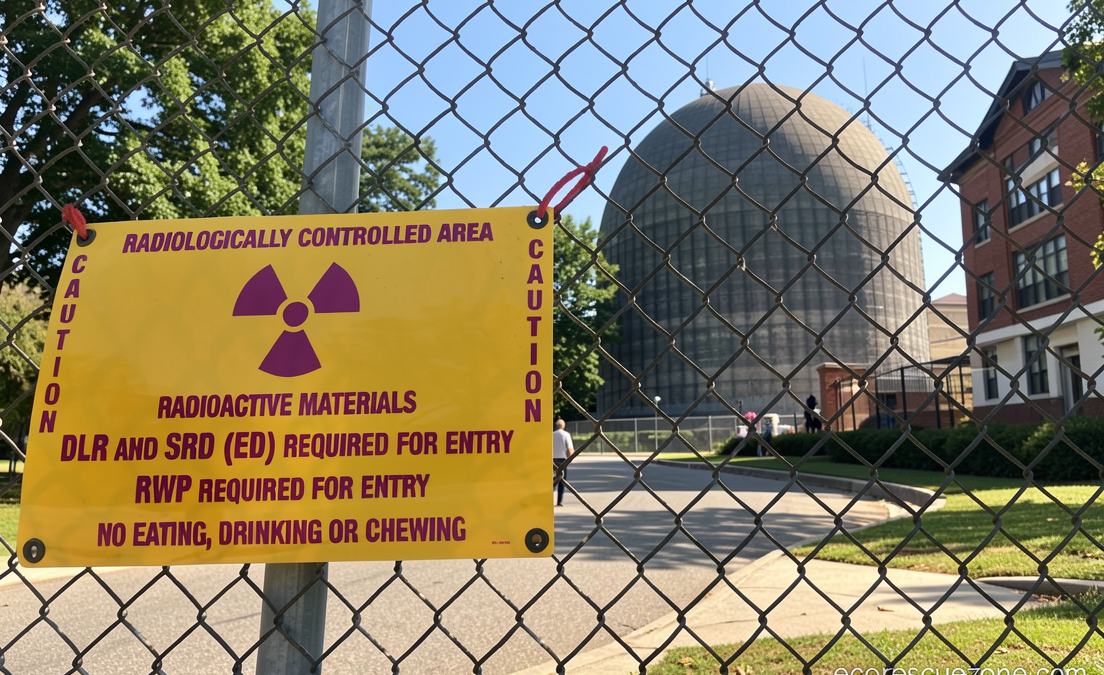
Ecorescuezone.com – The Nuclear Regulatory Commission is drafting a rule that would dismantle one of the most enduring pillars of American radiation protection. The agency’s proposed action targets the principle known as ALARA — “As Low As Reasonably Achievable” — a standard that has governed how nuclear facilities manage worker and public exposure since roughly the mid-1970s. Under the current framework, operators must push radiation doses below the numerical ceilings whenever engineering, operational, or economic considerations allow. The new proposal would strip away that obligation and, in certain defined scenarios, permit individual workers to absorb doses up to twice the existing occupational ceiling.
The move lands amid a broader push by the Trump administration to reshape nuclear oversight, a strategy explicitly tied to the administration’s ambition of restarting reactor construction to supply electricity to data centers powering artificial-intelligence workloads. A public comment window on the proposed rule closes on August 31, and the agency has signaled the change could take effect as early as the following year.
What ALARA Has Done for Fifty Years
Since the earliest days of the atomic era, researchers have understood that ionizing radiation damages DNA and, at sufficient intensity, triggers mutations capable of producing cancer. The difficulty arises at low doses. Because roughly 40 percent of Americans will develop some form of cancer over a lifetime, isolating a small radiation-attributable increment above that enormous background is extraordinarily challenging.
“As you go down in dose, what you’re looking for is a very small increase in cancer risk over a very large background. That’s what makes it really, really hard,” said David Brenner, director of the Center for Radiological Research at Columbia University.
For five decades the NRC has managed that scientific uncertainty by insisting on ALARA: even if a dose sits comfortably beneath the regulatory ceiling, operators must still take practical steps to reduce it further. The principle functions as a precautionary floor beneath the hard numerical limits.
The Political Trigger
Last May, President Trump signed an executive order demanding a sweeping revision of nuclear regulations. The order singled out ALARA by name, characterizing the principle as a “flawed” interpretation of radiation risk. The NRC has declined to abandon its underlying scientific model — the Linear No Threshold framework, which assumes no dose is entirely free of cancer risk — but it has proposed eliminating the ALARA overlay that sits atop that model.
Chairman Ho Nieh, speaking this week on the Federal News Network, framed the change in practical terms. He compared ALARA to a traffic rule layered on top of a posted speed limit:
“A road’s speed limit might be 55 miles per hour, but imagine if there’s another rule that says you have to drive as slow as reasonably achievable to be safer. Well, what does that mean? 50, 45, 25 miles per hour?”
Nieh argued that the same vagueness that would confuse motorists now complicates reactor design, particularly for the compact, next-generation reactors the agency hopes will feed power to AI infrastructure and industrial expansion. He described the reform as one element of a wider regulatory cleanup mandated by the executive order, driven by what he called “an urgent demand for more electricity in the United States, due to artificial intelligence, data centers and industrial growth.”
Expert Reactions Split
Not every radiation-safety specialist views the elimination as a loss. Emily Caffrey, a radiation health physicist at the University of Alabama at Birmingham, acknowledged the original intent was sound but noted that in practice the standard pushed companies toward ever-more-stringent protective measures while generating interpretive ambiguity.
“Keeping doses as low as reasonably achievable was a fair idea,” Caffrey said. “But in practice, the standard forced companies to take increasingly stringent radiation protection measures. It also created ambiguity, because what’s ‘reasonable’ to one person isn’t reasonable to another person.”
Caffrey added that she is comfortable with the agency simply enforcing the existing numerical thresholds: “You should have a number because ‘reasonable’ is too loosey-goosey.”
Edwin Lyman, director of nuclear power safety at the Union of Concerned Scientists, a long-standing watchdog organization, offered a sharper caution. He warned that removing the principle would strip away the ongoing incentive for operators to maintain protective practices beyond the bare minimum.
“Removing it would remove that incentive for these companies to continue to maintain the practices that protected their workers and the public,” Lyman said.
What the New Rule Would Actually Change
The proposal leaves the existing dose ceilings intact: five rem per year for an individual worker and 0.1 rem per year for members of the public. For perspective, the Environmental Protection Agency estimates that a whole-body CT scan delivers roughly one rem, so the public limit corresponds to about one-tenth of that scan’s dose, spread across an entire year.
What the rule adds is a mechanism called a “planned occupational dose limit extension.” Under this carve-out, an operator could petition the NRC to allow a specific worker to receive up to 10 rem in a given period — double the standard 5-rem occupational ceiling — in special circumstances the agency would define. The proposal does not alter other regulatory limits governing reactor operations, waste handling, or public-area monitoring.
Why the Timing Matters
The administration’s stated rationale ties nuclear expansion directly to the electricity appetite of large-scale AI training and inference workloads. Data centers built to house those workloads consume power on a scale that has already strained regional grids. If the NRC’s streamlined regulatory posture accelerates licensing for smaller modular reactors, proponents argue the sector could reach commercial operation faster than under the previous, more precautionary framework. Critics counter that the precautionary layer ALARA provided was inexpensive relative to the cost of a radiation-related illness and that its removal, however well-intentioned, shifts risk onto the workers who operate the machines.
The comment period’s August 31 deadline gives stakeholders — utility companies, labor unions, public-health researchers, and state regulators — a final window to file objections or amendments before the agency moves toward finalization.
Related Reading
Frequently Asked Questions
What is Nuclear regulator prepares to abandon a decades?
Nuclear regulator prepares to abandon a decades is the main topic of this guide. The article explains the context, practical details, and next steps readers should understand.
Why does Nuclear regulator prepares to abandon a decades matter?
Nuclear regulator prepares to abandon a decades matters because readers are looking for a useful answer, not just a short summary. Good content should match search intent and help them decide what to do next.