Opinion: A sculpture in perpetual motion, removed

Daftar Isi
The Blue Giant Walks Away: What the Removal of a Sculpture Says About Power and Public Space
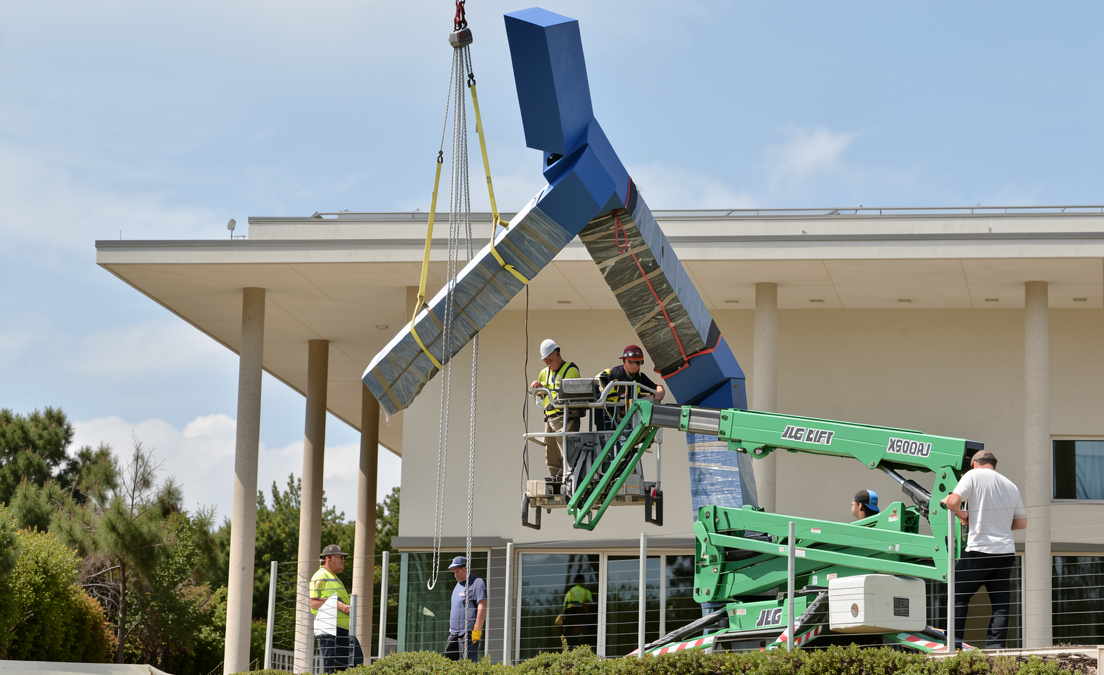
Ecorescuezone.com – For years, anyone strolling along the Potomac riverfront in Washington, D.C., could look up and see a towering blue figure frozen mid-gesture — a shape that seemed to be walking, leaping, or spinning at any given moment. That figure, a 24-foot-tall metal sculpture titled Blue by the late American artist Joel Shapiro, stood on the grounds of the John F. Kennedy Center for the Performing Arts. On Wednesday, a crew dismantled it. The sculpture is gone from the capital’s skyline, and the question now is where — and whether — it will ever return to public view.
What Blue Was, and Where It Stood
The work occupied a stretch of Kennedy Center property known as The REACH, an outdoor area that opened to the public in 2019. Before the institution became entangled in the political turbulence of the current administration, The REACH hosted free concerts, dance performances, and theatrical events nearly every evening. Shapiro’s sculpture, perched at the edge of that lively landscape, became an informal landmark for locals and visitors alike. Families gathered beneath it. Couples posed beside it. It was, in the most ordinary sense, part of the city’s visual vocabulary.
Formally, Blue presents a giant stick figure with what appear to be four limbs balanced on a single leg while the other lifts off the ground. The uppermost appendages, resembling arms, stretch outward in a pose that resists a single reading. Is the figure welcoming? Twirling? Swinging? The ambiguity was the point. Shapiro designed the shape to hover between motion states, inviting each viewer to project their own narrative onto the steel silhouette.
The Artist’s Intent and His Passing
Shapiro, who died last year, spoke about the work in a video previously hosted on the Kennedy Center’s website. His words framed the sculpture not as a monument to a fixed idea but as an invitation to kinetic imagination:
“It’s about action and risk and performance and energy. It’s a celebration of possibility.”
That language — action, risk, possibility — carried particular weight in a public square where free cultural programming had once flourished without gatekeeping. The sculpture’s perpetual-motion ambiguity mirrored the open-endedness of the performances that filled The REACH each night.
Who Decided, and Why
The removal did not arrive as a surprise to those watching the institution closely. Josef Palermo, who served as curator of visual arts and special programming at the Kennedy Center until he was let go this past March, told the New York Times this week that Blue had been “targeted early on” for removal by the Trump administration. In other words, the sculpture’s fate was likely settled well before the crew ever arrived with tools. The administration, Palermo suggested, may have read something into the figure’s posture that did not align with its preferred visual language for federal cultural spaces.
The Kennedy Center itself, now led by figures aligned with President Trump’s circle, issued a brief statement expressing gratitude:
“We are deeply grateful to Joel Shapiro for the years Blue has spent animating our campus and connecting visitors to his vision.”
The phrasing — “animating our campus” — is telling. It frames the sculpture as a decorative accessory to the institution’s programming rather than as an independent work of art with its own claims on public space. The statement offered no explanation for the removal, no timeline for relocation, and no acknowledgment that a public audience had formed emotional attachments to the figure over years of nightly encounters.
The Public Says Goodbye
Despite the quietness of the official announcement, people showed up. Families, neighbors, and curious passersby gathered to watch the dismantling. One man present, identified as working for the Shapiro foundation, offered a practical assurance: the sculpture will be cleaned, reassembled, and reinstalled at a new location. He expressed confidence that the work would find another perch. Whether that promise materializes, and on what timeline, remains to be seen.
What the gathering revealed, however, was something harder to quantify. A steel shape, frozen in implied motion, had become a site of personal memory for thousands of people who walked past it daily. Its removal is not merely a curatorial decision; it is a small act of urban erasure that asks residents to revise their mental map of the riverfront.
What a Removed Sculpture Asks of Us
Public art occupies a peculiar legal and emotional niche. It is owned by an institution, displayed in a public space, and perceived by anyone who happens to look up. When a political authority decides that a particular shape in a particular spot is unwelcome, the decision operates less like a museum deaccession and more like a zoning change — invisible until the day the crane arrives, then irreversible in its effect on daily sightlines.
Shapiro’s figure was never didactic. It did not spell out a slogan or commemorate a date. Its meaning lived entirely in the viewer’s projection: the stomp, the spin, the prance each person imagined. That openness, which made it so engaging to passersby, may also be what made it legible as a threat to those who prefer public objects to carry unambiguous messages. A sculpture that says “imagine anything” is, to a certain administrative logic, a sculpture that says nothing — and therefore a sculpture that can be moved without ceremony.
The question now facing Washington’s cultural landscape is straightforward: will Blue find a new home where the river still catches its silhouette at dusk, or will it sit in a warehouse, cleaned and reassembled, waiting for a political climate that permits a giant blue figure to stand in perpetual, ambiguous motion? The answer will say more about the city’s relationship to public art than any statement from any institution could.
Related Reading
Frequently Asked Questions
What is Opinion: A sculpture in perpetual motion, removed?
Opinion: A sculpture in perpetual motion, removed is the main topic of this guide. The article explains the context, practical details, and next steps readers should understand.
Why does Opinion: A sculpture in perpetual motion, removed matter?
Opinion: A sculpture in perpetual motion, removed matters because readers are looking for a useful answer, not just a short summary. Good content should match search intent and help them decide what to do next.