Russian missile and drone attack on Ukraine’s capital kills at least 11

Russian Missile and Drone Attack on Kyiv Kills at Least 11
Escalating Strikes in the Capital
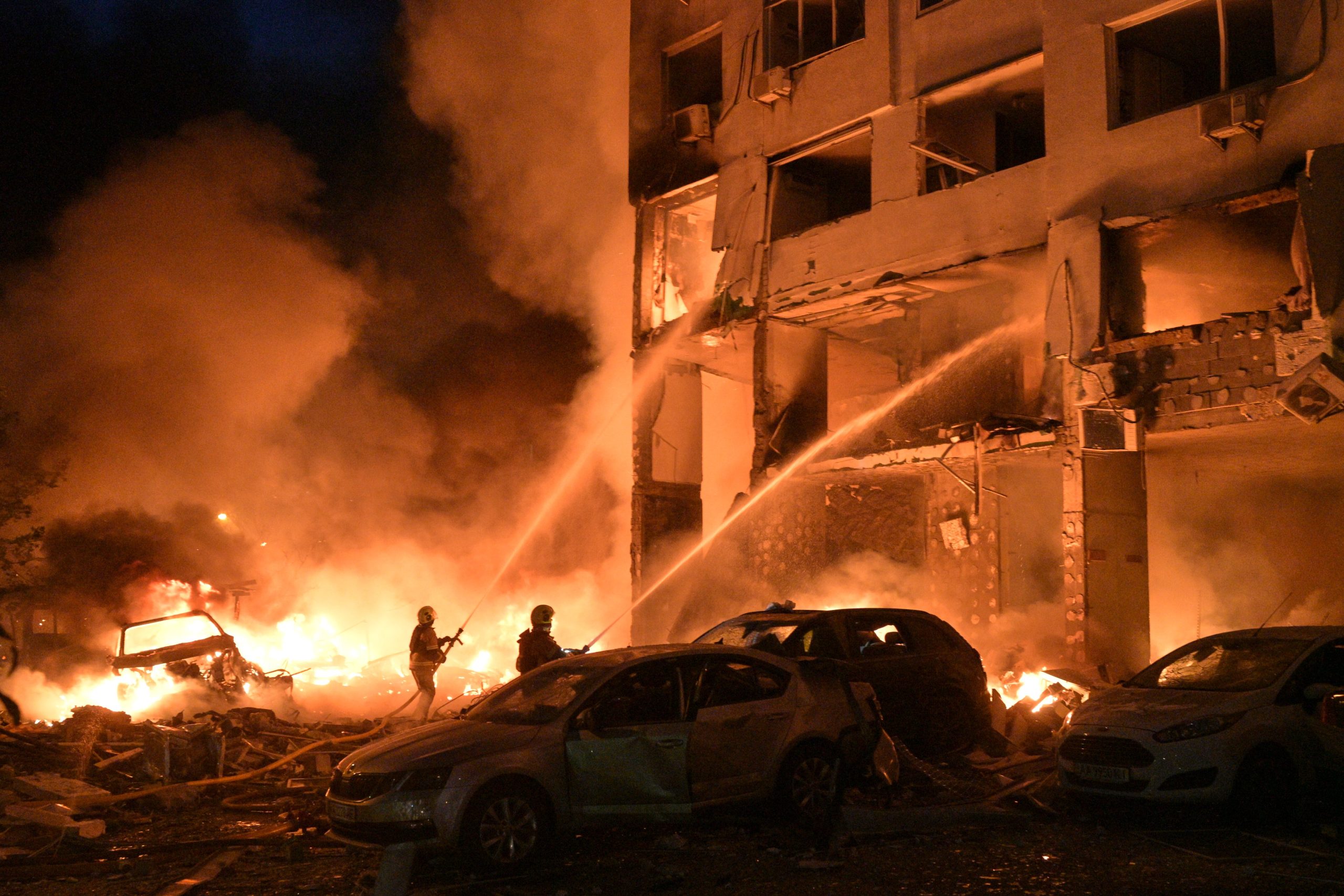
Russian missile and drone attack on Ukraine – Kyiv, Ukraine — Early Monday, Russian forces unleashed a series of missile and drone strikes on the capital, leaving at least 11 civilians dead and 60 others injured, according to local officials. The assault occurred shortly after Ukrainian President Volodymyr Zelenskyy issued a warning that a major attack was expected. Emergency teams worked through the night to clear debris from two residential high-rises that sustained direct hits, searching for survivors amid the devastation.
Retaliation for Recent Ukrainian Strikes
Russia’s Defense Ministry stated the attack was a response to Ukraine’s recent long-range missile campaigns, which have disrupted supply lines and led to severe fuel shortages. The ministry claimed the strikes targeted key infrastructure in Kyiv, including facilities responsible for manufacturing drones, sea drones, armored vehicles, and missiles. They also hit repair sites for air defense systems, as well as energy and fuel networks in the region. However, these assertions could not be independently confirmed.
Ukraine’s Drone Advantage and Defenses
Analysts and Western officials noted that Ukraine’s progress in drone technology has been a critical factor in recent military successes. These unmanned systems have effectively targeted Russian supply routes, weakening the enemy’s operational momentum and increasing the cost of their advance. However, the recent attacks exposed a vulnerability in Ukraine’s air defenses, which still depend heavily on U.S. Patriot systems to counter ballistic missiles. With limited numbers of these interceptors, Ukraine struggles to defend against the sheer volume of Russian strikes.
The shortage of Patriot interceptors has been exacerbated by the war in the Middle East, where global demand for the systems has surged. This scarcity has made it increasingly difficult for Ukraine to intercept Russian ballistic missiles, which continue to strike with little warning. According to Kyiv’s Air Force, hundreds of drones and dozens of missiles were deployed overnight, with 29 ballistic missiles hitting their intended targets. The attacks highlighted the challenges Ukraine faces in maintaining an effective air defense network.
Quotes from Officials on the Impact
“To intercept ballistics, we need the means for interception,” said Air Force spokesman Yurii Ihnat during a national broadcast. “Russians are certainly using the fact that there is a serious deficit of interceptor missiles now, in Ukraine and the world.”
Zelenskyy, speaking on X ahead of a NATO summit in Ankara, acknowledged Ukraine’s ability to resist drone and cruise missile attacks but criticized the lack of resources to counter ballistic missiles. He attributed this gap to insufficient supplies of Patriot interceptors, which he claimed were held back by allies. “As long as Patriot missiles remain in our allies’ stockpiles, Russia is only encouraged to keep ‘vanquishing’ residential buildings,” Zelenskyy stated. “The United States and Europe have enough strength to stop this terror.”
Civilian Toll and Strategic Targets
The attack’s focus on residential areas underscored its devastating impact on civilians. Tymur Tkachenko, head of Kyiv’s City Military Administration, described the strikes as targeting “places where people slept and lived their ordinary lives” in a post on Telegram. In the Podilskyi district, a residential building partially collapsed, while several multistory structures in the Darnytsia district sustained damage, with reports indicating people were trapped beneath the rubble.
This comes after a previous Russian strike on Kyiv’s capital on Thursday killed 31 individuals, marking the deadliest incident in the city this year. The current attack, which followed this earlier assault, has further intensified the humanitarian crisis, with over 16,000 Ukrainian civilians reportedly killed in the war by the United Nations. The repeated targeting of residential zones has raised concerns about the broader strategy of Russia to maximize civilian casualties.
Reactions from Russia-Occupied Crimea
In parallel, an energy provider in Russia-occupied Crimea reported a widespread blackout across the peninsula, citing “external impact” as the cause. The Moscow-appointed head of Sevastopol, Mikhail Razvozhayev, stated that Ukrainian attacks disrupted power supplies in the city early Monday, though backup systems eventually restored electricity. Meanwhile, in the Yaroslavl region of Russia, Governor Mikhail Yavrayev confirmed that over 70 Ukrainian drones were shot down during an attack on the city of the same name. While Yavrayev did not specify whether any infrastructure was damaged, the Astra online news outlet reported that the strike targeted an oil refinery, resulting in a fire.
Global Implications of the Attack
The recent barrage of missiles and drones has not only affected Kyiv but also strained international defense alliances. The reliance on Patriot systems by Ukraine has become a focal point of discussions among NATO members, who are now considering how to bolster the country’s capacity to intercept Russian ballistic missiles. Zelenskyy’s call for stronger commitments from U.S. and European partners during the Ankara summit reflects the urgency of the situation, as the attacks continue to threaten both military and civilian targets.
Context of the Conflict and Future Outlook
More than four years into Moscow’s full-scale invasion, the balance of power has shifted in subtle ways. While Ukraine has made strides in drone warfare, the inability to counter ballistic missiles remains a critical weakness. This has prompted a shift in Russia’s approach, with the focus now on exploiting gaps in Ukraine’s air defenses. Analysts suggest that the next phase of the conflict may depend on the availability of advanced interceptors, as well as the effectiveness of Ukraine’s defensive strategies against the escalating aerial assault.
As the attacks continue, the toll on Kyiv’s population and infrastructure grows. The repeated strikes on residential areas have drawn international condemnation, with many arguing that the war is no longer just a military conflict but a sustained effort to destabilize Ukrainian society. The need for a robust air defense system has become more pressing than ever, as both sides prepare for the next round of confrontations in the skies over Kyiv and beyond.