Supreme Court allows Trump’s ballroom construction to continue for now

Daftar Isi
White House Ballroom Project Gets Green Light from Supreme Court, Keeping a $300 Million Construction Site Alive
Ecorescuezone.com – For months, workers have been digging beneath the north lawn of the White House, their activity sealed off from the public view that once framed Lafayette Park and the building’s northern façade. That work will not stop. On Friday, the Supreme Court issued a brief order — signed by Chief Justice John Roberts — staying a lower-court injunction that had paused construction of President Trump’s proposed ballroom on the footprint of the demolished East Wing. The effect is immediate: crews can resume pouring concrete, erecting steel, and advancing what the administration describes as a combined military and ceremonial complex.
The decision does not resolve the underlying legal question. It simply lets the project proceed while the courts sort out whether a sitting president may unilaterally authorize the construction of a 90,000-square-foot addition to the executive mansion without a single vote in Congress. That question, the National Trust for Historic Preservation argues, goes to the heart of separation of powers.
The Project and Its Price Tag
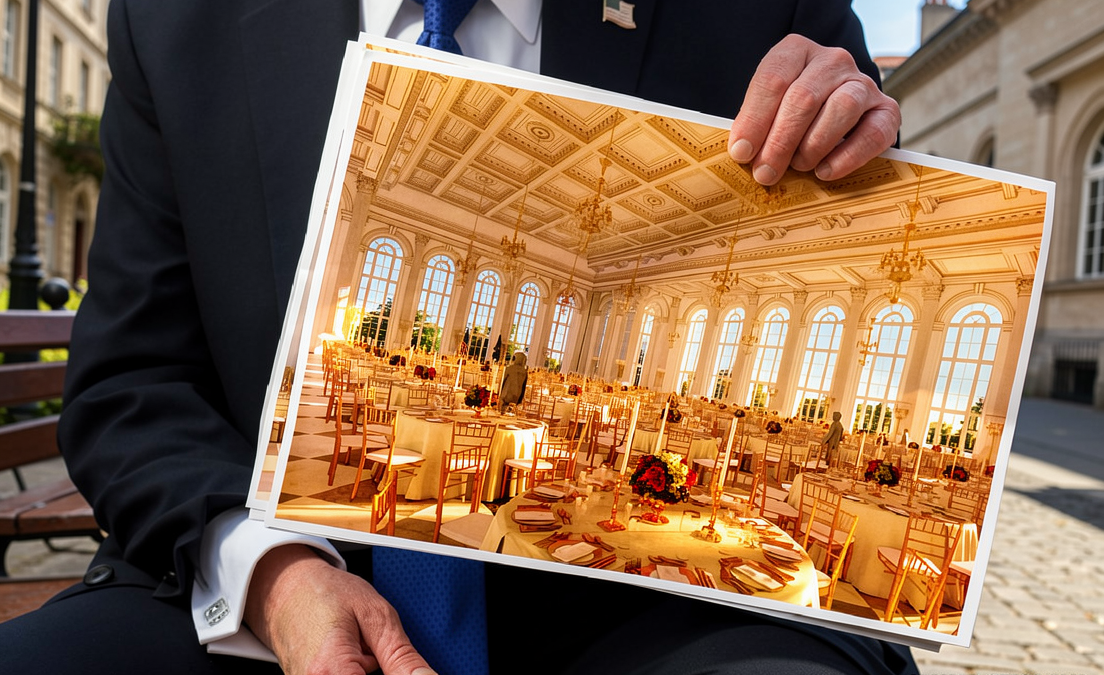
The ballroom, once completed, will occupy the space where the East Wing once housed offices for the First Lady and her staff. At roughly 90,000 square feet, the new structure would be approximately twice the footprint of the main White House complex itself. The administration has framed the addition as indispensable to modern presidential operations: a venue large enough to receive foreign heads of state without crowding the existing State Dining Room, plus what Trump has called critical national-security infrastructure — bomb shelters, a medical facility, sniper observation posts, and a drone landing pad.
Despite those claims of necessity, the estimated cost to federal taxpayers stands at no less than $300 million. Trump has repeatedly told the public that ordinary Americans would not bear that expense, yet the project is funded through federal appropriations and construction contracts paid from the public purse.
A Legal Battle That Began in March
The litigation traceable to its origin in March, when Republican-appointed federal judge Richard Leon, sitting in the U.S. District Court for the District of Columbia, ruled that construction must halt unless the work qualified as a safety or security addition to the White House. Leon’s order effectively froze the project.
The case then moved to the U.S. Court of Appeals for the D.C. Circuit, which permitted construction to continue temporarily. Leon, asked to clarify his earlier ruling, drew a line: below-ground work could proceed, but above-ground construction remained enjoined. The administration, unwilling to accept that distinction, filed an emergency appeal directly to the Supreme Court.
The trust, which has represented historic-preservation interests before Congress and the courts for decades, filed a brief earlier this week warning that granting the stay would amount to ending the case outright.
“Rather than obtain permission from Congress, Petitioners have instead decided to try to outrun judicial review” by accelerating construction. “It is clear that in Petitioners’ view, if the Court grants their stay application, this case is over—despite every court to have reviewed their project having found it to be patently unlawful, and no matter the fact that this Court has not reviewed those decisions on the merits.”
That framing underscores a broader constitutional tension: whether a president can use the pace of construction as a de facto finality mechanism, rendering judicial review moot before any appellate court reaches the merits.
Trump’s Public Reaction
The president took to social media within hours of the order, celebrating what he called a vindication.
“We are grateful for the Decision of the United States Supreme Court. The Military/Ballroom Complex being built on the hallowed grounds of the White House, which is so vital for National Security, will be THE GREATEST OF ITS KIND!”
Earlier in the litigation, when Leon’s initial ruling threatened to shut down the site entirely, Trump had posted a defense of the project’s indivisibility:
“It’s all tied together as one big, expensive, and very complex unit, which is vital for National Security and Military Operations of the United States of America!”
Public Access, Public Opinion
Construction began in July of last year and has required closing the north side of the White House grounds and the adjacent stretch of Lafayette Park to the public — a change that altered a landscape familiar to Washington residents and visitors for generations. The park, once a quiet green space where pedestrians strolled within sight of the mansion’s north portico, now sits behind fencing and active excavation.
Polling suggests the trade-off between presidential ambition and public access is not landing well with voters. An April survey conducted by Washington Post, ABC News, and Ipsos found that 56 percent of Americans disapproved of the decision to tear down the East Wing and replace it with the ballroom. That figure sits alongside broader skepticism about the administration’s wider program of reshaping the capital’s skyline and public spaces.
What Comes Next
The Friday order is a stay, not a merits decision. The Supreme Court has not ruled that the ballroom is lawful; it has ruled only that the lower court’s pause order cannot take effect while the appeal is pending. The trust retains the right to press its case on the merits, and Congress retains the right to legislate — or to appropriate, or to defund — the project at any point before completion.
Until then, however, the cranes remain over the north lawn, the concrete keeps curing, and the question of whether one person can reshape the most watched building in the country without legislative consent stays unanswered — buried, for now, beneath the very foundations being poured.
Related Reading
Frequently Asked Questions
What is Supreme Court allows Trump s ballroom?
Supreme Court allows Trump s ballroom is the main topic of this guide. The article explains the context, practical details, and next steps readers should understand.
Why does Supreme Court allows Trump s ballroom matter?
Supreme Court allows Trump s ballroom matters because readers are looking for a useful answer, not just a short summary. Good content should match search intent and help them decide what to do next.