At Big Bend National Park, bulldozers begin clearing pristine desert land for border barrier work

Daftar Isi
Heavy Machinery Enters Big Bend as Border Barrier Work Accelerates
Ecorescuezone.com – Joan Stutts Escamilla has spent decades watching the Rio Grande carve through the limestone cliffs of Santa Elena Canyon, one of the most photographed landscapes in the American Southwest. Now the 70-year-old local resident watches bulldozers rumble through territory she once considered untouched. Sitting quietly beside the river’s edge, she reflects on what she sees as a profound transformation of a place she calls “a god-given gift.”
The canyon’s towering limestone walls, rising 1,500 feet above the river, have stood for millennia. But within the past week, federal contractors have brought heavy equipment into Big Bend National Park, crushing desert shrubs and disturbing ecologically sensitive terrain. Bright pink ribbons flutter in the wind, marking where willow and mesquite trees once thrived along the riverbank.
A Billion-Dollar Investment in Border Security
The construction effort carries a price tag of $1.7 billion, encompassing vehicle barriers, winding patrol roads, and modern surveillance technology. This initiative represents a significant shift in how the Trump administration approaches border security, particularly through its decision to bypass traditional environmental laws that would normally require extensive review and public comment.
A federal judge recently declined to issue an injunction against the work, allowing contractors to proceed despite legal challenges from conservation groups. The administration’s strategy has drawn criticism from environmental advocates who argue that the rapid timeline undermines protections for one of America’s most pristine desert ecosystems.
Local Opposition Forms a Broad Coalition
The construction plans have galvanized an unlikely alliance in the Big Bend region. Landowners, outdoor enthusiasts, and business owners from across the political spectrum have united in opposition to what they see as an irreversible alteration of the landscape. Many locals refer to the area as “Texas’ gift to the nation,” emphasizing its cultural and ecological significance.
Laiken Jordahl with the Center for Biological Diversity, a national conservation nonprofit currently pursuing legal action against the federal government’s border barrier projects, expressed deep concern. “If we lose places like Big Bend, we never get them back,” Jordahl stated. “The destruction that will be inflicted here will truly be irreparable.”
The administration’s initial vision for Big Bend included imposing 30-foot walls across the landscape. Following widespread public outcry, officials revised their approach to focus on patrol roads, vehicle barriers, and surveillance systems instead, according to details provided by Customs and Border Protection.
Border Crossings Decline Amid Construction
One of the more contentious aspects of the project involves its timing. The Big Bend Sector, spanning 517 miles along the U.S.-Mexico border, has experienced a significant drop in illegal crossings. According to CBP data, the region recorded the fewest encounters along the Texas border during fiscal year 2025. Within the national park boundaries, numbers are even lower, according to a local advocacy organization.
CBP Commissioner Rodney Scott addressed these statistics in a statement to NPR, explaining that current activity represents survey and design work rather than full-scale construction. He emphasized that the new infrastructure aims to secure the park and “protect its legacy” while helping border patrol “detect illegal crossings, respond faster, and assist visitors in danger.”
Political Responses and Community Action
Republican Senator John Cornyn requested that federal officials meet with local residents before advancing additional work in the region. Governor Greg Abbott’s office, while not responding to recent inquiries about the park construction, shared a previous statement highlighting the area’s potential for technology deployment.
“Rugged, isolated areas like Big Bend are great opportunities to deploy technology to aid in securing the border,” said Andrew Mahaleris, the governor’s press secretary.
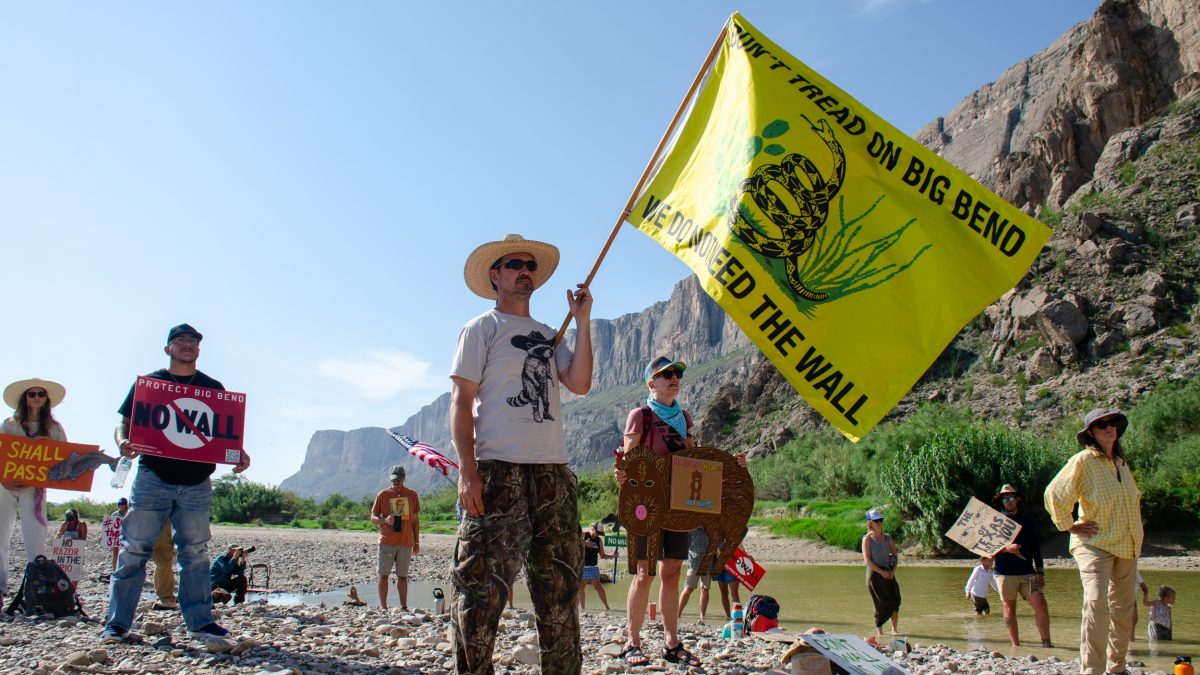
Local voices continue to amplify their concerns. Bernadette Devine, an educator and former river guide, has been calling on state leaders to intervene. At Santa Elena Canyon on Wednesday, river guide Billy Miller addressed a crowd of nearly 150 people, some standing in the river and others on the banks holding signs reading “don’t bulldoze my church” and “don’t tread on Big Bend.”
“The river’s being threatened as we speak,” Miller told the gathering through a megaphone, his voice echoing off the canyon walls. “A lot of people might think, ‘Well, we saved it from the 30-foot wall, we won the battle.’ The battle is just now beginning.”
Broader Context Beyond the Park
While the fight within Big Bend National Park intensifies, federal border security efforts continue expanding in surrounding areas. Staging sites have been established throughout rural West Texas, where the administration seeks to secure private land in border counties. These efforts could result in up to 175 miles of steel fencing extending beyond the park’s boundaries.
The construction in Big Bend represents more than a local issue—it reflects a national debate about balancing security needs with environmental preservation. As bulldozers continue their work along the Rio Grande, residents and visitors alike wonder whether the changes being made will be temporary or permanent, and whether the landscape they love will survive the transformation.
Related Reading
Frequently Asked Questions
What is At Big Bend National Park bulldozers?
At Big Bend National Park bulldozers is the main topic of this guide. The article explains the context, practical details, and next steps readers should understand.
Why does At Big Bend National Park bulldozers matter?
At Big Bend National Park bulldozers matters because readers are looking for a useful answer, not just a short summary. Good content should match search intent and help them decide what to do next.